Amber
Amber is a fossil tree resin that occurs in a variety of shades and forms. While it is most commonly recognized as a dark orange-yellow color, it naturally…
What are the different colors and varieties of amber?
Amber is a fossil tree resin that occurs in a variety of shades and forms. While it is most commonly recognized as a dark orange-yellow color, it naturally appears in all shades of yellow, often with nuances of brown, orange, and—more rarely—red.123
The physical appearance of amber is influenced by its internal structure:
- Transparency: Deeply colored, translucent to transparent pieces are highly valued as gem material.13
- Turbidity: Some varieties appear cloudy or opaque due to the presence of numerous minute air bubbles trapped within the resin.1
- Bone Amber: This term refers specifically to milky-white, opaque varieties of the fossil.1
In addition to natural amber, there is a product known as amberoid, or “pressed amber.” This is created by fusing smaller pieces of natural amber together under pressure. It can often be distinguished from natural, solid amber by the presence of parallel bands or flow structures.1
How has amber been used by humans throughout history?
Throughout history, amber has been highly valued as a decorative material and a significant commodity in international trade. Because of its ability to take a fine polish, it has long been used to create various ornamental objects, including beads, rosaries, cigarette holders, and pipe mouthpieces.14
The economic importance of the material was so great that it spurred the development of extensive trade networks known as the Amber Routes. These routes, which were among the earliest roads in Europe, were used by Etruscan and Greek traders as early as the 2nd millennium BCE to transport amber from northern Europe to the Mediterranean and Adriatic seas. These paths were not modern roads but were improved at critical points—such as river crossings and mountain passes—using sophisticated log-road construction techniques to facilitate the movement of goods.25
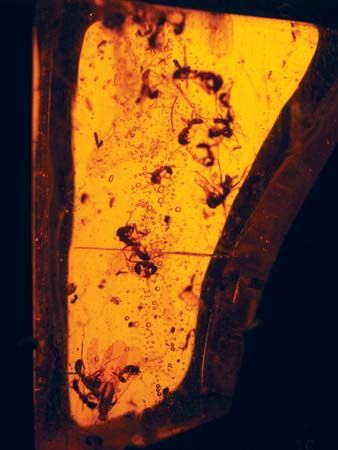
Beyond its utility as a gem and trade item, amber serves as a vital scientific resource, as it often contains fossil insects and plants that provide a window into the ancient world.1
What are some of the most famous or significant amber discoveries?
One of the most significant historical treasures involving this material is the Amber Room, a world-renowned chamber originally commissioned in the early 18th century for the Prussian King Frederick I. Often called the “Eighth Wonder of the World,” the room featured nearly six tons of amber panels, gold leaf, and precious stones. After being gifted to Russia in 1716, it was installed in the Catherine Palace near St. Petersburg, where it remained until it was looted by Nazi forces during World War II. The original room was lost in the aftermath of the war, though a faithful reconstruction was completed in 2003 using historical photographs and recovered fragments.1
Beyond such architectural marvels, amber is scientifically significant for the “discoveries” it preserves within its structure. Because the resin traps organic matter as it hardens, it acts as a natural time capsule, preserving hundreds of species of fossil insects and plants. These inclusions provide researchers with invaluable data for studying ancient ecosystems and establishing genetic relationships between prehistoric and modern trees.7
What is amber and how is it formed?
Amber is a fossil tree resin that has achieved a stable state through the loss of volatile constituents and chemical changes after being buried in the ground. It is a hard, translucent material that typically appears in shades of yellow, orange, and brown, and it is highly prized for its ability to take a fine polish.12
The formation of amber begins with resin secreted by trees in an amber forest. Over millions of years, this resin undergoes a process of fossilization. While amber is found globally, the most significant deposits are located along the shores of the Baltic Sea, where the material is estimated to be between 40,000,000 and 60,000,000 years old. During this long period of burial, the resin hardens into irregular nodules, rods, or droplike shapes.1
Sources
- amber — Encyclopædia Britannica
- amber — Merriam-Webster
- Color Words to Describe Autumn Leaves | Amber — Merriam-Webster
- road - The Amber Routes — Encyclopædia Britannica
- Amber Routes — Encyclopædia Britannica
- amber — Merriam-Webster
- Amber Room — Encyclopædia Britannica
- amber oil — Merriam-Webster
- amber forest — Merriam-Webster
- Congo copal — Merriam-Webster
Published on · 3 min read