Piculet
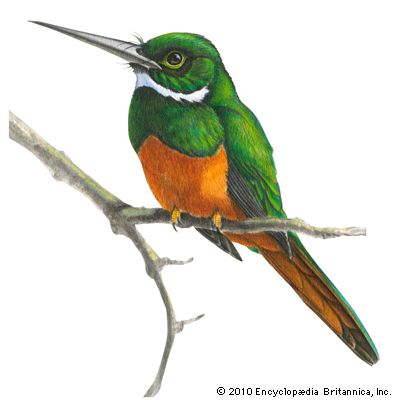
A piculet is any of approximately 29 species of small, stub-tailed birds belonging to the subfamily Picumninae within the family Picidae, which also includes…
What is Piculet?
A piculet is any of approximately 29 species of small, stub-tailed birds belonging to the subfamily Picumninae within the family Picidae, which also includes woodpeckers.1
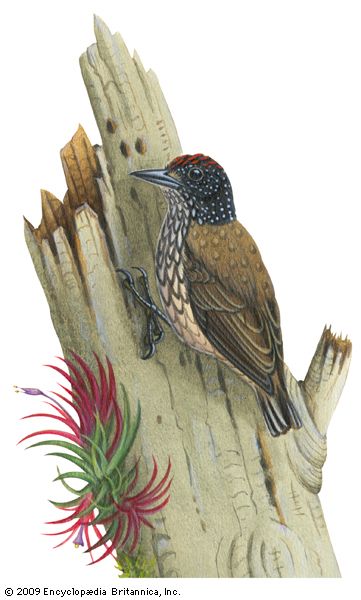
Measuring between 9 and 14 cm (3.5 to 5.5 inches) in length, these birds are typically mottled gray-green or brown on their upper bodies and white with spots or bars underneath. Unlike many of their relatives, piculets have soft, rounded tail feathers and are capable of perching crosswise on branches. They exhibit behavior similar to nuthatches, climbing along surfaces to forage for insects, and they possess the ability to excavate nest holes in soft wood despite their small bills.12
While the majority of species are found in Central and South America, there are also representatives in East Asia and western Africa. For example, the white-barred piculet is widely distributed across the Guiana Highlands down to Argentina, while the speckled piculet of southeast Asia is known for drumming on dry bamboo.1
How do piculets differ from typical woodpeckers?
Piculets and typical woodpeckers both belong to the family Picidae, but they exhibit distinct morphological and behavioral differences:
- Tail Structure: The most notable difference is that true woodpeckers (subfamily Picinae) possess stiffened tail feathers used to prop themselves up against tree trunks. In contrast, piculets (subfamily Picumninae) have soft, rounded tails, which prevents them from using their tails for support in the same manner.13
- Perching Habits: Because they lack stiffened tails, piculets are capable of perching crosswise on branches, similar to many other birds. True woodpeckers typically perch lengthwise on tree trunks or branches.41
- Foraging and Movement: While both groups forage for insects, piculets often climb and move along surfaces in a manner reminiscent of nuthatches. They frequently probe small branchlets and vines. True woodpeckers are generally more specialized for climbing vertical trunks and often use their bills to chisel or excavate, whereas piculets primarily glean or probe.41
- Size: Piculets are significantly smaller, ranging from 9 to 14 cm in length, with some species being only sparrow-sized.41
What kind of insects do piculets eat?
Piculets feed primarily or entirely on insects. They forage in a manner similar to woodpeckers, tapping and probing into small branchlets and vines to locate their prey.1
Why do piculets have soft, rounded tail feathers?
Piculets (subfamily Picumninae) possess soft, rounded tail feathers because they lack the specialized, stiffened tail structure found in true woodpeckers (subfamily Picinae).
In true woodpeckers, the central tail feathers are reinforced to act as a prop, supporting the bird’s body against vertical tree trunks while it hammers or chisels with its bill. Because piculets do not rely on this vertical propping mechanism, they do not require the same structural reinforcement. Instead, piculets are adapted to perch crosswise on branches, similar to many other birds, and they forage by gleaning or probing small branchlets and vines rather than excavating deep into wood.134
Sources
- Piculet — Encyclopædia Britannica
- piculet — Merriam-Webster
- Piciform - Distribution and ecology — Encyclopædia Britannica
- Piciform - Form and function — Encyclopædia Britannica
- Piciform - Annotated classification — Encyclopædia Britannica
Published on · 2 min read