Picidae
Picidae is a family of birds belonging to the order Piciformes that encompasses approximately 210 species, including woodpeckers, piculets, and wrynecks.…
What is Picidae?
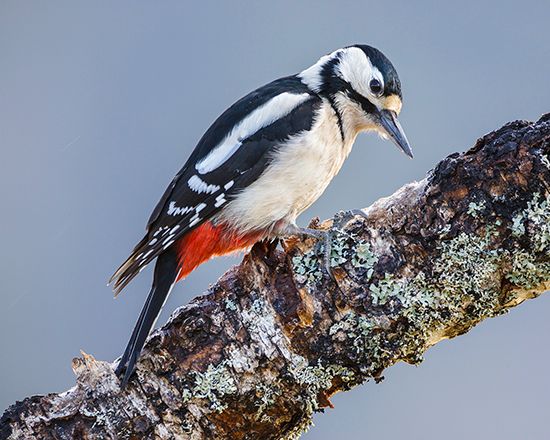
Picidae is a family of birds belonging to the order Piciformes that encompasses approximately 210 species, including woodpeckers, piculets, and wrynecks. These birds are found globally, with the notable exception of Madagascar and regions east of Wallace’s Line, such as Australia and New Guinea.123
The family is divided into three distinct subfamilies:2
- Jynginae (Wrynecks): Two species characterized by soft, unspecialized tails that forage for ants.2
- Picumninae (Piculets): Tiny, soft-tailed birds that forage in a manner similar to woodpeckers, primarily on small branches and vines.2
- Picinae (True Woodpeckers): Birds with stiffened tails that typically perch on tree trunks and branches. While many are known for chiseling into wood, most species primarily forage by gleaning insects from bark surfaces or probing into cracks.32
While their diet consists mainly of insects, some species also consume fruits, berries, nuts, and tree sap.132
How do woodpeckers protect their brains while drumming on trees?
Woodpeckers have evolved a specialized food-gathering apparatus that allows them to withstand the intense forces generated while drumming on trees. Their primary protection against brain injury involves several key anatomical adaptations:
- Thickened Skull: The skull is unusually thick, providing a robust structure to endure repeated impacts.4
- Built-in Shock Absorber: In highly specialized species, the skull curves inward at the upper base of the bill rather than meeting it directly, which acts as a natural shock-absorbing mechanism.4
- Specialized Musculature: The head muscles are specifically adapted to both power the forceful thrusts of the bill and assist in absorbing the shock produced during the pecking process.4
- Supportive Anatomy: Other parts of the body are also modified to provide necessary support and prevent damage from the repetitive impact of pecking.4
What are the main differences between wrynecks, piculets, and true woodpeckers?
The family Picidae is divided into three distinct subfamilies, each with unique physical and behavioral characteristics:
Jynginae (Wrynecks)
Wrynecks are characterized by their soft, unspecialized tail feathers, which distinguish them from true woodpeckers. They are named for their habit of twisting their necks in a snakelike fashion when alarmed. Unlike many other members of the family, they often forage for ants on the ground, though they also take insects from trees using their long tongues.153
Picumninae (Piculets)
Piculets are tiny, soft-tailed birds that exhibit woodpecker-like foraging behaviors. They are generally small, with the largest species being only sparrow-sized. They typically forage by tapping and probing on small branchlets and vines rather than excavating large holes in tree trunks.1
Picinae (True Woodpeckers)
True woodpeckers are distinguished by their stiffened tail feathers, which act as a prop to support the bird against tree trunks and branches while they hammer with their bills. While they are famous for their ability to chisel into wood, most species primarily forage by gleaning insects from bark surfaces or probing into cracks. Their anatomy is highly specialized for this lifestyle, featuring a thick skull, shock-absorbing structures, and a long, distensible tongue used to extract prey.14
Why do some woodpeckers store food like acorns in tree bark?
Some woodpeckers, such as the acorn woodpecker, store food like acorns in tree bark as a vital strategy for survival. These birds depend on acorns as a primary food source during the winter months when other resources may be scarce. To secure this supply, they drill individual holes into the bark of trees and insert the acorns, effectively creating a stored pantry that they can rely on throughout the colder season.8
Sources
- Picidae — Encyclopædia Britannica
- woodpecker — Encyclopædia Britannica
- piciform - Distribution and ecology — Encyclopædia Britannica
- piciform - Form and function — Encyclopædia Britannica
- piciform — Encyclopædia Britannica
- wryneck — Encyclopædia Britannica
- wryneck — Merriam-Webster
- piciform - Importance to humans — Encyclopædia Britannica
- piciform - Reproduction — Encyclopædia Britannica
Published on · 3 min read