Jacamar
A jacamar is any of 18 species of tropical American birds that make up the family Galbulidae (order Piciformes). These birds are characterized by their…
What is Jacamar?
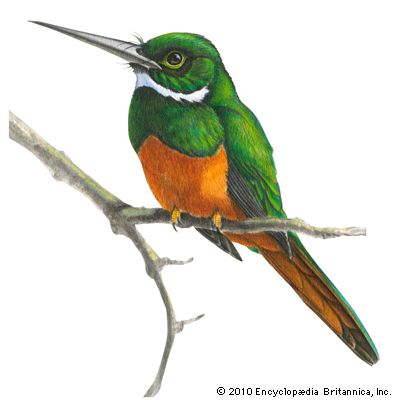
A jacamar is any of 18 species of tropical American birds that make up the family Galbulidae (order Piciformes)1. These birds are characterized by their glittering, iridescent plumage, which is typically dominated by shades of blue, green, or bronze. They possess a long, sharp bill and a tapered body that ends in a long, graduated or square tail.12
Jacamars are primarily insectivorous, feeding by catching insects—such as butterflies and dragonflies—on the wing. They are often observed sitting in trees along forest streams with their bills tilted upward, waiting to dash after prey. Once caught, the insects are typically pounded against a perch before being eaten. Unlike many other birds, jacamars nest in burrows that they excavate into banks or level ground. The most common species is the rufous-tailed jacamar, which ranges from southern Mexico to Argentina.21
What are some other birds in the order Piciformes?
The order Piciformes comprises approximately 450 species of arboreal birds, characterized by their zygodactylous feet (two toes pointing forward and two backward). Beyond the jacamars, the order includes the following families:456
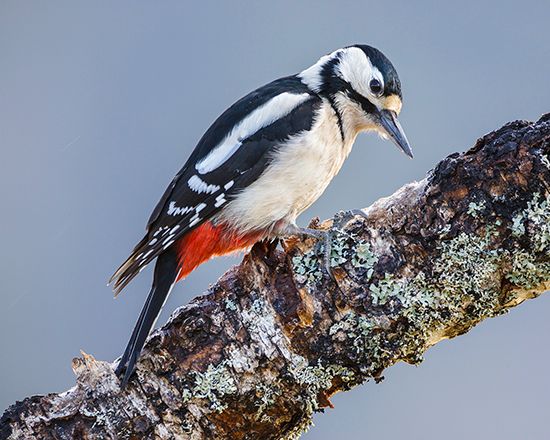
- Picidae: The most widespread family, including woodpeckers, piculets, and wrynecks. They are known for their chisel-like bills and specialized tongues used to extract insects from trees.46
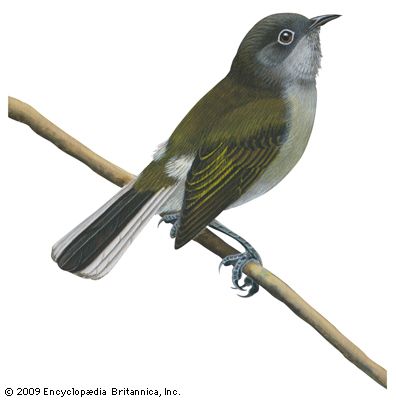
- Bucconidae: Commonly known as puffbirds, these are dull-colored, large-headed birds found in the American tropics that, like jacamars, catch insects on the wing.56
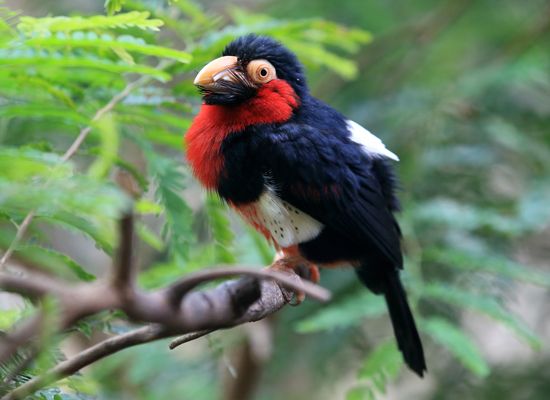
- Capitonidae: Barbets are stocky, often brightly colored birds that feed on fruit and insects.46
- Indicatoridae: Honey guides are unique for their ability to consume beeswax and their behavior as brood parasites.456
- Ramphastidae: Toucans are recognized by their large, often colorful, serrated bills, which they use primarily to feed on fruit.456
How do puffbirds differ from jacamars?
While puffbirds and jacamars are closely related members of the order Piciformes, they exhibit several distinct physical and behavioral differences:
Physical Appearance
- Plumage: Jacamars are known for their glittering, iridescent plumage, typically featuring shades of blue, green, or bronze. In contrast, puffbirds are characterized by dull, non-iridescent, and lax plumage.182
- Bill Structure: Jacamars possess long, sharp, and slender bills. Puffbirds have shorter, wider bills that feature a decurved tip, giving them a shrike-like appearance.182
- Body Shape: Puffbirds are noted for their unusually large heads and short necks, which they often puff out while perching.29
Nesting and Behavior
- Nest Sites: While both families excavate burrows, puffbirds nest in the ground, in termite nests on the ground, or in trees. Jacamars typically restrict their nesting to burrows excavated in banks or level ground.1081
- Nest Construction: Puffbird tunnels are often deeper than those of jacamars, sometimes reaching a meter or more. Some puffbird species line their nests with grass or leaves, or even conceal the entrance with sticks and leaves, whereas jacamars generally leave their nest chambers unlined.10
- Diet: While both are insectivorous flycatchers, puffbirds have a broader diet that includes other arthropods and vertebrates in addition to insects.8
What does it mean for a bird to be zygodactylous?
To be zygodactylous means that a bird has its toes arranged in pairs, with two toes directed forward and two directed backward. Specifically, the inner and middle toes point forward, while the outer and hallux (the first toe) point toward the rear.1112
The term is derived from the Greek words for “yoke” and “toe,” reflecting this paired, yoke-like configuration. This arrangement is distinct from the more common anisodactyl condition, where three toes point forward and only one points backward.12
Zygodactyly is a specialized adaptation that provides birds with enhanced grasping and climbing abilities. It is found in several groups of birds, including:12
- Piciformes: A group that includes woodpeckers, toucans, barbets, honey guides, jacamars, and puffbirds.1312
- Psittaciformes: Parrots, cockatoos, and their relatives use these feet to climb and manipulate objects with great dexterity.1412
- Cuculiformes: This order, which includes cuckoos, also exhibits this toe arrangement.12
Sources
- Jacamar — Encyclopædia Britannica
- Piciform - Annotated classification — Encyclopædia Britannica
- jacamar — Merriam-Webster
- Piciform — Encyclopædia Britannica
- Piciform - Form and function — Encyclopædia Britannica
- Piciform - Evolution and paleontology — Encyclopædia Britannica
- Piciform - Critical appraisal — Encyclopædia Britannica
- Piciform - Reproduction — Encyclopædia Britannica
- Puffbird — Encyclopædia Britannica
- puffbird — Merriam-Webster
- zygodactyl — Merriam-Webster
- Bird - Annotated classification — Encyclopædia Britannica
- Zygodactylae — Merriam-Webster
- Locomotion - Climbing birds and mammals — Encyclopædia Britannica
- Psittaciform - Feet — Encyclopædia Britannica
- Locomotion - Arboreal amphibians and reptiles — Encyclopædia Britannica
- perissodactyl - Limbs — Encyclopædia Britannica
Published on · 3 min read