Pig
Members of the family Suidae—which includes both domestic and wild pigs—are native to the Old World. While there is no single definitive count of all…
How many different species of pigs exist, and where are they found in the wild?
Members of the family Suidae—which includes both domestic and wild pigs—are native to the Old World. While there is no single definitive count of all species, several distinct wild species are recognized within this family.12
Key wild pig species and their natural habitats include:
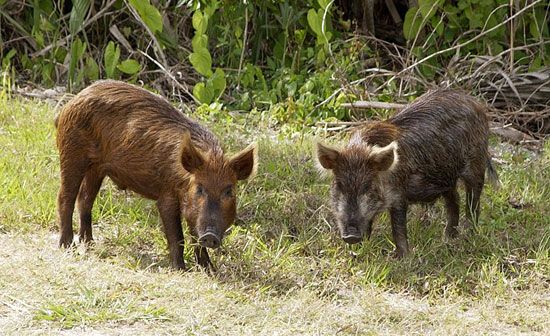
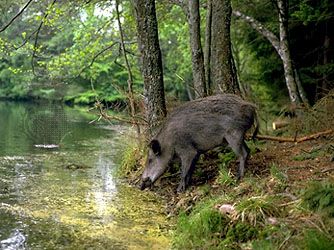
- Wild boar (Sus scrofa): Native to forests ranging from western and northern Europe and North Africa to India, the Andaman Islands, and China.3
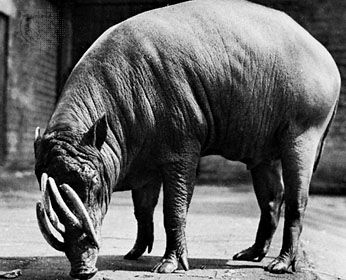
- Babirusa (Babirousa babyrussa): Found in the dense jungles of Celebes and the Molucca islands2.2
- Warthog (Phacochoerus aethiopicus): Inhabits open and lightly forested areas of Africa.4
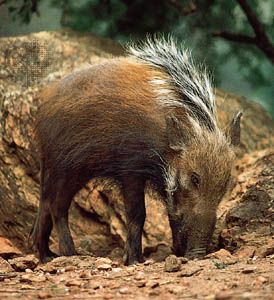
- Bush pig (Potamochoerus porcus): A species native to Africa, which includes the red river hog as a subspecies.2
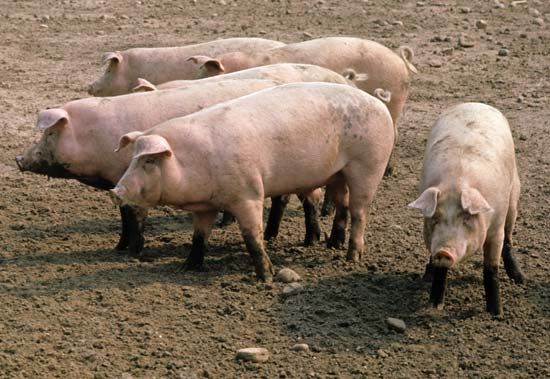
Domestic pigs, while found worldwide, are not a distinct wild species but originated from wild stocks.15
How long do pigs typically live, and how does their lifespan compare to other mammals?
Wild pigs, or boars, are capable of living up to 25 years or more in the wild.7
In contrast, domestic pigs raised for commercial production are typically brought to market when they are only five to six months old. While the provided search results do not offer a comprehensive comparative analysis of lifespans across all mammals, it is notable that the longevity of wild pigs significantly exceeds that of many other small domesticated animals, such as the guinea pig, which typically lives for three to five years and rarely exceeds eight years in captivity.896
Because domestic pigs are primarily managed for agricultural purposes, their lifespans are dictated by production cycles rather than their biological potential.
What are some of the main breeds of domesticated pigs and their purposes?
There are more than 300 known breeds or local varieties of domesticated pigs worldwide, which are primarily categorized into three types based on their intended use: lard, bacon, and pork types.116
Common Pig Breeds and Their Purposes
Name
Primary Use
Characteristics
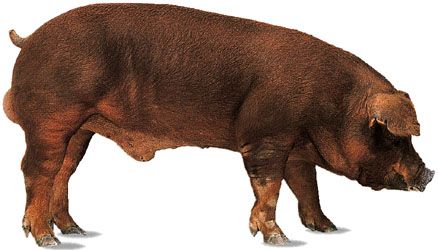
Duroc
Lard
Medium length; light gold-red to dark red color; noted for meat quality.
Hampshire
Meat
Black with a white belt; active and alert; known as a good grazer.
Landrace
Bacon
White, lop-eared; widely raised for bacon production.
Spotted
Meat
Black and white spotted; developed in the United States.
Yorkshire
Bacon
White; the most widely distributed breed globally; sows are known to be prolific.
Breeding and Economic Use
Domestic pigs are monogastric, meaning they require concentrate feed rather than large quantities of forage. Their primary economic value lies in the production of pork and lard.7
Modern commercial production often utilizes crossbreeding to optimize traits: white breeds are typically selected for maternal characteristics like large litter sizes, while colored breeds are often chosen for rapid growth rates and meat quality. Through selective breeding and improved nutrition, the industry has increasingly focused on producing leaner hogs to meet consumer demand.126
How have pigs been used in medical research, and what contributions have they made to science?
Pigs serve as valuable biomedical models in scientific research because they share significant physiological and anatomical similarities with humans. Their use allows researchers to study complex health conditions that cannot be safely or effectively investigated in human subjects.13
Contributions to Medical Science
Pigs are particularly important in the study of chronic degenerative diseases. Because these conditions can be experimentally induced in swine with relative ease, they provide a controlled environment for testing new surgical techniques, drug safety, and nutritional interventions.13
Specific contributions include:
- Cardiovascular Research: Pigs are frequently used to study atherosclerosis, a condition involving the buildup of fats and cholesterol in the arteries, which is a major factor in human heart disease.13
- Surgical Advancements: Swine models have been instrumental in the development and refinement of open-heart surgery and various organ transplantation procedures.13
- Gastrointestinal Studies: Researchers utilize pigs to study gastric ulcers, as the porcine digestive system provides a relevant model for human gastrointestinal health.1314
While animal research has been fundamental to medical breakthroughs, it remains a subject of ethical debate. Modern scientific practices emphasize the “three Rs”—replacement, reduction, and refinement—to ensure that animal welfare is prioritized and that their use in research is both necessary and humane.15
Sources
- suid — Encyclopædia Britannica
- babirusa — Encyclopædia Britannica
- List of pigs — Encyclopædia Britannica
- boar — Encyclopædia Britannica
- warthog — Encyclopædia Britannica
- Pig — Encyclopædia Britannica
- Livestock farming - Breeding and growth — Encyclopædia Britannica
- guinea pig — Encyclopædia Britannica
- Livestock farming - Special dietary requirements — Encyclopædia Britannica
- guinea pig: Top Questions — Encyclopædia Britannica
- Livestock farming - Breeds — Encyclopædia Britannica
- Livestock farming - Pigs — Encyclopædia Britannica
- animal disease - Animals in research : the biomedical model — Encyclopædia Britannica
- Animal testing — Encyclopædia Britannica
- Livestock farming - Disease prevention — Encyclopædia Britannica
- Livestock farming - Common diseases — Encyclopædia Britannica
- Livestock farming - Basic dietary requirements — Encyclopædia Britannica
Published on · 4 min read