Boar
A boar refers to any wild member of the pig species Sus scrofa (family Suidae), which are the ancestors of domestic swine. The term is also used to designate…
What is boar?
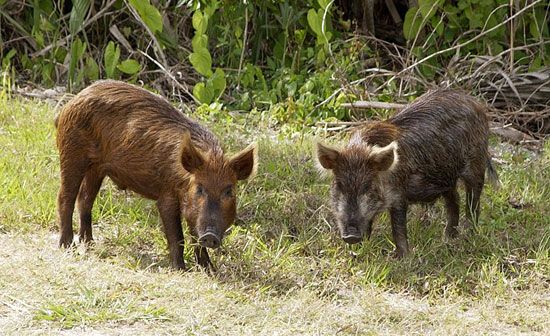
A boar refers to any wild member of the pig species Sus scrofa (family Suidae), which are the ancestors of domestic swine1. The term is also used to designate the uncastrated male of domestic pigs, guinea pigs, and various other mammals.12
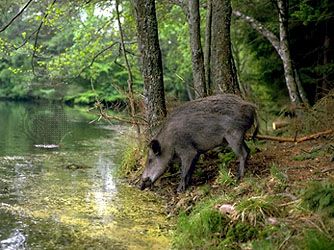
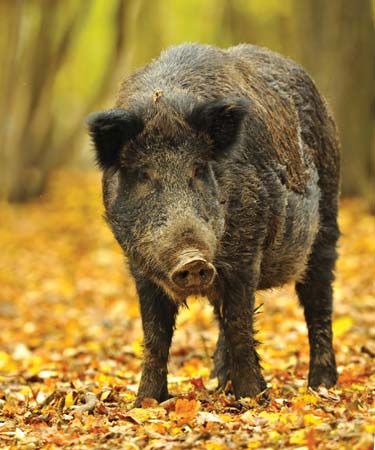
The wild boar, often called the European wild boar, is a bristly, omnivorous animal native to forests across Europe, North Africa, and parts of Asia2. Known for their strength and sharp tusks, they are typically nocturnal and live in groups, though older males are often solitary. Historically, they have been significant as a heraldic beast and a popular game animal, and their meat has long been considered a delicacy.1
How do wild boars differ from domestic pigs?
Wild boars and domestic pigs are closely related, as both belong to the species Sus scrofa. In fact, wild boars are the direct ancestors of domestic swine. Because of this close biological relationship, there is very little difference between the two.142
The most notable physical distinction lies in their dentition: domestic pigs have less developed tusklike teeth compared to their wild kin. Wild boars use these sharp, well-developed tusks to forage for roots and as defensive weapons.24
While domestic pigs are categorized by humans into specific types—such as lard, bacon, or pork breeds—based on their size and fat content, wild boars are characterized by their bristly, grizzled coats and their ability to thrive in forest environments. Wild boars are also known for being swift, nocturnal, and capable of living in groups, whereas domestic pigs are managed through selective breeding and specific livestock farming practices to optimize growth and production.24
What role do wild boars play in their ecosystems?
Wild boars are omnivorous animals that play a significant role in their forest habitats by foraging for a wide variety of food sources. Their behavior, which includes rooting in the soil with their snouts and tusks, can influence the structure of the forest floor and the distribution of plant life.2
As they move through their environment, wild boars act as both predators and prey, contributing to the complex dynamics of their ecosystems. While they are generally unaggressive, their strength and speed make them formidable inhabitants of the forests they occupy across Europe, North Africa, and Asia.2
It is important to note that when introduced to non-native regions, such as the United States or New Zealand, wild boars can become invasive, potentially disrupting local ecological balances.2
Why have wild boars been significant in history and heraldry?
The wild boar has held a significant place in human history and culture primarily due to its reputation for great strength, speed, and ferocity. Since ancient times, these traits made the animal a favored target for the chase, a sport historically reserved for rulers and nobility to demonstrate their prowess and courage.23
In European tradition, the boar is recognized as one of the four heraldic “beasts of the chase.” Its symbolic importance is perhaps most famously illustrated by its role as the personal emblem of Richard III, king of England, who used the boar as his distinguishing mark. Beyond its heraldic and sporting significance, the boar also held a place in culinary history, where the boar’s head was long regarded as a special delicacy.2
The animal’s cultural footprint is further evidenced by its inclusion in early literature, such as the 4th-century BCE work Kynēgetikos (“On Hunting”) by the ancient Greek writer Xenophon, which detailed the techniques used to hunt boars and stags.3
Sources
- wild boar — Encyclopædia Britannica
- boar — Encyclopædia Britannica
- wild boar — Merriam-Webster
- Pig — Encyclopædia Britannica
- Livestock farming - Special dietary requirements — Encyclopædia Britannica
- hunting - Ancient history — Encyclopædia Britannica
- boar — Merriam-Webster
Published on · 3 min read