Peccary
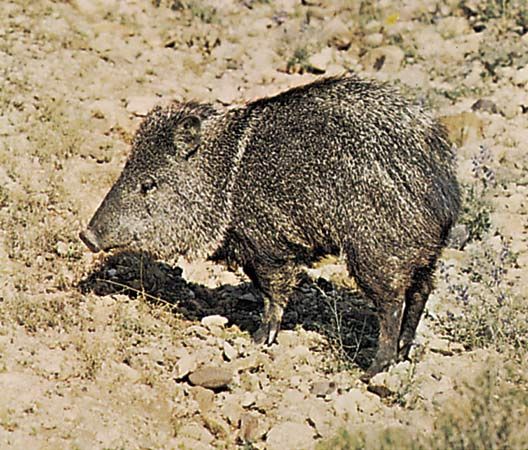
Peccaries (family Tayassuidae) are New World mammals that closely resemble pigs, yet they are distinguished by several unique biological characteristics.
What are the main characteristics that distinguish peccaries from other mammals?
Peccaries (family Tayassuidae) are New World mammals that closely resemble pigs, yet they are distinguished by several unique biological characteristics.1
Key Distinguishing Features
- Scent Gland: A defining trait is a scent gland located under the skin on the ridge of the back. This gland emits a strong, musky odor and has led to the common misconception that the animals possess two navels.1
- Dental Structure: Unlike true swine, peccaries possess spearlike canine teeth. These teeth do not protrude outward but create distinct lumps in the lips.1
- Skeletal Differences: Peccaries differ from other piglike mammals in specific skeletal features.1
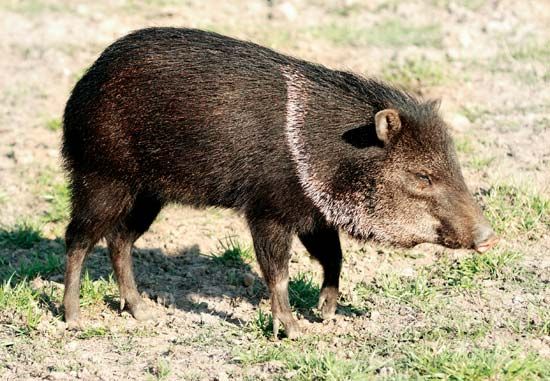
- Physical Appearance: They are characterized by dark, coarse hair, a large head, and a circular snout. Their ears and tails are small, with the tail typically being invisible.1
While they are often called javelinas due to their teeth, they are social, omnivorous animals that communicate through barking alarm calls and teeth-chattering sounds.1
How many species of peccaries exist, and where are they primarily found?
There are three recognized species of peccaries, all of which are native to the New World. Their range extends from the southern deserts of the United States southward through Central America and the Amazon basin to Patagonia in South America.1
The three species are:
- Collared peccary (Tayassu tajacu): The most common and smallest species, it inhabits a wide variety of environments throughout the entire range of the family Tayassuidae.1
- White-lipped peccary (T. pecari): Larger and darker than the collared peccary, this species is found exclusively in the forests and scrublands of Central and South America.1
- Chacoan peccary (Catagonus wagneri): The largest and rarest species, it is restricted to the dry Gran Chaco region of South America. It is currently considered endangered due to habitat loss and hunting.1
How do peccaries differ from wild pigs or boars, which they are often confused with?
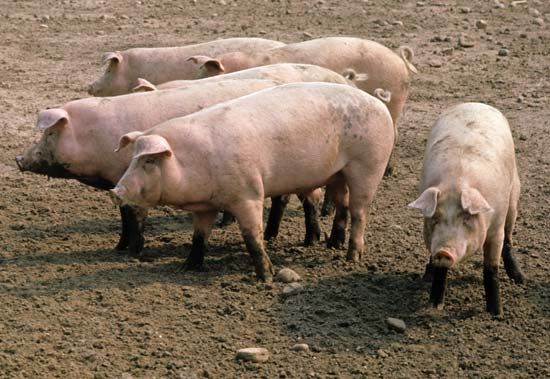
While peccaries are often confused with wild pigs or boars, they belong to a distinct family, Tayassuidae, whereas true pigs belong to the family Suidae. Although both are members of the suborder Suina, they possess several key anatomical and biological differences.13
Dental and Skeletal Differences
Peccaries can be distinguished from true pigs by specific dental and skeletal features:
- Dentition: Peccaries have one fewer incisor and one fewer premolar than pigs. Additionally, their canine teeth are smaller and more spearlike, and their cheek teeth are less advanced than those of pigs.34
- Skeletal Structure: Peccaries possess a cannon bone in their hindlegs, a feature not found in pigs.3
- Digestive System: Peccaries have a more complicated stomach structure compared to true swine.3
Physical and Behavioral Distinctions
- Scent Gland: A primary external identifier is a scent gland located under the skin on the ridge of the back, which emits a strong, musky odor. This gland is absent in true pigs.1
- Coat: Peccaries generally have a more densely haired coat than their suid counterparts.3
- Appearance: While both have circular snouts, peccaries are characterized by their small ears and a tail that is typically not visible.1
What unique physical features do peccaries have, such as their scent glands?
Peccaries are distinct piglike mammals characterized by several unique physical features that set them apart from true swine.
Key Physical Features
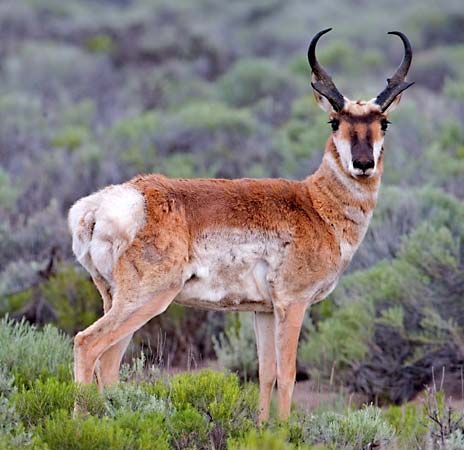
- Scent Gland: A defining feature of the peccary is a scent gland located under the skin on the ridge of the back. This gland emits a strong, musky odor and is the source of a common misconception that the animals possess two navels—one above and one below the gland. This dorsal gland is a specialized feature also found in other animals like the pronghorn and springbok, though its exact function remains a subject of scientific conjecture.14
- Dentition: Peccaries possess spearlike canine teeth that create notable lumps in their lips, though they do not protrude like those of many other suids. They also have a reduced set of teeth compared to true pigs, specifically lacking the lateral pair of upper incisors and having one fewer premolar.15
- General Appearance: They have dark, coarse hair, a large head, and a circular snout. Their ears are small, and their tails are typically not visible.1
Sources
- peccary — Encyclopædia Britannica
- peccary — Merriam-Webster
- artiodactyl - Annotated classification — Encyclopædia Britannica
- artiodactyl - Teeth — Encyclopædia Britannica
- artiodactyl - Scent glands — Encyclopædia Britannica
Published on · 3 min read