Plain of Jars
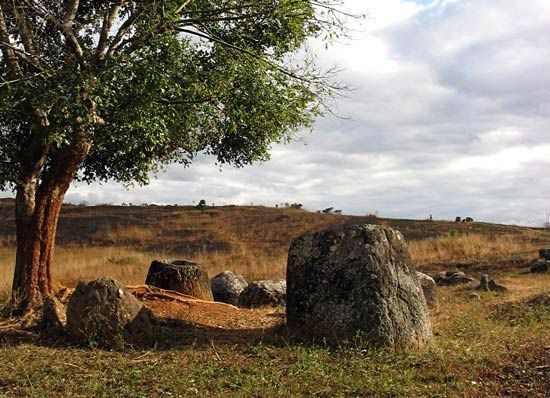
The Plain of Jars is a region located on the Xiangkhoang Plateau in north-central Laos.
What is the Plain of Jars and where exactly is it located in Laos?
The Plain of Jars is a region located on the Xiangkhoang Plateau in north-central Laos.1
The area is characterized by narrow river valleys and hills composed of limestone and sandstone, with elevations ranging from 3,000 to 3,600 feet (900 to 1,100 meters). It derives its name from several hundred ancient, massive stone jars scattered across the landscape, which are believed by some to be funerary urns dating back nearly 2,000 years.12
Beyond its archaeological significance, the region holds a complex modern history. It served as a strategic military site during the Laotian civil war in the 1960s and was the location of intense conflict and heavy aerial bombardment in 1969. Today, the plain remains a site of military activity, featuring a major airfield, while the surrounding hills support subsistence agriculture for local Khmu and Miao (Hmong) populations.1
How has the Plain of Jars been affected by modern conflicts, particularly the Vietnam War?
The Plain of Jars was profoundly impacted by the conflicts of the 1960s, as its geography became a focal point of strategic military importance during the Laotian civil war. The region served as a critical base of operations, where several airfields were constructed to support the Royal Lao government in its efforts against Pathet Lao communist insurgents.1
The area suffered significantly in 1969 when it became a major battlefield between North Vietnamese forces and the Royal Lao government. During this period, the region was subjected to heavy aerial bombardment by the United States. These military actions left a lasting mark on the landscape, which continues to host a major Laotian military airfield today.1
We could dive deeper into the broader impact of the Vietnam War on the region or explore the archaeological significance of the stone jars themselves.
What is the significance of the Plain of Jars in Laotian culture and folklore?
The Plain of Jars is a significant archaeological site in north-central Laos, recognized for its collection of hundreds of massive, ancient stone vessels scattered across the Xiangkhoang Plateau. While these jars are widely believed to be funerary urns dating back nearly 2,000 years, the provided information does not detail specific local folklore or cultural myths associated with their origins.13
The site’s cultural importance is underscored by its designation as a World Heritage site, specifically categorized under the Megalithic Jar Sites in Xiengkhuang. Although the region is of limited economic or agricultural value, it remains a vital part of the nation’s historical landscape, distinct from the religious and architectural landmarks found in cities like Vientiane or Louangphrabang.213
Are there any similar megalithic sites in Southeast Asia, and how do they compare to the Plain of Jars?
Southeast Asia is home to a diverse array of megalithic monuments that share cultural and chronological links with the Plain of Jars in Laos. These sites, which include menhirs, dolmens, and cist graves, are found across regions such as Cambodia, Indonesia, and Sumatra.456
Comparison and Context
- Cultural Connections: Many of these monuments are attributed to the same late Neolithic cultures, with some scholars suggesting that speakers of Mon-Khmer languages may have been responsible for the megalithic traditions in both Cambodia and Laos.5
- Function: Like the stone jars of Laos, which are believed to be funerary urns, many other Southeast Asian megaliths—such as terraced burial mounds and stone sarcophagi—were deeply connected to rituals surrounding the dead and a belief in a spirit world.46
- Regional Diversity: While the Plain of Jars is defined by its colossal stone vessels, sites in the Pasemah region of Sumatra feature large stones carved into relief images of humans and animals, such as buffalo and elephants. Unlike the Plain of Jars, where the tradition is ancient, some Indonesian megalithic practices persisted into much more recent centuries.46
Sources
- Plain of Jars — Encyclopædia Britannica
- Laos - Cultural institutions — Encyclopædia Britannica
- list of World Heritage sites - Laos — Encyclopædia Britannica
- Southeast Asian arts - Neolithic Period — Encyclopædia Britannica
- Southeast Asian arts - Cambodia and Vietnam — Encyclopædia Britannica
- Southeast Asian arts - Indonesia — Encyclopædia Britannica
Published on · 3 min read