Poison Oak
Poison oak refers to two species of poisonous plants in the Anacardiaceae family, native to North America](https://www.britannica.com/plant/Anacardiaceae)…
What is poison oak?
Poison oak refers to two species of poisonous plants in the Anacardiaceae family, native to North America](https://www.britannica.com/plant/Anacardiaceae) family, native to North America. Despite their name, they are not true oaks of the genus Quercus.1
The two primary species are:
- Pacific poison oak (Toxicodendron diversilobum): Found in western North America, this plant can grow as a small shrub or a climbing vine.1
- Atlantic poison oak (T. pubescens): A small shrub native to the southeastern United States, often found in open woodlands and sandy thickets.1
Both species contain urushiol, an oil that causes severe, itchy, and painful contact dermatitis upon contact with the plant’s leaves or sap. Atlantic poison oak is frequently confused with poison ivy, which shares similar irritating properties.12
What is urushiol and how does it affect the skin?
Urushiol is an oily, toxic irritant substance found in plants such as poison ivy, poison oak, and the lacquer tree. Chemically, it is a mixture of catechol derivatives with long carbon side chains.345
When urushiol comes into contact with the skin, it triggers a Type IV hypersensitivity reaction, also known as contact dermatitis known as contact dermatitis. The process occurs as follows:45
- Sensitization: Urushiol diffuses into the skin and binds to body proteins, altering them so they appear foreign to the immune system.5
- Immune Response: These modified protein complexes migrate to the lymph nodes, where they stimulate specific T cells to multiply.5
- Inflammation: When these T cells return to the site of contact, they induce inflammation, resulting in the characteristic itchy, painful rash that can persist for weeks.5
Because urushiol is nearly nonvolatile, it can remain active on clothing, tools, or animal fur for up to a year, potentially causing reactions even without direct contact with the plant.4
How can you distinguish poison oak from poison ivy?
Distinguishing between poison oak and poison ivy can be challenging because both belong to the same family and produce the same irritating oil, urushiol. However, there are key physical differences to observe:
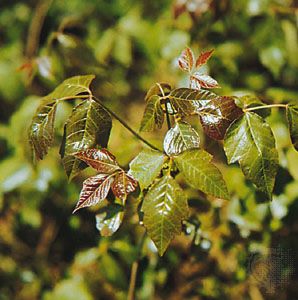
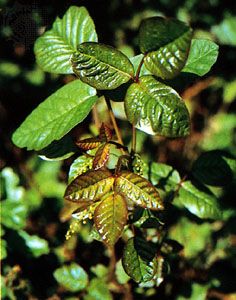
- Leaf Shape: The leaflets of Atlantic poison oak are typically lobed and often resemble the leaves of a white oak. In contrast, poison ivy leaves are generally smoother or have jagged edges rather than rounded lobes.
- Texture: Atlantic poison oak leaves are characteristically hairy, whereas poison ivy leaves are often glossy or smooth.
- Growth Habit: Pacific poison oak is highly variable, appearing as either a small shrub or a climbing vine, and its compound leaves may feature three or five leaflets. Atlantic poison oak is strictly a small shrub, usually under one meter in height, and typically features three leaflets.
Because both plants can cause severe contact dermatitis, it is best to avoid any three-leafed plant in these regions.
What are the best ways to treat a poison oak rash?
The provided search results do not contain information regarding the treatment of a poison oak or poison ivy rash.
Sorry, the Britannica knowledge base does not contain this information.
Sources
- poison oak — Encyclopædia Britannica
- poison oak — Merriam-Webster
- urushiol — Merriam-Webster
- poison ivy — Encyclopædia Britannica
- immune system disorder - Contact hypersensitivity and dermatitis — Encyclopædia Britannica
Published on · 2 min read