Pistachio
The pistachio (Pistacia vera) is a small tree belonging to the cashew family (Anacardiaceae) and is widely recognized for its edible seeds. Believed to be…
What is Pistachio?
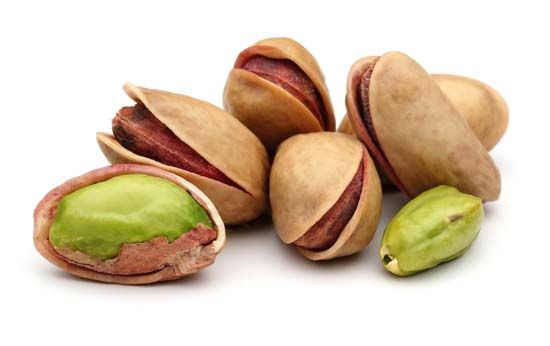
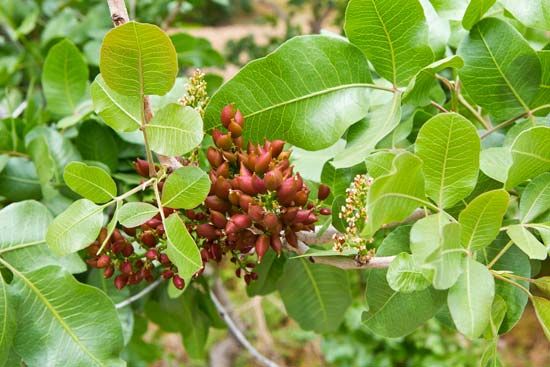
The pistachio (Pistacia vera) is a small tree belonging to the cashew family (Anacardiaceae) and is widely recognized for its edible seeds. Believed to be indigenous to Iran, the tree is cultivated in warm, temperate, and dry climates, including regions from Afghanistan to the Mediterranean and California1.1
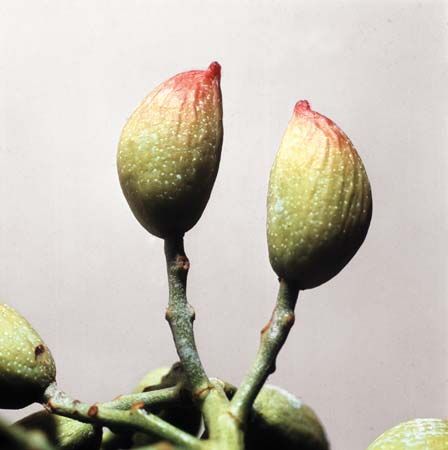
The plant is dioecious, meaning male and female flowers grow on separate trees, requiring wind for pollination. The fruit is a small drupe that typically splits open as it matures, revealing a greenish kernel covered by a thin, reddish skin. These kernels are valued for their mild, resinous flavor and are rich in protein, fat, and vitamin B6.12
In culinary applications, pistachios are eaten fresh or roasted and are common ingredients in baklava, halvah, and ice cream, or used to provide a natural yellowish-green color to confections.13
What other plants belong to the cashew family?
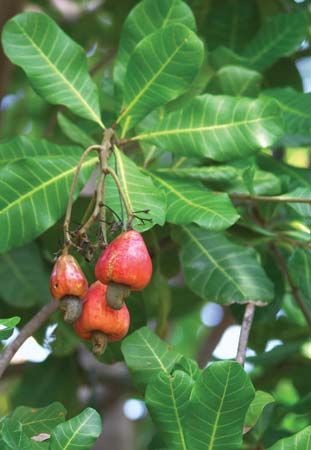
The cashew family (Anacardiaceae) is a diverse group comprising approximately 80 genera and over 700 species of trees, shrubs, and woody vines, primarily found in tropical and subtropical regions. Members of this family are characterized by the presence of resin ducts in their bark and often produce gums or resins that darken upon exposure to air.45
Beyond the pistachio and cashew, the family includes several economically significant plants:
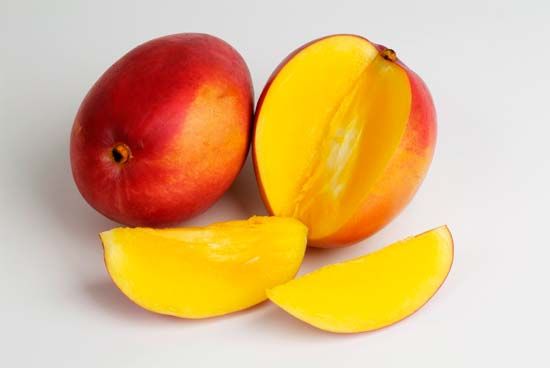
- Edible Fruits: The mango (Mangifera indica), hog plum, and wild plum (Harpephyllum caffrum) are valued for their edible fruits.5
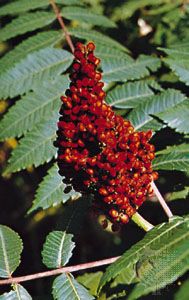
- Ornamentals: The pepper tree (Schinus molle), smoke tree (Cotinus), and various species of sumac (Rhus) are commonly cultivated for their aesthetic appeal.45
- Industrial Uses: The mastic tree and Chinese lacquer tree are sources of useful oils, resins, and lacquers, while quebracho trees are harvested for commercial [tannin]4.5
- Irritants: The genus Toxicodendron includes plants known for causing skin irritation, such as poison ivy, poison oak, and poison sumac.45
How do wind-pollinated trees like the pistachio reproduce?
Wind-pollinated trees like the pistachio reproduce through a process known as anemophily, which relies on air currents to transfer pollen from male to female flowers.111
Because wind pollination is inherently imprecise and wasteful, these plants have evolved specific strategies to ensure reproductive success:
- Dioecious Nature: Many wind-pollinated species, including the pistachio, are dioecious, meaning they bear male and female flowers on separate trees. This structure effectively prevents self-pollination. In agricultural settings, growers ensure fertilization by interplanting male and female trees in specific ratios, such as 1:5 or 1:6.111
- Flower Adaptations: These trees produce inconspicuous flowers that lack showy petals, fragrance, or nectar, as they do not need to attract insects. To maximize exposure to the wind, flowers often bloom before leaves emerge in the spring or are positioned high on the plant.11
- Pollen Dispersal: Male flowers produce vast quantities of dry, smooth-surfaced pollen grains that are easily carried by the breeze. Conversely, female flowers often feature stigmas that are long or divided into lobes, creating a larger surface area to capture airborne pollen.11
What are some other types of drupe fruits?
A drupe is a simple, fleshy fruit derived from a single ovary that typically contains a hard, stony inner layer known as a pit or putamen. While many people associate drupes primarily with stone fruits, the category includes a wide variety of plants with diverse characteristics.
Common examples of drupes include:
- Traditional Stone Fruits: Cherry, peach, plum, and olive.1314
- Tropical and Ornamental Varieties: Mango and dogwood.13
- Fruits with Fibrous or Tough Layers: The coconut features a fibrous outer part, while the almond and walnut have pericarps that differentiate into tough or fleshy husks surrounding a hard shell.1314
Additionally, some fruits that appear to be single units are actually aggregates of tiny drupes, known as drupelets. Examples include raspberries and blackberries, which are formed from numerous fused carpels of a single flower.1314
Sources
- Pistachio — Encyclopædia Britannica
- pistachio nut — Merriam-Webster
- Pistacia — Encyclopædia Britannica
- list of plants in the family Anacardiaceae — Encyclopædia Britannica
- Anacardiaceae — Merriam-Webster
- Mango — Encyclopædia Britannica
- Cashew — Encyclopædia Britannica
- Anacardiaceae — Encyclopædia Britannica
- Magnoliales - Timber — Encyclopædia Britannica
- Caryophyllales - Other families — Encyclopædia Britannica
- Pollination - Wind — Encyclopædia Britannica
- Fruit - Wind dispersal — Encyclopædia Britannica
- Drupe — Encyclopædia Britannica
- Fruit - Types of fruits — Encyclopædia Britannica
- drupe — Merriam-Webster
Published on · 3 min read