Poland China
The Poland China is a prominent breed of pig developed in the United States between 1835 and 1870, specifically in Butler and Warren counties, Ohio.
What is Poland China?
The Poland China is a prominent breed of pig developed in the United States between 1835 and 1870, specifically in Butler and Warren counties, Ohio.1
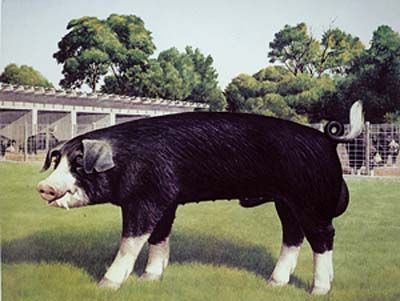
Characterized by its large size and drooping ears, the breed is black with a white face, white feet, and a white tip on the tail. Its name reflects the historical influence of various breeds, including Polish pigs and “Big Chinas,” which were used in its development. Today, the Poland China is a popular meat animal widely raised in the United States—particularly within the Midwest Corn Belt—as well as in South America. A related variety, the Spotted Poland China, was later developed in Indiana around 1915 through crosses with native spotted pigs.12
What are the key differences between Poland China and other popular pig breeds?
The Poland China is distinguished from other commercial pig breeds primarily by its unique color pattern and historical development. While many breeds are defined by specific regional origins and physical traits, the Poland China is noted for being one of the largest modern breeds, characterized by its black coat with a white face, feet, and tail tip, and its drooping ears.12
Key differences between the Poland China and other popular breeds include:
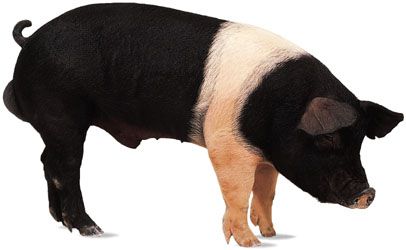
- Coloration and Markings: Unlike the solid white Yorkshire or the red Duroc, the Poland China features a distinct black-and-white pattern. It differs from the Hampshire, which is black with a white belt encircling the shoulders and front legs.12
- Developmental History: The breed originated in Ohio through the fusion of Polish and “Big China” stock, whereas breeds like the Landrace were developed in Europe through rigorous progeny testing for bacon production.12
- Usage: While many breeds are specialized for bacon or specific meat quality, the Poland China is recognized as a large, general-purpose meat animal.12
How did the geography of the U.S. Corn Belt influence pig farming?
The geography of the U.S. Corn Belt has profoundly shaped pig farming, creating a region often referred to as the swine belt due to the close relationship between crop production and livestock raising.
The region’s deep, fertile soils and favorable climate provide ideal conditions for growing corn, which serves as a primary energy source for pigs. This geographic abundance allows farmers to integrate grain and livestock operations, saving on the costs of transporting and selling grain by feeding it directly to their herds.456
Furthermore, the symbiotic nature of this system is reinforced by the use of pig manure as a nutrient-rich fertilizer for cropland, providing essential nitrogen, phosphorus, and potassium. The economic interdependence of these sectors is captured by the corn-hog ratio, a key metric used to measure the profitability of pork production based on the market value of corn relative to live hogs. Consequently, the Corn Belt’s geography has established a model where grain production and hog farming remain fundamentally linked for efficiency and sustainability.678
What is the history behind the Spotted Poland China breed?
The Spotted Poland China, often referred to simply as “Spots,” is a distinct breed that originated in Indiana around 1915. Its development was the result of crossing the established Poland China breed with native spotted pigs found in the region.1
While the Poland China itself was developed in Ohio between 1835 and 1870 through the fusion of Polish and “Big China” stock, the Spotted variety emerged later as a separate effort to refine the breed’s characteristics. The Spotted breed is recognized for its meat production and is characterized by a black and white spotted coat, ideally distributed in a 50/50 ratio.21
It is important to note that while the name “Poland China” reflects the historical influence of Asian pig breeds—specifically the use of Chinese and “Siamese” stock in the improvement of early North American breeds—the Spotted Poland China is a uniquely American development.1
Sources
- Poland China — Encyclopædia Britannica
- Livestock farming - Breeds — Encyclopædia Britannica
- Poland China — Merriam-Webster
- Corn Belt — Encyclopædia Britannica
- corn-hog ratio — Merriam-Webster
- hog-corn ratio — Merriam-Webster
- Midwest — Encyclopædia Britannica
- swine belt — Merriam-Webster
- Livestock farming - Basic dietary requirements — Encyclopædia Britannica
- Livestock farming - Production systems — Encyclopædia Britannica
Published on · 3 min read