Gulf Stream
The Gulf Stream is a vital component of global ocean circulation, serving as a major western boundary current that facilitates the poleward transfer of heat.…
What role does the Gulf Stream play in global ocean circulation patterns?
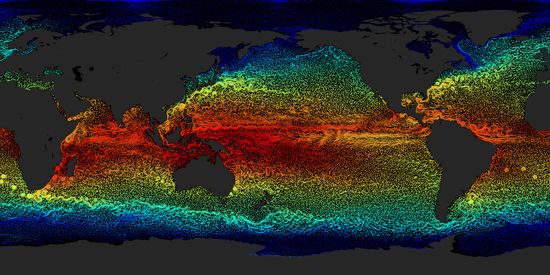
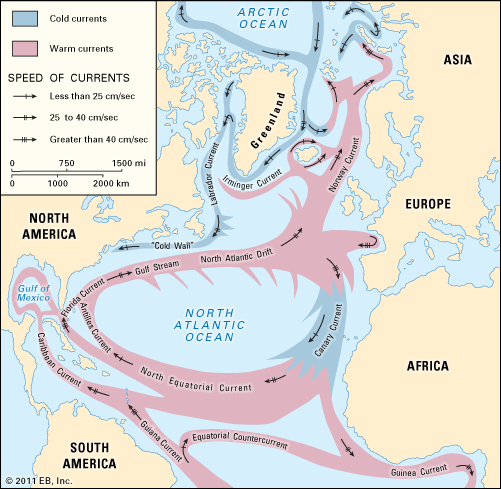
The Gulf Stream is a vital component of global ocean circulation, serving as a major western boundary current that facilitates the poleward transfer of heat. As part of the Atlantic Meridional Overturning Circulation (AMOC), it conveys warm, saline surface water from the tropics northward toward northwestern Europe.12
This movement is essential for regulating regional and global climates. By transporting heat to higher latitudes, the Gulf Stream helps maintain milder temperatures in northwestern Europe than would otherwise be expected at those latitudes. As the water travels north, it cools and increases in density due to evaporation, eventually sinking in the Arctic to form North Atlantic Deep Water. This sinking process drives the deeper, southward-flowing limb of the global thermohaline circulation, which effectively distributes heat and nutrients throughout the world’s oceans.21
Beyond its role in heat transport, the Gulf Stream supports marine ecosystems by circulating nutrients and contributes to the energy balance of the North Atlantic subtropical gyre.12
What methods do scientists use to study and monitor the Gulf Stream?
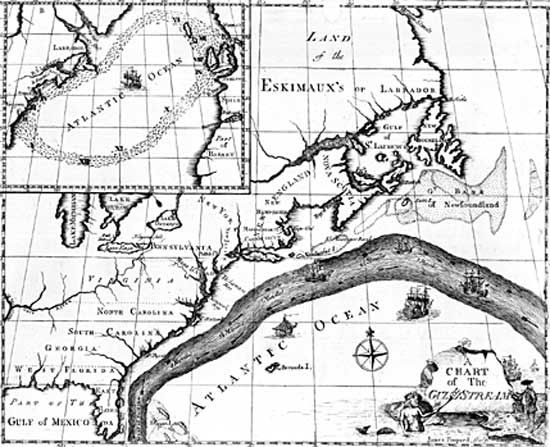
Scientists employ a variety of direct and indirect methods to study and monitor the complex, shifting nature of the Gulf Stream.
Direct Measurement
Direct techniques establish absolute current velocity and monitor rapid changes.
- Current Meters: Instruments like the Vector Averaging Current Meter (VACM) are deployed on moorings to record speed and direction at specific depths.3
- Drifting Floats: Scientists track surface buoys via satellite or subsurface floats acoustically. Subsurface drifters often utilize SOFAR channels to transmit signals over long distances.34
- Doppler-Sonar: These systems measure velocity by analyzing the Doppler shift of sound waves scattered off plankton and other organisms in the upper ocean.3
- Vertical Profiling: Specialized instruments, such as neutrally buoyant floats or free-fall devices, are used to measure vertical velocity and create depth-dependent profiles of the current.3
Indirect and Remote Sensing
- Satellite Altimetry: Radar altimeters measure sea-surface height to map topography and deduce pressure fields, which helps estimate geostrophic currents.15
- Radiometry: Infrared and microwave radiometers detect temperature and color variations, allowing researchers to trace the current’s path and monitor its meanders and eddies.16
- Geostrophic Method: This theoretical approach calculates current velocity based on the balance between pressure gradients, gravity, and the Coriolis force.4
- Acoustic Tomography: By monitoring the travel time of sound pulses across arrays of transmitters and receivers, scientists can gather large-scale data on averaged oceanic properties.1
What is the Gulf Stream and where is it located?
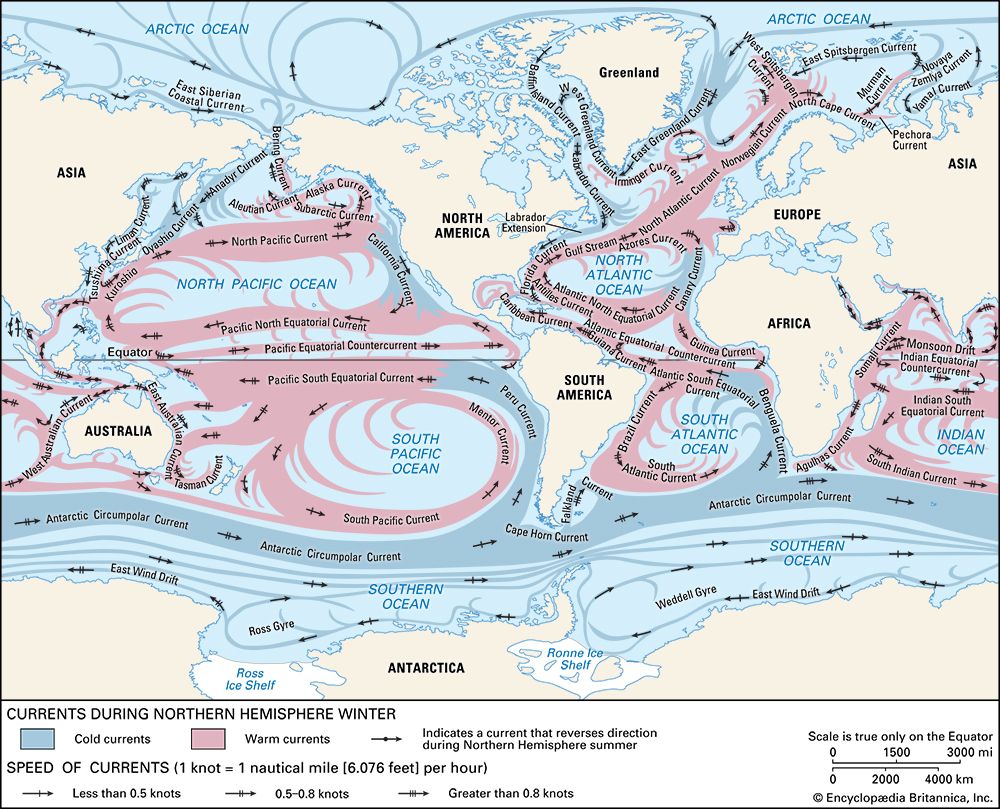
The Gulf Stream is a powerful, warm ocean current that serves as a major western boundary current in the North Atlantic Ocean. It is a key component of the North Atlantic subtropical gyre, a clockwise-rotating system of currents driven by wind and the Coriolis force.617
Location and Path
The Gulf Stream originates as the Florida Current, which emerges from the Gulf of Mexico through the Straits of Florida. It flows northward along the continental slope of the eastern United States until it reaches Cape Hatteras, North Carolina.61
At Cape Hatteras, the current separates from the continental margin and turns northeastward toward the Grand Banks of Newfoundland. As it moves into the open North Atlantic, it broadens and eventually transitions into the North Atlantic Current, which carries warm water toward northwestern Europe.618
How does the Gulf Stream impact marine life and ecosystems?
The Gulf Stream plays a vital role in shaping marine ecosystems by acting as a transport mechanism and a source of biological enrichment. Its influence on marine life includes the following key processes:
- Larval Transport: The current serves as a major conduit for the dispersal of marine organisms. It transports larvae over vast distances, which is essential for the survival and distribution of various species. For example, the successful recruitment of eels to Europe relies on the Gulf Stream to carry them from their spawning grounds in the Caribbean.6
- Biological Enrichment: The Gulf Stream’s warm, saline waters frequently mingle with colder, nutrient-rich waters—particularly off the Grand Banks and near northwestern Europe. This interaction creates turbulence that brings nutrient salts to the surface, supporting high levels of biological productivity.9
- Eddy Dynamics: The current generates complex eddy structures, such as warm-core and cold-core rings. These features are not only significant for heat transport but also serve as vehicles for moving nutrients, which are critical for sustaining local biological systems.1
- Species Range and Diversity: By relocating tropical larvae to higher latitudes, the current facilitates a tropical infusion into cold temperate coral reefs, thereby influencing the biodiversity of those regions.6
Sources
- Climate - The Gulf Stream — Encyclopædia Britannica
- Atlantic Meridional Overturning Circulation — Encyclopædia Britannica
- undersea exploration - Measurements of ocean currents — Encyclopædia Britannica
- undersea exploration - Acoustic and satellite sensing — Encyclopædia Britannica
- hydrologic sciences - The circulation of the oceans — Encyclopædia Britannica
- Gulf Stream — Encyclopædia Britannica
- subtropical gyre — Encyclopædia Britannica
- How Do Ocean Currents Affect the Biosphere? — Encyclopædia Britannica
- Marine ecosystem - Ocean currents — Encyclopædia Britannica
Published on · 4 min read