Population Density
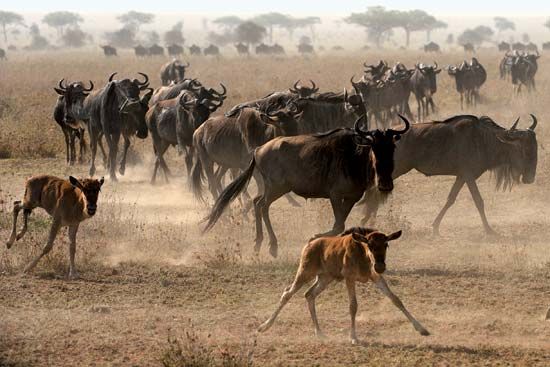
Population density is defined as the number of individuals of a certain species per unit area. It is calculated using the formula:
What is Population density?
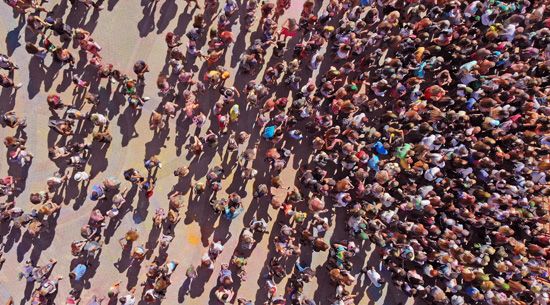
Population density is defined as the number of individuals of a certain species per unit area. It is calculated using the formula:1
$D_p = N_i / A$
In this equation, $D_p$ represents population density, $N_i$ is the total number of individuals, and $A$ is the area in square units, such as square kilometers or square miles.1
While often used to study human geography and urban planning, it is an imperfect measure because it can obscure variations in settlement intensity within a region. To address this, researchers may use population-weighted densities or alternative metrics like agricultural and physiological density. In the biological sciences, ecologists utilize this metric to understand population ecology, including species distribution, carrying capacity, and the impacts of competition or resource scarcity.1
What is the difference between physiological density and agricultural density?
Physiological density and agricultural density are both specialized measures used to analyze human populations in relation to land, specifically focusing on arable land rather than total land area.2
The primary differences between these two metrics are:
- Physiological Density: This is defined as the number of individuals per unit of arable land. It is used to examine the pressure on the land by assessing how many people a specific unit of agricultural land must support.2
- Agricultural Density: This is defined as the number of farmers per unit of arable land. It is primarily used to study the productivity of farms and the intensity of agricultural labor.2
While simple population density provides a general overview of people per total land area, these specific measures offer deeper insight into the relationship between human populations and the resources required to sustain them.24
How do ecologists use population density to determine the carrying capacity of an environment?
Ecologists use population density as a key metric to determine an environment’s carrying capacity—the maximum population size a habitat can support without undergoing deterioration.562
Because life-sustaining resources like food, shelter, and water are finite, population density serves as a primary indicator of resource pressure. Ecologists observe how density influences population growth through several mechanisms:57
- Resource Competition: As density increases, competition for limited resources intensifies. This often leads to increased mortality or reduced fertility, which eventually causes population growth to plateau.78
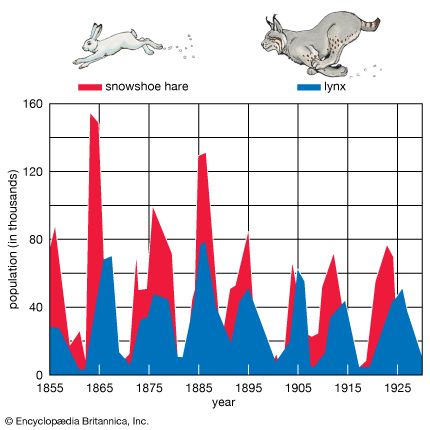
- Density-Dependent Factors: Ecologists track density-dependent factors, such as disease transmission, predation, and resource scarcity, which regulate population size. When a population exceeds its carrying capacity, these factors trigger a decline in numbers.85
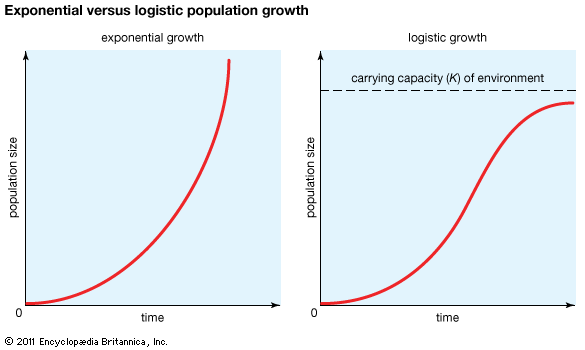
- Logistic Growth: These dynamics are often modeled using a logistic curve. Ecologists monitor the transition from exponential growth to a stable plateau, identifying the density at which the environment can no longer support further increases.7
Why might population density be an imperfect measure for understanding how people actually live in a region?
Population density is an imperfect measure because it often obscures significant variations in settlement intensity within a given unit of land. By averaging population over a total area, it can create a distorted picture of how people actually live; for example, if a region contains both a city and rural countryside, the calculation makes urban residents appear to live in lower-density areas than they truly do, while those in towns and villages appear to live in higher-density areas than they actually experience.2
Furthermore, data collection challenges can lead to inaccuracies. Censuses frequently struggle to account for mobile populations, such as nomadic groups, migrants, and refugees. Additionally, individuals without housing or those living in settlements not recognized by governmental authorities are often undercounted, leading to an incomplete understanding of the population distribution.2
To address these distortions, researchers sometimes use population-weighted densities or alternative metrics like physiological density to better reflect the realities of human geography.2
Sources
- population density — Merriam-Webster
- Population density — Encyclopædia Britannica
- Europe - Overall densities — Encyclopædia Britannica
- Agricultural economics - Land, output, and yields — Encyclopædia Britannica
- carrying capacity — Encyclopædia Britannica
- Population growth — Encyclopædia Britannica
- Population density: Top Questions — Encyclopædia Britannica
- carrying capacity — Merriam-Webster
- density-dependent factor — Encyclopædia Britannica
Published on · 3 min read