Porgy
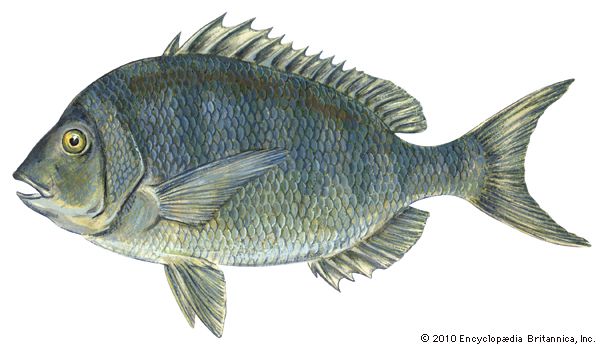
Porgies, which belong to the family Sparidae, are marine fishes characterized by their small mouths and strong teeth. These physical adaptations allow them…
What do porgy fish typically eat and how do they hunt for food?
Porgies, which belong to the family Sparidae, are marine fishes characterized by their small mouths and strong teeth. These physical adaptations allow them to consume a diet consisting of other fishes and hard-shelled invertebrates.1
While the provided information does not detail specific hunting strategies for porgies, it notes that they are generally shallow-water inhabitants found in tropical and temperate regions. Their robust dentition is specifically suited for processing their prey, particularly the hard-shelled organisms they encounter in their environment.1
What are the main characteristics of porgy fish?
Porgies, members of the family Sparidae, are marine fishes characterized by several distinct physical and ecological traits:
- Body Shape: They are typically deep-bodied, high-backed fish that resemble snappers or grunts.15
- Dentition: A defining feature is their small mouths equipped with strong teeth. Many species possess large, blunt molars along the sides of their jaws, which are specialized for crushing hard-shelled invertebrates.15
- Size: Most species remain small, typically not exceeding 30 cm (1 foot) in length, though some can grow significantly larger, reaching up to 120 cm.1
- Habitat: They are primarily shallow-water dwellers found in tropical and temperate marine environments globally.1
- Diversity: The family includes about 100 species, many of which are highly valued as food and game fish, such as the scup, the sheepshead, and the red sea bream.1
How are porgy fish important in commercial and recreational fishing?
Porgies, also known as sea breams, are highly significant in both commercial and recreational fishing due to their widespread popularity as food and game fish.1
Commercial Importance
Porgies have been a staple food source for humans since ancient times, with archaeological evidence showing they were consumed by early populations in Scotland. Today, they remain economically valuable in global commercial fisheries. Notable examples include:7
- Red Tai (Chrysophrys major): Highly prized in Japan, where it is considered the “king of sea fish” and holds significant cultural and market value.17
- Red Sea Bream (Pagellus centrodontus): A valuable species harvested in European waters.1
- Regional Varieties: Various species are commercially harvested in Australia and other temperate and tropical regions worldwide.1
Recreational Importance
Many porgy species are popular targets for sport fishing, valued for their fighting ability and quality as food.1
- Musselcrackers: In South Africa, these are popular sport fishes that can grow as heavy as 45 kg (100 pounds).1
- Western Atlantic Species: The scup and the sheepshead are both widely sought after by recreational anglers.1
Where are porgy fish typically found in the world?
Porgies, which belong to the family Sparidae, are widely distributed marine fishes typically found in shallow tropical and temperate waters across the globe.18
Their geographic presence includes:
- Atlantic Ocean: Various species inhabit the western Atlantic, such as the scup and the sheepshead, as well as the Florida coast, where the grass porgy resides in eelgrass habitats.15
- Europe: Several valuable species, including the red sea bream, are found in European waters.1
- Africa: South Africa is home to an exceptional variety of species, including the large musselcrackers.1
- Asia and Oceania: Important food species are found in Japan, such as the red tai, and in Australia, where several species are known as snappers.1
Sources
- porgy — Encyclopædia Britannica
- porgy — Merriam-Webster
- perciform - Life history — Encyclopædia Britannica
- perciform - Feeding behaviour — Encyclopædia Britannica
- Sparidae — Merriam-Webster
- sparid — Merriam-Webster
- perciform - Use as food — Encyclopædia Britannica
- grass porgy — Merriam-Webster
Published on · 2 min read
