Perciform
Perciforms (order Perciformes) are bony fishes belonging to the superorder Acanthopterygii, which represents a major evolutionary radiation of modern…
What is the evolutionary history of perciform fish?
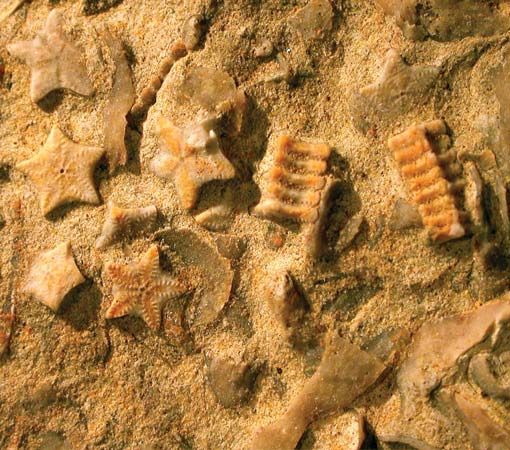
Perciforms (order Perciformes) are bony fishes belonging to the superorder Acanthopterygii, which represents a major evolutionary radiation of modern spiny-rayed fishes. Their evolutionary history is rooted in the broader development of teleosts, which first appeared in the fossil record approximately 200 million years ago.12
Perciforms are thought to have evolved from an early protacanthopterygian-like ancestor. The order is characterized by significant functional advancements, most notably the development of a mobile, protractile mouth, which is considered a key factor in their evolutionary success. Other defining traits include the presence of spiny rays in their fins, which are believed to have evolved for defense, and a pelvic fin position that enhances maneuverability.231
While fossil remains of perciforms date back to the Upper Cretaceous (100 million to 65.5 million years ago), the order is likely not monophyletic. Many suborders and families within the group have presumably evolved from a percoidlike ancestor, with some species undergoing such extensive modification that they bear little external resemblance to their generalized relatives.1
How do perciform fish interact with other species in their ecosystems?
Perciform fish interact with other species through a wide range of complex ecological relationships, including predation, mutualism, and specialized mimicry.
Predation and Food Web Dynamics
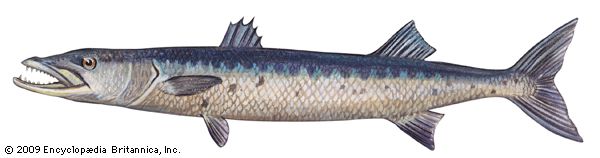
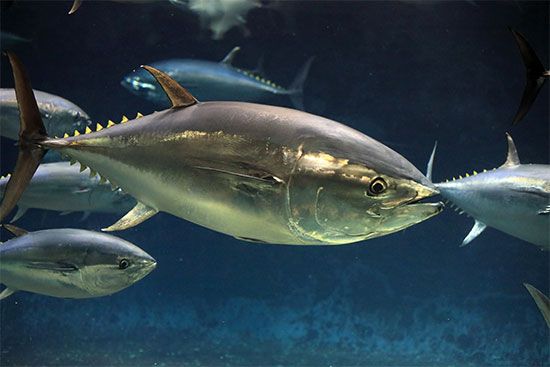
As both predators and prey, perciforms are vital to aquatic food chains. Many species, such as tunas, billfishes, and barracudas, are high-level predators that consume smaller fish, birds, and mammals. Conversely, herbivorous species like parrot fishes and damselfishes play a key role in reef ecosystems by grazing on algae and plankton. Some species exhibit highly specialized feeding strategies, such as the archer fish, which uses water jets to knock insects into the water, or the cichlid that practices lepidophagy (eating the scales of other fish).1
Mutualism and Symbiosis
Many perciforms engage in beneficial interspecific relationships:
- Cleaning Stations: Cleaner fishes (such as the wrasse Labroides) remove parasites from larger carnivores, which in turn allow the cleaners to enter their mouths and gills safely.7
- Protective Associations: Species like the clown anemone fish live among the stinging tentacles of sea anemones, protected by a special mucous coating. Similarly, young butterfishes and mackerel often seek refuge among jellyfish tentacles.7
- Commensalism: The blind goby relies entirely on burrows created by ghost shrimp for shelter.7
Mimicry
Some perciforms use mimicry to survive or hunt. For example, the sabre-toothed blenny mimics a cleaner fish to approach and bite unsuspecting prey, while others, like the leaf fish, use their appearance to blend into their surroundings, either for protection or to ambush prey.7
What is the economic and ecological importance of perciform fish?
Perciform fish (order Perciformes) hold immense significance both economically and ecologically as the largest and most diverse group of fishes globally.1
Economic Importance
Perciforms are central to global commercial fisheries, providing a vital source of protein for human populations. The order includes many of the world’s most highly valued food and game species, such as tunas, mackerels, sea basses, and billfishes. Beyond direct consumption, these fish support various industries:111
- Byproducts: Isinglass, used to clarify beverages and produce jellies, is derived from drums and threadfins.11
- Materials: The skin of wolffishes is used for leather, while guanin from the cutlass fish is utilized in manufacturing artificial pearls.11
- Aquaculture: Species like the cichlid Tilapia are widely cultivated due to their rapid growth and reproduction, offering a sustainable, low-cost protein source.11
Ecological Importance
Ecologically, perciforms are foundational to aquatic food webs across diverse habitats, from shallow freshwater ponds to deep ocean trenches. They occupy various niches, acting as top predators, herbivores, and essential components of reef biodiversity. In tropical regions, they are integral to the health of coral reefs, where they contribute to ecosystem balance through grazing and complex symbiotic relationships. However, these populations face severe threats from overfishing, ocean pollution, and ocean acidification, which destabilize marine biodiversity.1121013
What are the defining characteristics of perciform fish?
Perciform fish, belonging to the order Perciformes, represent the largest and most diverse group of bony fishes in the world, encompassing over 6,000 species across approximately 150 families. Because of this immense diversity, a single definition is difficult, though they generally share several key anatomical features.23
Defining Characteristics
- Fin Structure: Perciforms typically possess spines in their dorsal, anal, and pelvic fins. The dorsal fin is often divided into two distinct parts—one supported by spiny rays (likely for defense) and the other by soft, articulated rays—or it may feature a notch indicating two joined portions.31
- Pelvic Fin Position: The pelvic fins are usually thoracic (located ventrally below the pectoral fins), though they can sometimes be found ahead of the pectoral fins (jugular) or, occasionally, behind them. They are typically supported by one spine and five or fewer soft rays.31
- Jaw Structure: Jaws are generally protrusible, allowing for a wide variety of feeding behaviors. The premaxillary bone of the upper jaw typically excludes the maxilla from the mouth’s gape.31
- Scales and Anatomy: Scales are usually ctenoid (rough-edged with small teeth), though some are cycloid (smooth). Internally, the swim bladder is not connected to the throat by an open duct, and the skull lacks an orbitosphenoid bone.1
Sources
- perciform — Encyclopædia Britannica
- perciform - Form and function — Encyclopædia Britannica
- perciform - Annotated classification — Encyclopædia Britannica
- fish - Actinopterygii: ray-finned fishes — Encyclopædia Britannica
- perciform — Merriam-Webster
- paracanthopterygian - Evolution and paleontology — Encyclopædia Britannica
- perciform - Feeding behaviour — Encyclopædia Britannica
- perciform - Interspecific relationships — Encyclopædia Britannica
- perciform - Life history — Encyclopædia Britannica
- perciform - Distribution — Encyclopædia Britannica
- perciform - Use as food — Encyclopædia Britannica
- paracanthopterygian - General features — Encyclopædia Britannica
- conservation - Fishing — Encyclopædia Britannica
- commercial fishing - History of commercial fishing — Encyclopædia Britannica
Published on · 4 min read