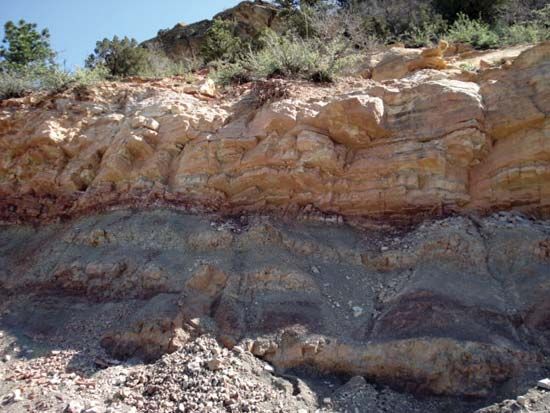
Potassium-argon Dating
Potassium-argon (K-Ar) dating is a versatile method for determining the age of rocks by measuring the decay of radioactive potassium-40 into argon-40. Unlike…
How does potassium-argon dating compare to other radiometric dating methods?
Potassium-argon (K-Ar) dating is a versatile method for determining the age of rocks by measuring the decay of radioactive potassium-40 into argon-40. Unlike other methods, it relies on the analysis of a noble gas, which requires specialized vacuum-line technology to purify and measure.12
Compared to other radiometric techniques, K-Ar dating offers unique advantages and limitations:
- Versatility and Range: K-Ar dating is highly effective for a wide range of ages, from volcanic rocks as young as 20,000 years to meteorites billions of years old.1
- Thermal Sensitivity: The method is particularly responsive to thermal events, making it useful for establishing the cooling history of geologic regions.2
- Technical Distinctions: While methods like the uranium-lead method are often considered superior for providing precise ages with fewer assumptions, K-Ar dating remains essential due to the abundance of potassium in Earth’s crust.23
- Complexity: K-Ar dating can be complicated by inherited argon or sample alteration, which may lead to inaccurate ages. Advanced variations, such as the argon-40–argon-39 method, were developed to mitigate these issues by allowing for more precise, stage-based heating analysis.2
What types of materials can be dated using the potassium-argon method?
The potassium-argon (K-Ar) dating method is used to determine the age of various rocks and minerals that contain potassium. Because potassium is one of the most abundant elements in the Earth’s crust, it is a major constituent of many common rock-forming minerals, making this method highly versatile for geological research.13
Materials commonly analyzed include:
- Volcanic Rocks: The method is frequently used to date volcanic materials, including volcanic ash, which can be dated as young as 20,000 years.13
- Igneous and Metamorphic Rocks: It is effective for dating large segments of the crust, such as geologic provinces, by identifying when they cooled and were uplifted.35
- Meteorites: K-Ar dating can be applied to extraterrestrial samples, with some meteorites dated as old as 4.5 billion years.1
- Specific Minerals: Minerals such as biotite are often studied, though researchers must account for potential inherited argon or thermal resetting that can occur during geological events.3
Because the method relies on the accumulation of radiogenic argon-40—which only begins to be trapped once a rock cools below a certain “blocking temperature”—it is particularly useful for establishing the cooling history of a region.35
What is the half-life of potassium-40, and why is this important for potassium-argon dating?
The half-life of radioactive potassium-40 is approximately 1.25 billion years (often cited as 10910^9 years in general contexts).1
This half-life is fundamental to potassium-argon dating because it provides a reliable “geologic clock” for measuring the age of rocks and minerals. Because potassium-40 decays at a uniform, known rate into argon-40, scientists can determine the age of a sample by measuring the ratio of the remaining parent isotope (potassium-40) to the accumulated daughter isotope (argon-40).56
The specific duration of this half-life makes the method exceptionally versatile, allowing researchers to date materials ranging from relatively young volcanic rocks (as recent as 20,000 years) to ancient meteorites billions of years old. Furthermore, because argon-40 is a gas that escapes from molten rock, the “clock” effectively resets when a rock cools below a specific blocking temperature (approximately 200 °C). This allows geologists to pinpoint the exact time a rock solidified or cooled during tectonic events.56
What role has potassium-argon dating played in understanding Earth’s geological history?
Potassium-argon dating has been a cornerstone of geochronology, providing essential data for reconstructing Earth’s geological history. Because potassium is a major constituent of many common rock-forming minerals, this method allows scientists to date a vast array of materials, from volcanic rocks as young as 20,000 years to ancient meteorites billions of years old.13
Key contributions to understanding Earth’s history include:
- Plate Tectonics: The method was instrumental in dating the alternating magnetic stripes of volcanic rocks along mid-oceanic ridges, providing critical evidence for the theory of seafloor spreading.3
- Crustal Evolution: By identifying when large segments of the crust cooled and were uplifted, researchers have successfully mapped distinct [geologic provinces] in ancient shield areas.3
- Thermal History: Because the method is highly sensitive to thermal events—as argon gas escapes when rock is heated—it allows geologists to establish the precise cooling history of specific regions.3
Through technical refinements like the argon-40–argon-39 method, scientists can now analyze smaller samples and account for complex geological alterations, further increasing the precision of our timeline of Earth’s past.3
Sources
- potassium-argon dating — Encyclopædia Britannica
- dating - Origin of radioactive elements used — Encyclopædia Britannica
- dating - Potassium–argon methods — Encyclopædia Britannica
- dating - Uranium–lead method — Encyclopædia Britannica
- geology - Isotopic geochemistry — Encyclopædia Britannica
- potassium - Properties, occurrence, and uses — Encyclopædia Britannica
Published on · 3 min read