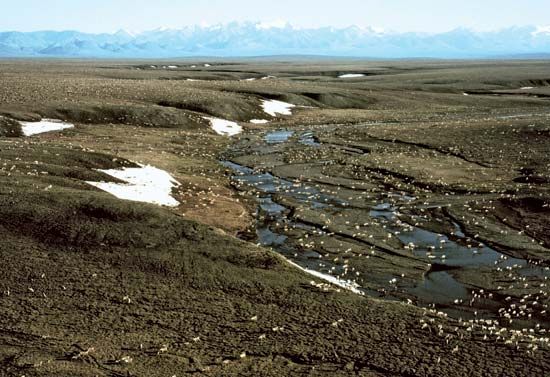
Quaternary
Scientists study the Quaternary period (approximately 2.6 million years ago to the present) by analyzing a variety of natural archives that record past…
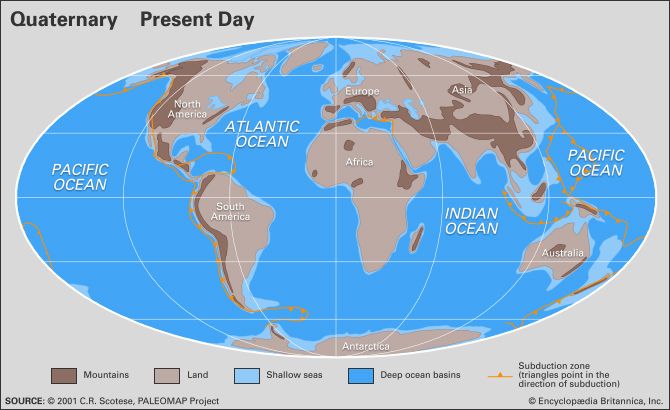
What specific geological evidence do scientists use to study the Quaternary period?
Scientists study the Quaternary period (approximately 2.6 million years ago to the present) by analyzing a variety of natural archives that record past climatic and environmental changes. Key geological and biological evidence includes:123
- Ice Cores: Extracted from ice sheets in Antarctica and Greenland, these cores provide detailed records of temperature and ice volume. They contain annual layers, dust, and trapped air bubbles that help scientists reconstruct past climates.145
- Marine Oxygen Isotope Records: By analyzing the ratio of oxygen isotopes (18O^{18}O to 16O^{16}O) in the calcium carbonate shells of microfossils found in deep-sea sediment cores, researchers can track global ice volume and temperature fluctuations over time.456
- Glacial Landforms and Sediments: Features such as moraines, drumlins, and eskers provide physical evidence of the extent and movement of past ice sheets.7
- Palynology: The study of fossilized pollen and spores found in sedimentary rocks and bogs allows scientists to reconstruct past vegetation patterns and regional climates.38
- Volcanic Ash: Distinctive ash layers serve as “instantaneous” marker horizons that can be chemically identified and dated using radiometric techniques like potassium-argon dating, helping to correlate records across different locations.5
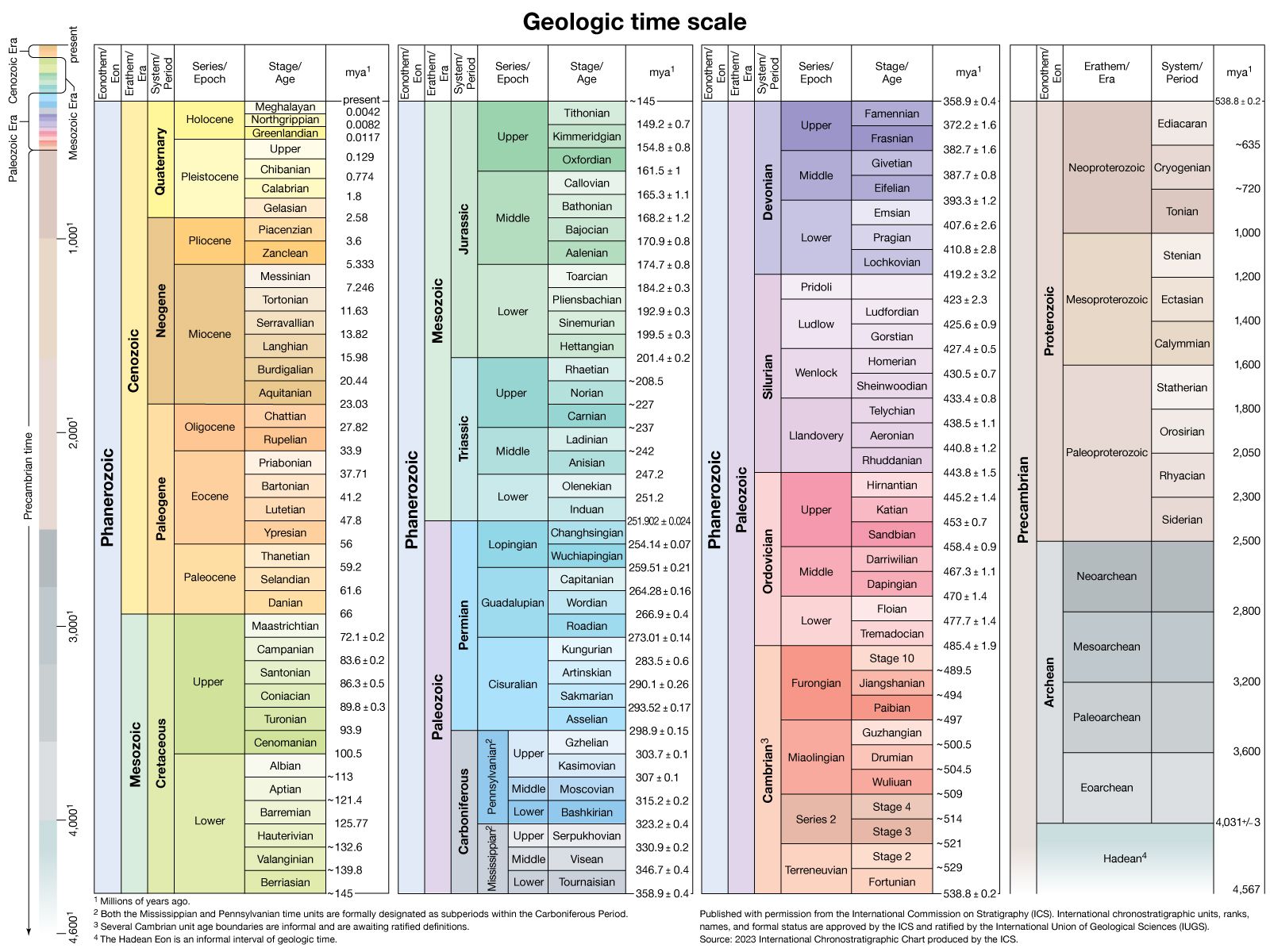
What are some key fossil discoveries from the Quaternary period?
The Quaternary period, spanning from approximately 2.6 million years ago to the present, is characterized by a fossil record featuring many species identical or similar to modern forms, alongside several iconic extinct giants.9
Notable Megafauna
The Pleistocene epoch is particularly recognized for the phenomenon of mammalian gigantism. Many of these large animals were adapted to cold tundra environments or open grasslands. Key examples include:9
- Mammoths and Mastodons: The woolly mammoth and mastodon are among the most famous, with the former displaying heavy fur for cold-climate survival.9
- Predators: The sabre-toothed cat, dire wolf, American lion, and the giant short-faced bear are prominent extinct carnivores.9
- Other Herbivores: The fossil record includes the woolly rhinoceros, cave bear, giant beaver, giant sloth, and stag-moose.9
Plant Fossils and Correlation
While large animals capture public interest, plant fossils—specifically pollen—are essential tools for Quaternary scientists. Because pollen is nearly indestructible when preserved in lake and bog sediments, it serves as a diagnostic indicator of past humidity and temperature shifts. These fossil assemblages allow researchers to track vegetation changes, such as the transition from boreal to warmer climates during the early Holocene.9
Human Evolution
The Quaternary also encompasses the rise of modern humans. Fossil evidence of the genus Homo, including Homo habilis and Homo erectus, provides insight into the evolution of increased cranial capacity and the development of human characteristics over the last two million years.2
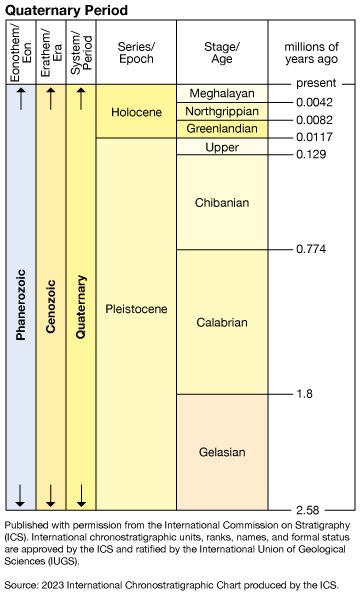
What major evolutionary and migration events occurred during the Quaternary period?
The Quaternary period (2.6 million years ago to the present) has been defined by dramatic climatic fluctuations, including repeated glacial and interglacial cycles, which profoundly influenced the evolution and migration of life-forms, particularly mammals and humans.31516
Evolutionary Developments
Evolutionary changes during this period were most significant among mammals, often driven by shifting climates, mountain building, and the emergence of new land bridges. Many species adapted to cold, periglacial environments, leading to the development of large-bodied forms such as the woolly mammoth and woolly rhinoceros.15
The most notable biological development was the rise of the genus Homo. Early species like H. habilis and H. erectus evolved in Africa and eventually spread across the Old World. Anatomically modern humans, H. sapiens, emerged in Africa approximately 315,000 years ago.151718
Migration and Expansion
Human migration was heavily influenced by changing sea levels and glacial retreats. Key migration events include:15
- Out of Africa: Successive waves of Homo species migrated out of Africa into Eurasia. H. sapiens began a major global expansion between 100,000 and 50,000 years ago, eventually replacing indigenous archaic human populations.1718
- Peopling of the Americas: Humans migrated from Siberia to Alaska via the Bering land bridge at least 30,000 years ago, with further southward expansion occurring as glacial corridors opened.1519
- Maritime Expansion: As sea levels dropped during glacial periods, humans utilized watercraft to populate regions such as Australia and various oceanic islands.1718
How have sea level changes during the Quaternary period affected Earth’s geography?
During the Quaternary period, Earth’s geography underwent significant transformations driven by the continuous, large-scale fluctuation of sea levels in response to glacial and interglacial cycles.2627
Impacts of Sea Level Fluctuations
- Exposure of Continental Shelves: During glacial maximums, such as 18,000 years ago, sea levels dropped by as much as 120 metres (390 feet). This exposed vast areas of the continental shelves, increasing global land area by approximately 18 percent—an expanse equivalent to the combined size of Europe and South America.27
- Formation of Land Bridges: The lowering of sea levels created critical land bridges that connected previously isolated landmasses. The most prominent was Beringia, which linked Siberia and Alaska, serving as a primary route for the migration of plants, animals, and early humans into the Americas. Similar connections narrowed or closed waterways in Southeast Asia and between Britain and continental Europe.262827
- Coastal Submergence and Estuaries: As glaciers melted during interglacial periods, rising seas inundated these shelf areas. This process transformed former river valleys into major estuaries, such as the Chesapeake Bay, and submerged coastal environments that are now largely hidden beneath the ocean.2627
- Tectonic and Isostatic Adjustments: In regions undergoing tectonic uplift, such as New Guinea and Barbados, ancient shorelines remain exposed as terraces, providing a vital record of past sea-level highstands. Conversely, areas once burdened by massive ice sheets experienced isostatic rebound, where the land rose as the weight of the ice was removed, creating distinct “marine limit” shorelines at high elevations.2629
Sources
- Climate change - Evidence for climate change — Encyclopædia Britannica
- Quaternary - Paleoclimate — Encyclopædia Britannica
- A Journey Through Time Since the Precambrian - Quaternary Period: 2.6 million years ago to the present — Encyclopædia Britannica
- Quaternary - Landforms — Encyclopædia Britannica
- Quaternary - Correlation of Quaternary deposits — Encyclopædia Britannica
- palynology — Encyclopædia Britannica
- pollen analysis — Merriam-Webster
- Pleistocene Epoch - Marine oxygen isotope record — Encyclopædia Britannica
- Quaternary - Fauna and flora — Encyclopædia Britannica
- Homo erectus - Theories of punctuated change — Encyclopædia Britannica
- Earth sciences - Micropaleontology — Encyclopædia Britannica
- evolution - The fossil record — Encyclopædia Britannica
- Pliocene Epoch — Encyclopædia Britannica
- Quaternary - Types of Quaternary sediments — Encyclopædia Britannica
- Pleistocene Epoch - Evolutionary changes — Encyclopædia Britannica
- South American Indian - The prehistoric period — Encyclopædia Britannica
- Quaternary - Glaciation — Encyclopædia Britannica
- Australopithecus - Transition to Homo — Encyclopædia Britannica
- Climate change - Climate change since the advent of humans — Encyclopædia Britannica
- Homo habilis - Dating the fossils — Encyclopædia Britannica
- Global warming - Climatic variation since the last glaciation — Encyclopædia Britannica
- human evolution - The emergence of Homo sapiens — Encyclopædia Britannica
- mammal - Diversity — Encyclopædia Britannica
- Homo sapiens - Bodily structure — Encyclopædia Britannica
- mammal — Encyclopædia Britannica
- Pleistocene Epoch - Coastal environments and sea-level changes — Encyclopædia Britannica
- Beringia — Encyclopædia Britannica
- Quaternary - Sea-level changes — Encyclopædia Britannica
- Holocene Epoch - Continental shelf and coastal regions — Encyclopædia Britannica
- Silurian Period - Silurian sea level — Encyclopædia Britannica
- paleoceanography — Encyclopædia Britannica
Published on · 4 min read