uranium-234–uranium-238 Dating
Uranium-234–uranium-238 dating is a method of age determination that utilizes the radioactive decay of uranium-238 into uranium-234. This technique is…
What is uranium-234–uranium-238 dating?
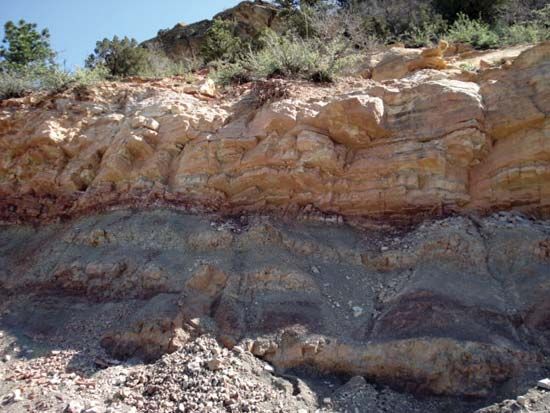
Uranium-234–uranium-238 dating is a method of age determination that utilizes the radioactive decay of uranium-238 into uranium-234. This technique is primarily used to date sediments found in marine or playa lake environments.1
The method is effective for determining the age of samples ranging from approximately 100,000 to 1,200,000 years before the present. By covering this specific timeframe, it serves as a valuable bridge between the carbon-14 dating method, which is typically used for more recent history, and the potassium-argon dating method, which is used for much older geological materials.1
This process is a form of uranium-series disequilibrium dating, which relies on the fact that intermediate isotopes in a decay chain can become isolated in certain minerals, allowing researchers to measure the time elapsed since that isolation occurred.2
How does radioactive decay work in the uranium series?
Radioactive decay in the uranium series is a complex, multistep process rather than a single transition. Because uranium-238 has an extremely long half-life of approximately 4.5 billion years, it serves as the parent isotope that continuously feeds a chain of shorter-lived radioactive daughter products.63
The Decay Chain Process
The transformation from uranium to its ultimate stable end product, lead-206, involves the emission of eight alpha particles and six beta particles. During this sequence:7
- Successive Decays: Each intermediate daughter nucleus is itself radioactive and will eventually decay into the next element in the series.6
- Steady State: In a closed system, these elements exist in a state of equilibrium, where the rate of formation for each isotope matches its rate of decay. Consequently, isotopes with longer half-lives are more abundant than those with shorter ones.78
- Disruption: When geological processes—such as the weathering of minerals—cause these elements to separate, the equilibrium is disrupted. This state of “disequilibrium” allows scientists to use the relative amounts of these isotopes to date geologically young materials.78
This series is essential for understanding natural radioactivity, as it continuously produces elements like radium and radon within the Earth’s crust.6
What is the difference between carbon-14 dating and uranium-series dating?
Carbon-14 dating and uranium-series dating are both essential tools for geochronology, but they differ significantly in their mechanisms, applicable timeframes, and the materials they analyze.
Key Differences
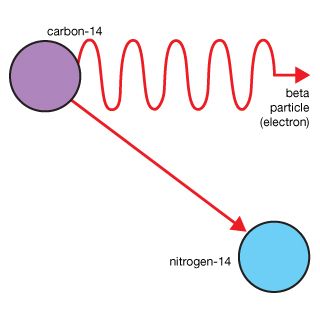
- Mechanism: Carbon-14 dating is a cosmogenic method that relies on the decay of radioactive carbon-14, which is produced in the atmosphere by cosmic-ray bombardment and incorporated into living organisms through the carbon cycle. In contrast, uranium-series dating is a form of disequilibrium dating that utilizes the decay chains of uranium and thorium. It measures the buildup of intermediate daughter isotopes that become isolated in minerals when chemical or geological processes disrupt their natural equilibrium.193
- Timeframe: Carbon-14 dating is typically effective for organic materials up to approximately 60,000 years old. Uranium-series dating covers a different range; for example, uranium-234–uranium-238 dating is useful for samples between 100,000 and 1,200,000 years old, effectively bridging the gap between carbon-14 and older methods like potassium-argon dating.18
- Materials: Carbon-14 is used primarily for biogenic carbon and calcium carbonate. Uranium-series methods are applied to a variety of inorganic materials, such as coral, carbonate deposits, and marine sediments.93
Why is it difficult to date very young geologic materials?
Dating very young geologic materials is challenging primarily because traditional radiometric methods, which rely on long-lived radioactive isotopes, are often unsuitable for these timeframes.12
The Challenge of Young Materials
- Insufficient Daughter Products: Methods that use long-lived isotopes (such as uranium-lead dating) are designed to measure the accumulation of daughter atoms over millions or billions of years. In very young samples, the amount of daughter isotope produced is extremely small, making it difficult to measure with the necessary precision.912
- Sensitivity Limits: While modern mass spectrometers have improved the ability to detect trace amounts of isotopes, the inherent scarcity of daughter products in young samples remains a significant hurdle for standard long-lived isotopic systems.1213
Alternative Approaches
To overcome these limitations, geochronologists use methods specifically suited for recent events:
- Uranium-Series Disequilibrium: This technique utilizes the decay chains of uranium and thorium, which include isotopes with shorter half-lives. By measuring the state of disequilibrium—where the natural balance of these isotopes has been disrupted—scientists can date materials like coral and sediments.12
- Cosmogenic Isotopes: Methods such as carbon-14 dating or the use of isotopes like beryllium-10 and krypton-81 are effective for dating events that occurred within the past few thousand to a few million years, as these isotopes are produced by cosmic-ray bombardment.1412
Sources
- uranium-234–uranium-238 dating — Encyclopædia Britannica
- dating - Lead-210 dating — Encyclopædia Britannica
- dating - Origin of radioactive elements used — Encyclopædia Britannica
- dating - Double uranium-lead chronometers — Encyclopædia Britannica
- uranium-thorium-lead dating — Encyclopædia Britannica
- atom - Radioactive decay — Encyclopædia Britannica
- uranium — Encyclopædia Britannica
- dating - Uranium-series disequilibrium dating — Encyclopædia Britannica
- dating - Carbon-14 dating and other cosmogenic methods — Encyclopædia Britannica
- dating - Uranium–lead method — Encyclopædia Britannica
- dating - Fission-track dating — Encyclopædia Britannica
- dating: Top Questions — Encyclopædia Britannica
- dating - Distinctions between relative-age and absolute-age measurements — Encyclopædia Britannica
- dating - Principles of isotopic dating — Encyclopædia Britannica
- dating - Analysis of separated minerals — Encyclopædia Britannica
Published on · 3 min read