Rhenium–osmium Dating
Rhenium–osmium dating is a geochronological method used to determine the age of specific minerals, most notably molybdenite (molybdenum disulfide, MoS22).…
What is rhenium–osmium dating?
Rhenium–osmium dating is a geochronological method used to determine the age of specific minerals, most notably molybdenite (molybdenum disulfide, MoS2_2). The technique relies on the radioactive decay of rhenium-187 into osmium-187.12
While the rhenium–osmium ratio is generally too low in most minerals for effective dating, molybdenite possesses a uniquely high ratio, and the osmium found within it is almost entirely radiogenic osmium-187. Because both elements are siderophilic and chalcophilic, this method is particularly valuable for studying the origin and age of sulfide ore deposits, as well as investigating mantle–crust evolution.12
Using this approach, researchers have successfully dated ores ranging from approximately 38 million to 3 billion years old. Due to the extremely low concentration of osmium in the crust, the method is most effective when applied to minerals specifically enriched in rhenium or osmium.12
What is the difference between absolute and relative dating in geology?
In geology, the distinction between relative and absolute dating lies in how they measure the timing of Earth’s history.
Relative Dating
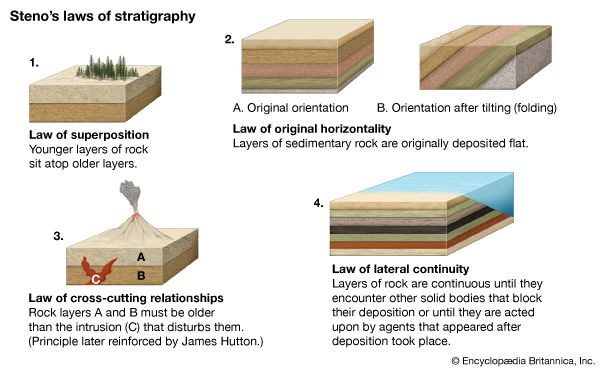
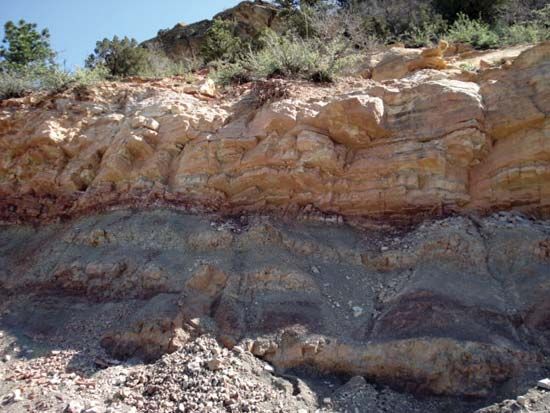
Relative dating determines the chronological order of past events without assigning a specific numerical age. It relies on logical observation and principles such as the law of superposition, which states that in an undisturbed sequence of sedimentary rock, the oldest layers are at the bottom and the youngest are at the top. Other methods include analyzing fossil content and crosscutting relationships, where features like dikes or faults are identified as younger than the rock units they penetrate. This approach requires no specialized equipment and is essential for establishing the sequence of geologic events.456
Absolute Dating
Absolute dating provides numerical ages for rocks and events, typically expressed in years. This method utilizes sophisticated laboratory techniques to measure the decay of radioactive isotopes within minerals. By calculating the ratio of parent atoms to daughter atoms, geochronologists can determine the time elapsed since a rock-forming event. While relative dating provides the sequence, absolute dating calibrates this timeline, allowing scientists to quantify Earth’s history back to its oldest known rocks.475
How do scientists determine the half-life of a radioactive isotope?
Scientists determine the half-life of a radioactive isotope using various methods depending on the duration of the decay process:
- Short to Moderate Half-lives (Seconds to Years): Researchers measure the intensity of radiation at successive intervals. By plotting the logarithm of the decay rate against time, they fit a straight line to the data. The time required for this decay curve to decrease by a factor of two is identified as the half-life.9
- Very Short Half-lives (100 microseconds to one nanosecond): These are measured using electronic coincidence experiments. A “start” pulse is triggered when the radioactive species is formed, and a “stop” pulse is triggered when it decays. The distribution of these time intervals is plotted to determine the half-life from the slope of the resulting line.9
- Long Half-lives (Years or longer): Because the decrease in activity is too slow to measure over a reasonable period, scientists measure the specific activity of a known mass of the isotope. By determining the disintegration rate (D) and the number of nuclei (N) present, they calculate the decay constant (λ\lambda), which is then used to find the half-life (T1/2=0.693/λT_{1/2} = 0.693/\lambda).109
What are some other common methods used to date rocks and minerals?
Beyond the methods previously discussed, scientists employ a variety of isotopic and analytical techniques to date rocks and minerals. These methods rely on the decay of long-lived radioactive isotopes or the physical evidence of radioactive processes.
Common Isotopic Dating Methods
- Uranium–lead dating: Considered highly reliable because it utilizes two separate uranium-lead chronometers (based on the decay of uranium-235 and uranium-238). This allows researchers to use a “concordia diagram” to verify if a sample has remained a closed system, meaning no daughter isotopes have leaked out over time.17
- Potassium-argon dating: This method measures the ratio of radioactive argon-40 to potassium-40. It is particularly useful for dating a wide range of materials, from meteorites billions of years old to volcanic rocks as young as 20,000 years.18
- Rubidium–strontium and Samarium–neodymium methods: These are often used as isochron methods to date various igneous and metamorphic rocks.19
- Fission-track dating: Instead of measuring isotope ratios, this technique counts the microscopic “tracks” or damage left in minerals by the spontaneous fission of uranium-238. By comparing these natural tracks to those induced by laboratory irradiation, scientists can determine the age of the sample.12
Analytical Advances
Modern geochronology also utilizes high-precision instruments to analyze samples:
- Mass spectrometry: Techniques like isotope dilution allow for the analysis of extremely small samples by adding a known “spike” of isotopes to the material.20
- In-situ analysis: Tools like the sensitive high-resolution ion microprobe (SHRIMP) and laser ablation (LA-ICP-MS) allow scientists to date specific spots on a mineral grain without dissolving the entire sample, providing spatial resolution that can distinguish between different stages of crystal growth.20
Sources
- rhenium–osmium dating — Encyclopædia Britannica
- dating - Rhenium–osmium method — Encyclopædia Britannica
- rhenium — Encyclopædia Britannica
- dating: Top Questions — Encyclopædia Britannica
- dating - Uranium–lead method — Encyclopædia Britannica
- dating - Distinctions between relative-age and absolute-age measurements — Encyclopædia Britannica
- dating - Determination of sequence — Encyclopædia Britannica
- geochronology — Encyclopædia Britannica
- decay constant — Encyclopædia Britannica
- half-life — Encyclopædia Britannica
- radioactivity — Encyclopædia Britannica
- dating - Origin of radioactive elements used — Encyclopædia Britannica
- dating - Principles of isotopic dating — Encyclopædia Britannica
- radioactivity - Calculation and measurement of energy — Encyclopædia Britannica
- radioactivity - Measurement of half-life — Encyclopædia Britannica
- chemical kinetics - The half-life — Encyclopædia Britannica
- potassium-argon dating — Encyclopædia Britannica
- fission-track dating — Encyclopædia Britannica
- carbon-14 dating — Encyclopædia Britannica
- dating - Technical advances — Encyclopædia Britannica
- dating - Double uranium-lead chronometers — Encyclopædia Britannica
Published on · 4 min read