Condensation Nucleus
A condensation nucleus is a tiny suspended particle, such as dust, soil, or sea salt, that serves as an essential initiation site for water vapour to…
What is Condensation nucleus?
A condensation nucleus is a tiny suspended particle, such as dust, soil, or sea salt, that serves as an essential initiation site for water vapour to condense in the atmosphere.123
In the atmosphere, water vapour typically requires these aerosol particles to transition into liquid droplets or ice crystals. Without these nuclei, air would need to be highly supersaturated—often reaching relative humidities well above 100 percent—to trigger spontaneous condensation, a process known as homogeneous nucleation. By providing a surface, these particles significantly reduce the amount of supersaturation required for cloud formation.43
These nuclei are ubiquitous and originate from both natural sources, such as wave action over oceans and forest fires, and human activities, including industrial pollution. While smaller particles like Aitken nuclei exist, they are generally less effective at inducing condensation under typical atmospheric conditions. Larger, hygroscopic (moisture-attracting) particles, such as sea salt, are particularly efficient at facilitating this process.145
What are ice nuclei and how do they differ from condensation nuclei?
Ice nuclei are specialized aerosols that facilitate the conversion of water vapour into ice crystals. While both ice nuclei and cloud condensation nuclei serve as initiation sites for phase changes in the atmosphere, they differ significantly in their physical properties and availability.3
Key Differences
- Affinity for Water: Condensation nuclei are typically hygroscopic (water-attracting) and effective at low supersaturation levels. In contrast, the most effective ice nuclei are hydrophobic (having a low affinity for water) and possess a molecular structure similar to that of ice.3
- Availability: Condensation nuclei are ubiquitous in the atmosphere. Ice nuclei are often scarce, which allows liquid water to remain in a supercooled state well below 0 °C (32 °F).3
- Mechanism: Condensation nuclei facilitate the transition of vapour to liquid. Ice nuclei function through three specific processes: deposition (vapour to ice), contact (touching a droplet), or freezing (acting from inside a droplet).3
Examples of condensation nuclei include sodium chloride, while ice nuclei include clay minerals like kaolinite and certain bacteria. In cloud seeding, substances like silver iodide are used to compensate for the natural scarcity of ice nuclei.3
How does air pollution affect the concentration of condensation nuclei?
Air pollution significantly increases the concentration of condensation nuclei in the atmosphere, directly impacting cloud formation and regional climate patterns.56
Impact of Pollution on Nuclei Concentration
While clean maritime air may contain only a few particles per cubic centimetre, the air over industrial cities can hold up to 1 million particles per cubic centimetre. This surge in concentration is primarily driven by human activities, including:5
- Combustion Processes: The burning of fossil fuels and biomass releases significant amounts of particulate matter, such as soot and fly ash, which serve as effective condensation nuclei.51
- Chemical Precursors: Industrial emissions of sulfur dioxide and ammonia react in the atmosphere to form sulfate and nitrate aerosols, which are highly efficient at facilitating condensation.57
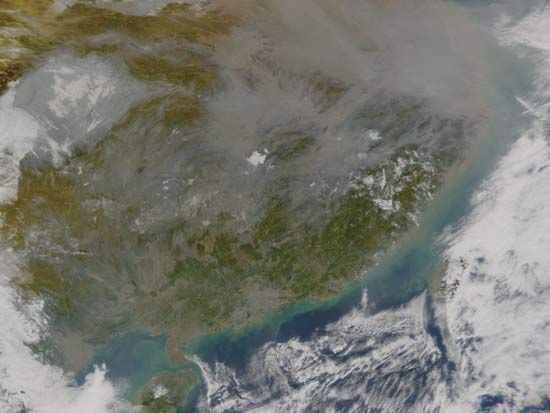
- Urbanization: Rapid industrial development has led to the formation of atmospheric brown clouds, which contain dense mixtures of these anthropogenic aerosols.1
Climatic Consequences
By increasing the number of available nuclei, air pollution modifies cloud properties, often leading to an “aerosol indirect effect”. These additional nuclei can change the brightness and lifetime of clouds, which influences the albedo of a region and can lead to surface “dimming”. Furthermore, these changes in cloudiness and radiation can disrupt regional hydrological cycles, such as altering monsoon rainfall patterns.716
What is the process of cloud seeding?
Cloud seeding is the deliberate introduction of substances into clouds to act as condensation nuclei or ice nuclei in an attempt to induce or modify precipitation in an attempt to induce or modify precipitation.10
The Process
The method varies depending on the temperature and state of the cloud:
- Supercooled Clouds: These clouds consist of water droplets at temperatures below freezing that remain liquid due to their purity. Seeding introduces ice nuclei, such as silver iodide or dry ice, which cause the droplets to freeze into ice crystals. These crystals then grow by attracting surrounding water droplets, eventually becoming heavy enough to fall as rain or snow.910
- Warm Clouds: In clouds with temperatures above freezing, materials like sodium chloride or calcium chloride are used. These particles act as condensation nuclei, encouraging the formation of larger droplets that grow through coalescence and fall as rain.910
Delivery Methods
Seeding agents are dispersed using various technologies, including:
- Aircraft: Dispensing materials directly into or above clouds.910
- Ground-based Generators: Releasing particles that are carried into clouds by air currents.910
- Rockets and Artillery: Firing projectiles that explode at specific altitudes to disperse the seeding agents.910
While the practice is used to increase water supplies and snowpacks or suppress hail, its effectiveness remains a subject of scientific debate, as results are highly dependent on specific atmospheric conditions.1011
Sources
- Condensation nucleus — Encyclopædia Britannica
- condensation nucleus — Merriam-Webster
- Atmosphere - Condensation — Encyclopædia Britannica
- hydrosphere - Water vapour and precipitation — Encyclopædia Britannica
- Climate - Cloud formation — Encyclopædia Britannica
- Global warming - Aerosols — Encyclopædia Britannica
- Climate - Cloud condensation nuclei — Encyclopædia Britannica
- Atmospheric brown cloud — Encyclopædia Britannica
- weather modification - Cloud seeding — Encyclopædia Britannica
- Cloud seeding — Encyclopædia Britannica
- weather modification - Precipitation modification — Encyclopædia Britannica
Published on · 4 min read