Psittacosaurus
Psittacosaurus is a genus of primitive, plant-eating horned dinosaurs that lived during the Early Cretaceous Period, approximately 100 million to 122 million…
What is Psittacosaurus?
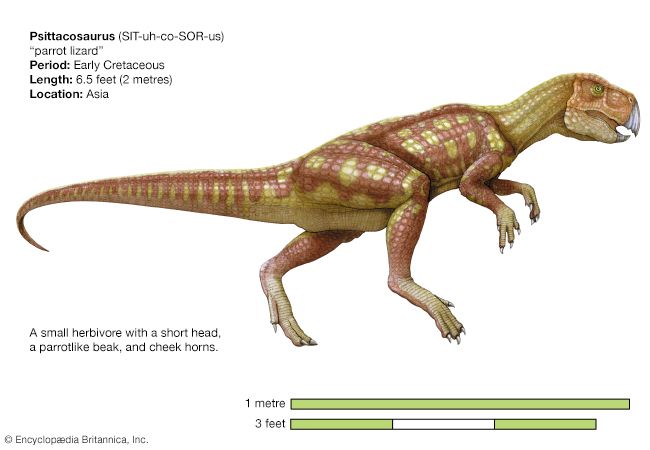
Psittacosaurus is a genus of primitive, plant-eating horned dinosaurs that lived during the Early Cretaceous Period, approximately 100 million to 122 million years ago. Fossils of these creatures have been discovered in Mongolia and China.1
Measuring about 2 meters (6.5 feet) in length, Psittacosaurus was primarily bipedal. It is a member of the Psittacosauridae family and is distinguished by a high, narrow skull featuring a small, unique bone called a rostral that forms an upper beak. This beak curved over the lower jaw, resembling that of a parrot—the source of the dinosaur’s name. Unlike its later, more famous relatives such as Triceratops, Psittacosaurus lacked horns and possessed only a small frill.12
How did the rostral bone help Psittacosaurus eat?
The rostral bone was a defining diagnostic feature of the ceratopsian group, including Psittacosaurus. This unique, toothless bone formed the upper portion of the dinosaur’s beak, which curved over the lower jaw—a structure similar to that of a modern parrot.34
While the rostral bone itself was toothless, it functioned in opposition to the predentary bone located in the lower jaw. Together, these structures created a stout, beaklike apparatus that allowed the animal to effectively grasp and process its food. In more advanced ceratopsians, this specialized jaw system evolved to support powerful batteries of teeth that operated like self-sharpening shears, enabling the dinosaurs to consume tough, fibrous vegetation such as the fronds of palms or cycads.3
What are the main differences between Psittacosaurus and Triceratops?
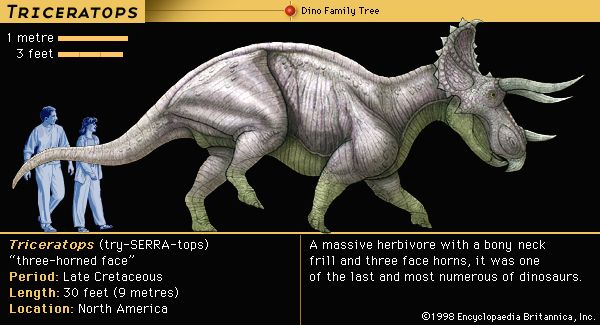
Psittacosaurus and Triceratops represent two distinct evolutionary stages within the ceratopsian group. Their primary differences are summarized below:
Feature
Psittacosaurus
Triceratops
Time Period
Early Cretaceous
Late Cretaceous
Geography
Asia (Mongolia and China)
North America
Locomotion
Mostly bipedal
Obligate quadruped
Size
Small (approx. 2 meters long)
Large (up to 9 meters long)
Horns
Absent
Present (three horns)
Frill
Small, primitive
Large, solid, and short
Key Evolutionary Distinctions
- Body Form: Psittacosaurus is considered a primitive, basal ceratopsian. It retained a bipedal stance with relatively long hind limbs and short front limbs. In contrast, Triceratops was a massive, heavy-bodied quadruped with a graviportal stance designed to support its significant weight.23
- Skull and Defense: While both possess the diagnostic rostral bone (a toothless upper beak), Triceratops evolved highly specialized features for defense and combat, including prominent horns and a massive neck shield. Psittacosaurus lacked these structures, possessing only the beginnings of a neck frill.23
- Dietary Specialization: Triceratops utilized advanced dental batteries that functioned like self-sharpening shears to process tough, fibrous vegetation, a more specialized system than that of the earlier Psittacosaurus.3
Why were some ceratopsians bipedal while others were quadrupedal?
The transition from bipedalism to quadrupedalism in ceratopsians was driven by significant changes in body size, skull anatomy, and defensive requirements as these dinosaurs evolved.3
Bipedal Origins
The most basal ceratopsians, such as Psittacosaurus, were bipedal. They possessed relatively long hind limbs and short front limbs, a body form that closely resembled typical ornithopods. This bipedal stance was a primitive trait inherited from their ancestors.3
The Shift to Quadrupedalism
As ceratopsians evolved into more advanced forms, they became obligate quadrupeds. This shift was largely necessitated by the following factors:
- Increased Body Mass: Advanced ceratopsids, such as Triceratops, grew to massive sizes, reaching weights of several tons. Their heavy, ponderous builds required a four-legged stance to support their weight.3
- Skull Size and Combat: The ceratopsian skull became disproportionately large, often featuring elaborate frills and horns. A quadrupedal posture provided a stable, wide base for these animals to carry their heavy heads, direct their horns toward opponents during combat, and resist attacks.3
- Mixed Posture: While advanced ceratopsians were quadrupeds, their front legs often projected to the sides in a “push-up” position, while the hind legs were held vertically. This unique stance kept the head low to the ground, which may have been an adaptation for feeding or defensive displays.3
Sources
- Psittacosaurus — Encyclopædia Britannica
- ceratopsian — Encyclopædia Britannica
- dinosaur - Ceratopsia — Encyclopædia Britannica
- Protoceratops — Encyclopædia Britannica
- human evolution - The anatomy of bipedalism — Encyclopædia Britannica
Published on · 3 min read