Puerto Rico Trench
The Puerto Rico Trench is a significant submarine depression located in the North Atlantic Ocean, situated approximately 75 miles (120 km) north of the…
What is Puerto Rico Trench?
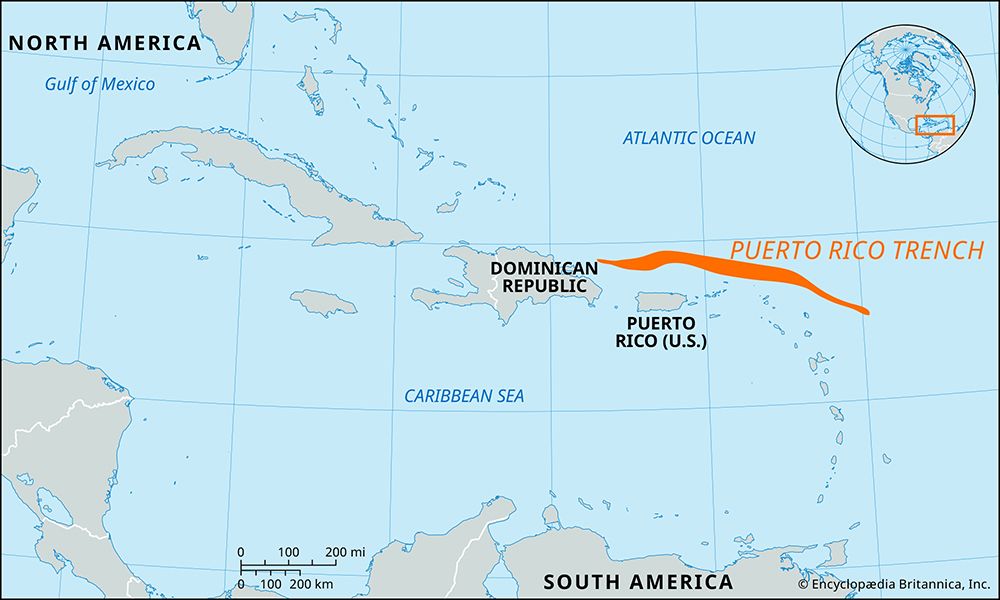
The Puerto Rico Trench is a significant submarine depression located in the North Atlantic Ocean, situated approximately 75 miles (120 km) north of the island of Puerto Rico.1
Spanning about 1,090 miles (1,750 km) in length and 60 miles (100 km) in width, the trench is notable for containing the deepest point in the Atlantic Ocean, known as the Milwaukee Depth, which reaches 27,493 feet (8,380 metres). Geologically, the trench originated at the start of the Cenozoic Era and is associated with a complex system of strike-slip faults in the northern Caribbean region. It has remained open for roughly 70 million years and is characterized by being partially filled with sediments.1
What is the Milwaukee Depth?
The Milwaukee Depth is the deepest point in the Atlantic Ocean, reaching a depth of 27,493 feet (8,380 meters).23
Located approximately 100 miles (160 km) northwest of Puerto Rico, this point sits within the Puerto Rico Trench at the southern edge of the North American Basin. It is situated between the Puerto Rico Ridge to the north and the North Antillean Arc to the south, resting about 7,000 feet (2,100 meters) deeper than the surrounding basin floors.2
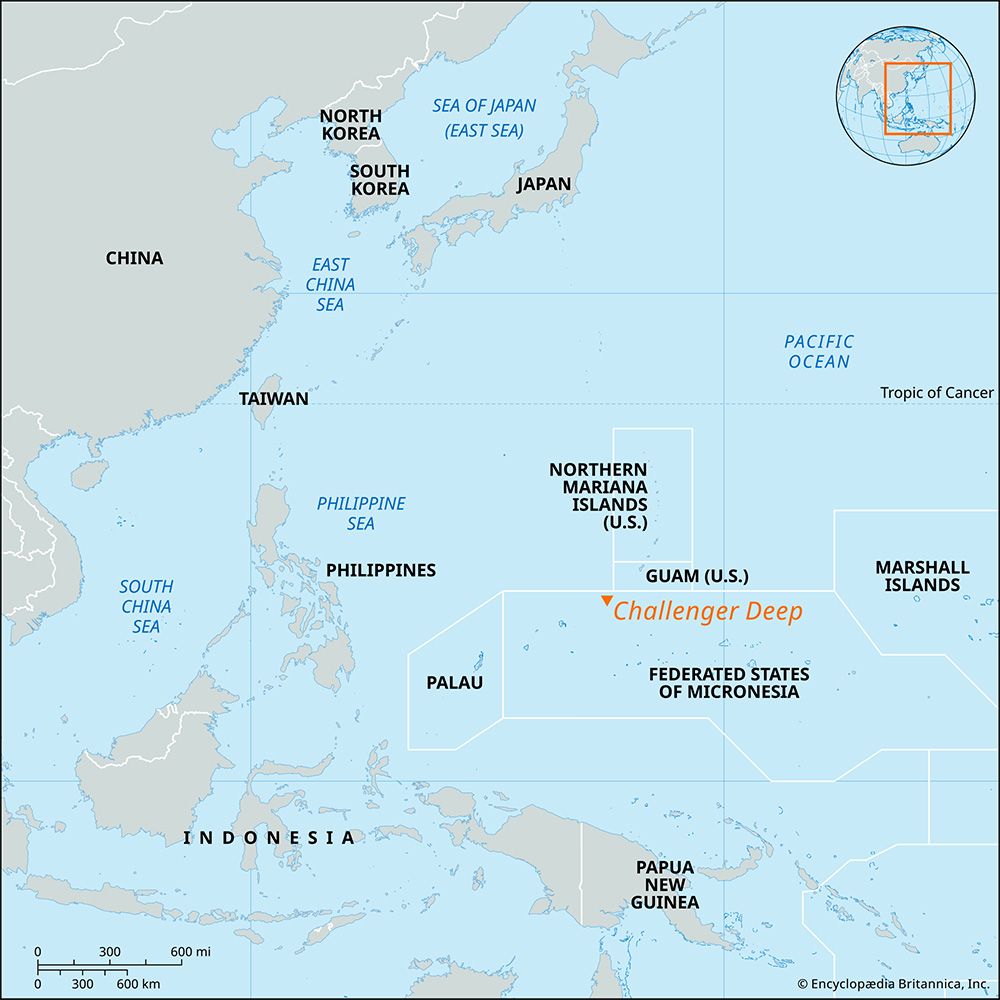
The area is named after the first ship that sounded it, and its floor is composed of a mixture of mud, sand, rock, and shells. While the Milwaukee Depth is the most profound point in the Atlantic, it is significantly shallower than the Challenger Deep in the Mariana Trench, which is the deepest point in the world’s oceans.23
How do tectonic plates create ocean trenches?
Ocean trenches are created through a process called subduction, which occurs at convergent plate boundaries where two tectonic plates collide.45
When a dense oceanic crust plate meets another plate—either another oceanic plate or a continental crust plate—the older, denser plate is forced downward into the Earth’s upper mantle. This descent is driven by gravity and is facilitated by the plate’s increasing density as it cools and ages.675
The formation of the trench involves several key mechanisms:
- Frictional Drag: As the descending plate bends and slides beneath the overriding plate, frictional drag creates a deep, V-shaped topographic depression.45
- Accretionary Wedge: The overriding plate often scrapes sediments and rock off the top of the subducting plate, forming a chaotic mixture of deformed material known as an accretionary wedge within the trench.5
- Volcanic Activity: As the subducting slab reaches depths of about 100 km (60 miles), it releases volatile components that trigger melting in the mantle above it. This produces magma, which rises to form volcanic arcs or island arcs parallel to the trench.8
What are strike-slip faults?
A strike-slip fault is a type of geological fracture in the Earth’s crust where rock masses slide past one another horizontally, parallel to the fault’s strike.1212
Key characteristics include:
- Movement: The fault plane is essentially vertical, and the relative displacement is lateral. These faults are classified as either “right-lateral” or “left-lateral,” depending on the direction the block on the opposite side of the fault moves relative to an observer.1314
- Formation: While caused by horizontal compression, these faults release energy through displacement that occurs almost parallel to the compressional force.1312
- Occurrence: They are widespread and frequently found at the boundaries where tectonic plates converge obliquely.1312
- Examples: The San Andreas Fault and the Anatolian Fault are prominent terrestrial examples, both of which have been the sites of significant earthquakes.1312
Because these faults often experience sudden, spasmodic slips rather than continuous movement, they are frequent sources of seismic activity.1412
Sources
- Puerto Rico Trench — Encyclopædia Britannica
- Milwaukee Depth — Encyclopædia Britannica
- Which ocean is deeper: The Atlantic or the Pacific? — Encyclopædia Britannica
- How was the Mariana Trench formed? — Encyclopædia Britannica
- subduction zone — Encyclopædia Britannica
- continental crust — Encyclopædia Britannica
- deep-sea trench - Types — Encyclopædia Britannica
- plate tectonics - Island arcs — Encyclopædia Britannica
- plate tectonics - Subduction zones — Encyclopædia Britannica
- plate tectonics - Discovery of ocean basin features — Encyclopædia Britannica
- plate tectonics - Sea level — Encyclopædia Britannica
- strike-slip fault — Encyclopædia Britannica
- earthquake - Tectonics — Encyclopædia Britannica
- fault — Encyclopædia Britannica
Published on · 3 min read