Mariana Trench
The Mariana Trench is a deep-sea trench located on the floor of the western North Pacific Ocean. It is the deepest known depression on Earth, extending from…
What is the Mariana Trench, and where is it located in the Pacific Ocean?
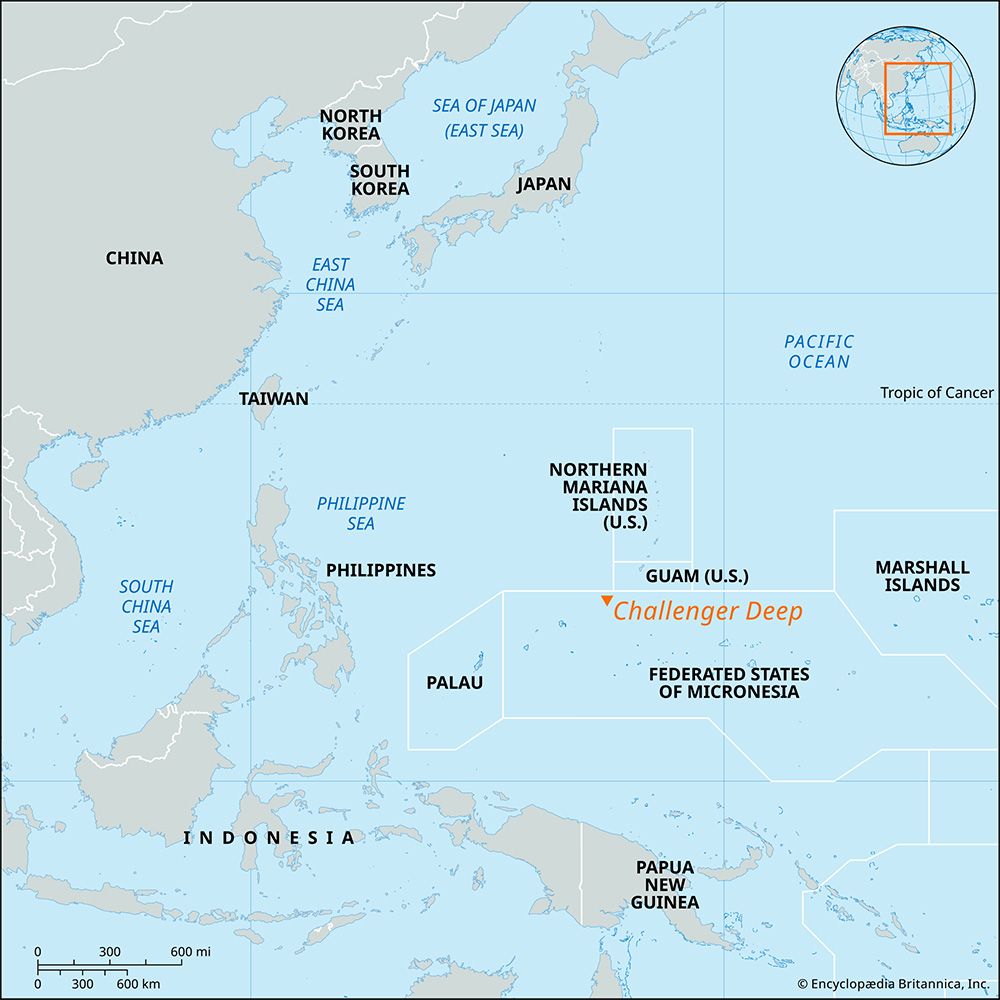
The Mariana Trench is a deep-sea trench located on the floor of the western North Pacific Ocean. It is the deepest known depression on Earth, extending from southeast of Guam to the northwest of the Mariana Islands.12
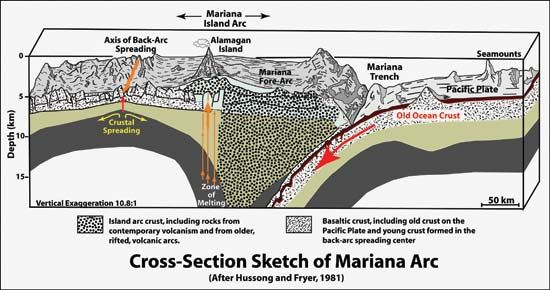
The trench was formed through subduction, a process where the dense, older Pacific Plate is forced beneath the smaller Mariana Plate into the Earth’s mantle. This collision creates a narrow, steep-sided, V-shaped depression. As the subducting plate melts, it generates magma that rises to form volcanic island arcs, such as the Mariana Islands. Depending on the measurement, the trench reaches depths of approximately 35,756 to 36,198 feet (10,898 to 11,033 meters).32
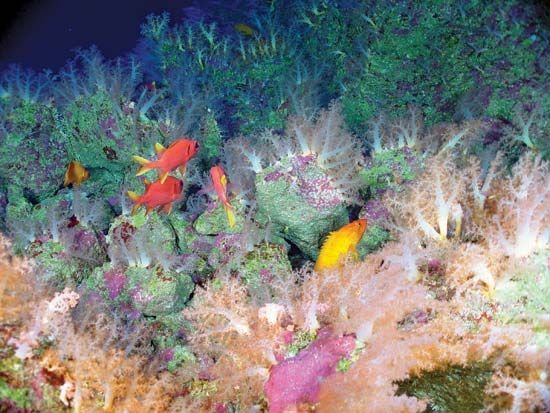
How deep is the Mariana Trench, and why is it considered the deepest part of the world’s oceans?
The Mariana Trench is the deepest known deep-sea trench on Earth, with its greatest depths reaching approximately 36,200 feet (11,034 meters) in a valley known as the Challenger Deep.14
It is considered the deepest part of the world’s oceans because it is a prime example of a subduction zone.1 In this region, the older, denser Pacific Plate is forced beneath the smaller Mariana Plate and sinks into the Earth’s mantle. This collision creates a narrow, steep-sided, V-shaped depression that extends for more than 1,580 miles. The extreme depth is a direct result of this tectonic process, where the bending and sinking of the oceanic crust create a profound void in the ocean floor.214
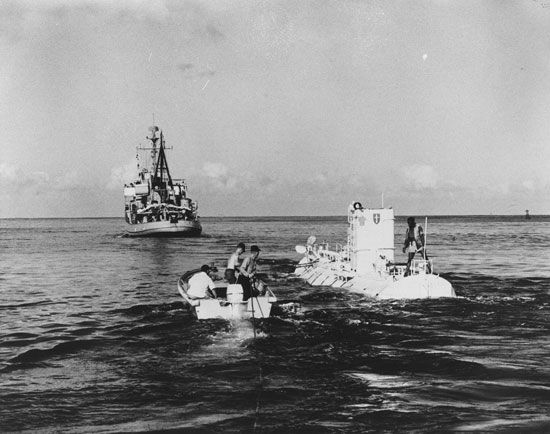
How has human exploration of the Mariana Trench evolved over time, and what challenges do researchers face?
Human exploration of the Mariana Trench has evolved from rudimentary soundings to sophisticated crewed and autonomous descents. Early efforts began in 1875 during the Challenger Expedition, which used weighted lines to estimate depth. By the mid-20th century, technology advanced significantly; in 1960, the bathyscaphe Trieste carried Jacques Piccard and Don Walsh to the bottom of the Challenger Deep. Following a long hiatus, exploration accelerated in 2012 with James Cameron’s solo dive in the Deepsea Challenger, and between 2019 and 2022, numerous crewed and robotic missions have further surveyed the region.46
Researchers face immense technical challenges in this remote environment:
- Hydrostatic Pressure: At the bottom of the trench, pressures exceed 1,089 standard atmospheres (16,000 pounds per square inch), requiring specialized, high-strength materials to prevent structural failure.6
- Data Acquisition: Delivering and retrieving instrumentation is difficult, and electromagnetic radiation cannot penetrate deep water, necessitating the use of acoustic signals and other remote sensing techniques to map the seafloor.47
- Environmental Stability: Operating in such extreme depths requires advanced robotics technology and remotely operated vehicles (ROVs) to perform tasks that are no longer feasible for human divers.8
What are some of the most surprising discoveries made in the Mariana Trench?
Exploration of the Mariana Trench has revealed a world defined by extreme conditions and unique biological adaptations. Some of the most significant and surprising findings include:
- Chemoautotrophic Ecosystems: Perhaps the most remarkable discovery in deep-sea environments is the existence of life that does not rely on sunlight. In areas of tectonic activity, hydrothermal vents support complex communities of chemoautotrophic organisms. These creatures, including mussels, large bivalve clams, and vestimentiferan worms, derive energy from bacteria that oxidize sulfur, creating a food web independent of photosynthesis.4
- Extreme Biological Adaptations: Marine life in the deep ocean has evolved specialized features to survive immense pressure and darkness. Many organisms in the aphotic zone utilize bioluminescence to attract prey or avoid detection, while others have developed unique physiological mechanisms to maintain buoyancy and survive in near-freezing temperatures.10
- Geological Complexity: Exploration has confirmed that the trench is a dynamic subduction zone where the Pacific Plate is forced beneath the Mariana Plate. The Challenger Deep itself is not a single hole but a series of three distinct seafloor basins, highlighting the complex topography of the ocean floor.611
Sources
- Pacific Ocean: Top Questions — Encyclopædia Britannica
- How was the Mariana Trench formed? — Encyclopædia Britannica
- Mariana Trench — Merriam-Webster
- Mariana Trench — Encyclopædia Britannica
- deep-sea trench — Encyclopædia Britannica
- Challenger Deep — Encyclopædia Britannica
- undersea exploration - Exploration of the seafloor and the Earth’s crust — Encyclopædia Britannica
- petroleum production - Deep and ultradeep water — Encyclopædia Britannica
- undersea exploration - Platforms — Encyclopædia Britannica
- Marine ecosystem - Organisms of the deep-sea vents — Encyclopædia Britannica
- Marine ecosystem - Physical and chemical properties of seawater — Encyclopædia Britannica
Published on · 3 min read