Challenger Deep
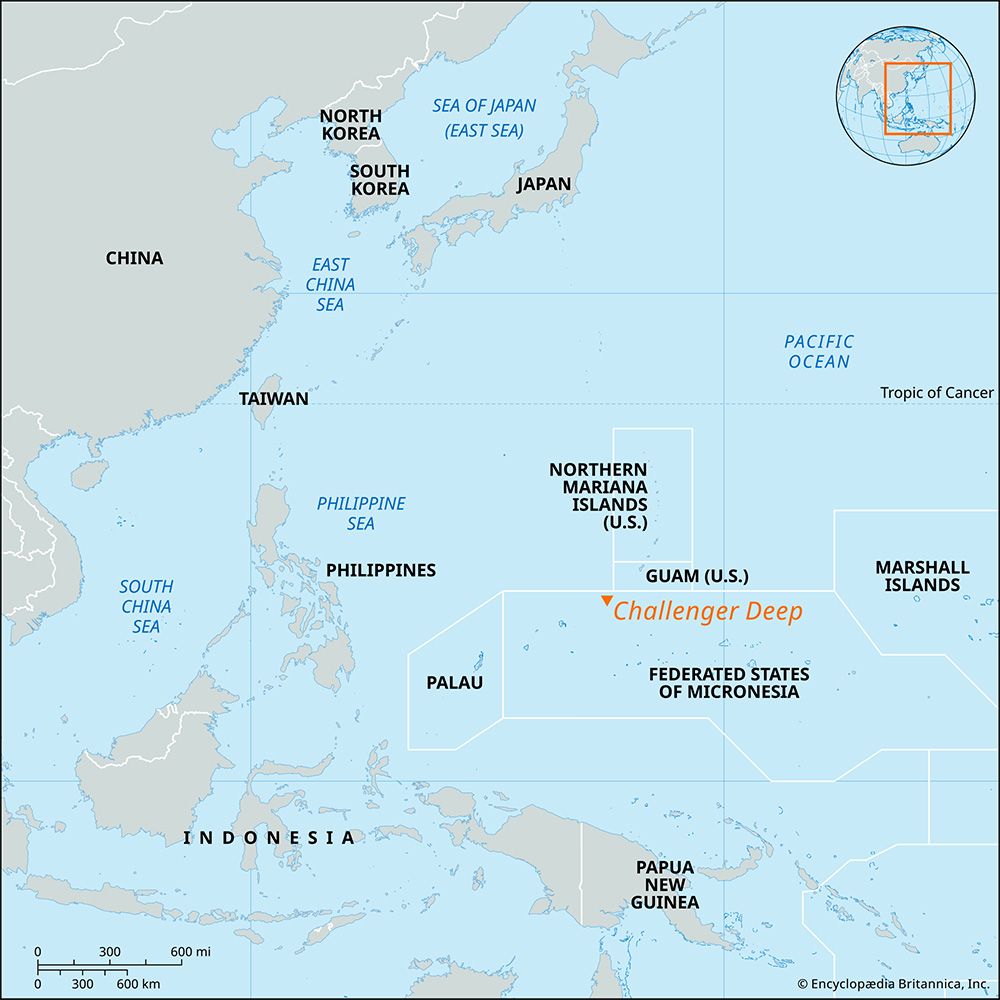
Challenger Deep is a series of three seafloor basins located at the bottom of a steep-walled valley within the Mariana Trench in the western Pacific Ocean.…
What is Challenger Deep?
Challenger Deep is a series of three seafloor basins located at the bottom of a steep-walled valley within the Mariana Trench in the western Pacific Ocean. It is recognized as the lowest point on Earth relative to surface elevation, reaching an estimated depth of approximately 10,935 meters (35,876 feet) below sea level.12
The site is named after the HMS Challenger, the vessel that conducted the Challenger Expedition and first charted the region’s extreme depths in 1875. The basins were formed by the subduction of the Pacific Plate beneath the Philippine Plate.12
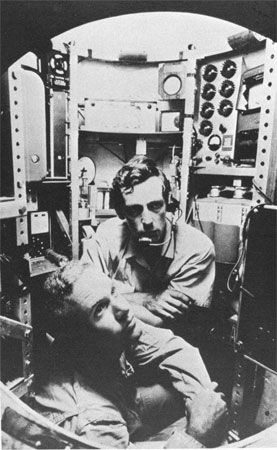
Human exploration of this extreme environment began on January 23, 1960, when Jacques Piccard and Don Walsh completed the first descent in the bathyscaphe Trieste. In 2012, filmmaker James Cameron achieved the first solo descent to the site in the Deepsea Challenger.12
How do tectonic plates create deep-sea trenches?
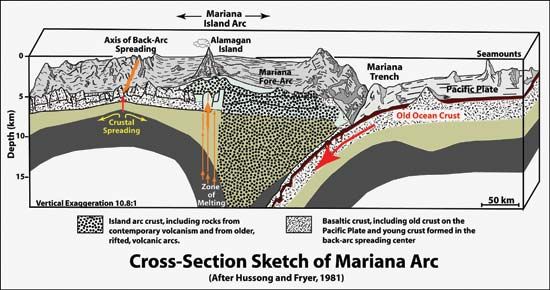
Deep-sea trenches are formed through subduction, a geological process occurring at convergent margins where two tectonic plates collide.45
The Mechanism of Subduction
When an older, denser oceanic crust meets a younger, less-dense plate or a continental margin, the denser plate is forced downward into the Earth’s mantle. As this plate bends and descends, it creates a narrow, V-shaped topographic depression known as a deep-sea trench. This process is driven by gravity and the frictional drag between the plates as they interact.46578
Key Features of Trenches
- Accretionary Wedges: As the lower plate descends, the overriding plate scrapes sediments and rock off the upper crust, forming a chaotic mixture of deformed material known as an accretionary wedge.7
- Volcanic Activity: The subducting slab eventually melts, creating magma that rises to form volcanic island arcs or mountain ranges on the overriding plate.48
- Seismic Activity: These zones are characterized by intense earthquakes that occur along the Wadati-Benioff zone, a plane dipping into the mantle.78
What kind of extreme conditions exist at the bottom of the ocean?
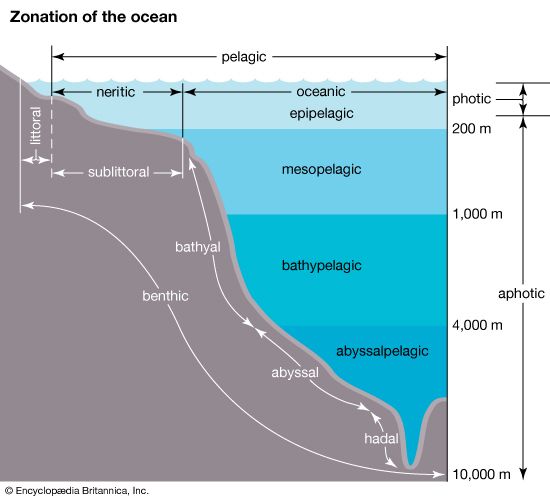
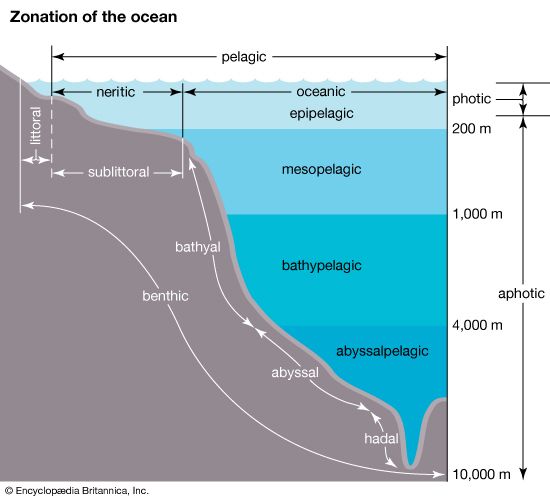
The bottom of the ocean is characterized by extreme environmental conditions that differ significantly from those at the surface. These deep-sea realms, including the bathyal zone and the abyssal zone, are defined by the following factors:
- High Hydrostatic Pressure: Pressure increases by approximately one atmosphere for every 10 meters of depth. In the abyssal zone, pressures range from 200 to 600 atmospheres. While extreme, these pressures are generally not harmful to deep-sea organisms because their internal body pressures match the external environment.9
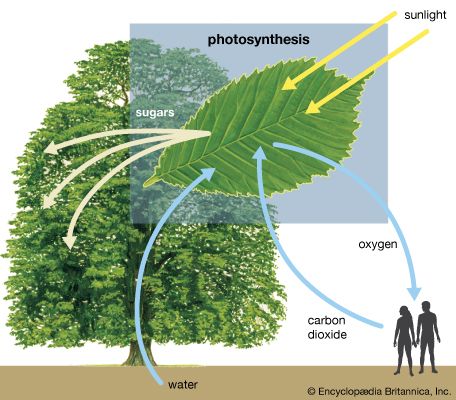
- Total Darkness: Sunlight is rapidly attenuated by water. While some light may penetrate to 600 meters in clear tropical waters, no sunlight reaches depths below 1,000 meters. Consequently, photosynthesis cannot occur, and many organisms have evolved bioluminescent organs.1011912
- Cold Temperatures: Temperatures at the seabed are consistently cold, typically ranging from 0° to 4° C (32° to 39° F). However, near hydrothermal vents, temperatures can reach as high as 113° C (235° F) due to geothermal activity, though the water does not boil because of the intense pressure.10913
- Nutrient and Oxygen Dynamics: Because photosynthesis is absent, deep-sea life relies on organic matter “raining down” from upper zones or on chemoautotrophic bacteria that derive energy from chemical reactions at vents.10914
What are bathyscaphes and how do they withstand such high pressure?
A bathyscaphe is a navigable, self-propelled diving vessel specifically engineered to reach extreme ocean depths, such as the Mariana Trench.17
Design and Pressure Resistance
The bathyscaphe is composed of two primary, interconnected parts designed to manage the immense hydrostatic pressure of the deep sea:
- The Cabin: This is a heavy, spherical steel chamber designed to accommodate observers. Its shape and material strength allow it to resist the crushing force of sea pressure at great depths.17
- The Float: To provide buoyancy, the cabin is attached to a light container filled with gasoline. Because gasoline is lighter than water, it provides the necessary lifting power. Crucially, the gasoline is in direct contact with the surrounding seawater, allowing it to compress in proportion to the depth. This ensures that the pressure inside the float remains balanced with the external environment, preventing the structure from collapsing.17
Operation
To descend, the vessel replaces air in its ballast tanks with water, making it heavy enough to sink. During the descent, the gasoline compresses, causing the vessel to lose buoyancy and accelerate. To slow down or ascend, the pilot releases iron shot ballast held by electromagnets.17
Sources
- Mariana Trench — Encyclopædia Britannica
- Challenger Deep — Encyclopædia Britannica
- Mariana Trench — Merriam-Webster
- How was the Mariana Trench formed? — Encyclopædia Britannica
- subduction zone — Encyclopædia Britannica
- plate tectonics - Subduction zones — Encyclopædia Britannica
- deep-sea trench - Types — Encyclopædia Britannica
- ocean basin - General features — Encyclopædia Britannica
- life - Temperature and desiccation — Encyclopædia Britannica
- ocean current - Pressure gradients — Encyclopædia Britannica
- bathyal zone — Encyclopædia Britannica
- abyssal zone — Encyclopædia Britannica
- Marine ecosystem - Organisms of the deep-sea vents — Encyclopædia Britannica
- seawater - Temperature distribution — Encyclopædia Britannica
- Pacific Ocean - Temperature — Encyclopædia Britannica
- seawater - Optical properties — Encyclopædia Britannica
- bathyscaphe — Encyclopædia Britannica
- undersea exploration - Platforms — Encyclopædia Britannica
- bathysphere — Encyclopædia Britannica
- Biosphere - Hydrostatic pressure — Encyclopædia Britannica
- petroleum production - Deep and ultradeep water — Encyclopædia Britannica
Published on · 4 min read