Python
Pythons are a group of approximately 40 species of snakes primarily found in the Old World tropics and subtropics of Africa, Asia, and Australia. They are…
What are the key characteristics that define pythons as a group of snakes?
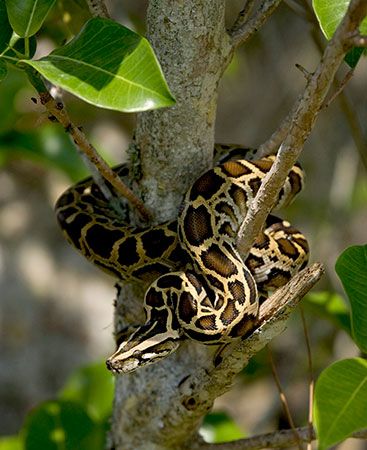
Pythons are a group of approximately 40 species of snakes primarily found in the Old World tropics and subtropics of Africa, Asia, and Australia. They are defined by several key biological and behavioral characteristics:12
- Physical Traits: Pythons are generally large, muscular, and elongated snakes. Many species possess heat-sensing pits located between their lip scales, which contain receptors sensitive to infrared radiation, allowing them to detect the heat signatures of prey in total darkness.132
- Reproduction: Unlike many other large constrictors, pythons are oviparous, meaning they lay eggs. A defining maternal behavior is that females coil around their clutch to protect and incubate them; some species can even generate heat through rhythmic muscle contractions (shivering) to maintain a stable temperature for the developing embryos.132
- Hunting and Diet: Pythons are typically terrestrial or semiarboreal predators that hunt by striking and biting their prey before subduing it through constriction. Their diet varies by size, ranging from small vertebrates like amphibians and reptiles to larger mammals and birds.24
What is the typical size range of pythons, and which species is considered the largest?
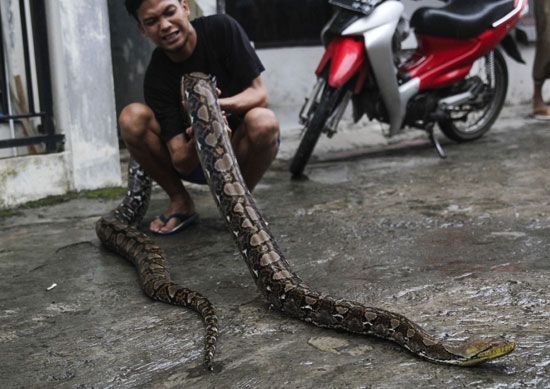
Pythons exhibit a wide range of sizes, reflecting the diversity within the approximately 40 species that make up the family Pythonidae. While some smaller species, such as certain Australian pythons and the New World python (Loxocemus bicolor), typically measure one meter (3.3 feet) or less, many others are significantly larger. Several species from Africa, Asia, and Australia, including the Burmese python and the African rock python, regularly exceed 3 meters (10 feet) in length.5
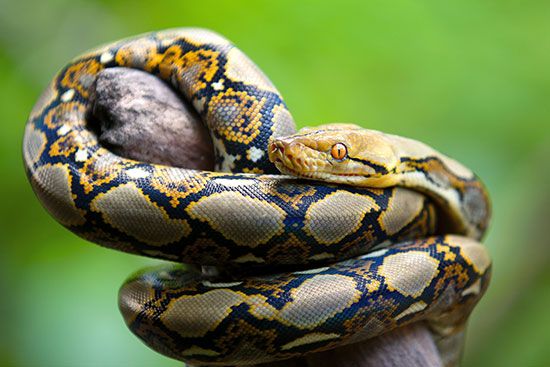
The reticulated python (Malayopython reticulatus) is considered the longest living snake in the world. While most individuals are less than 5 meters (16.4 feet) long, the largest verified adults typically measure between 7 and 8 meters (22.9 to 26.2 feet). Although there is a historical report of a 10-meter (32.8-foot) specimen from 1912, evidence for this measurement remains unverified. It is worth noting that while reticulated pythons hold the record for length, green anacondas often surpass them in weight and girth.6257
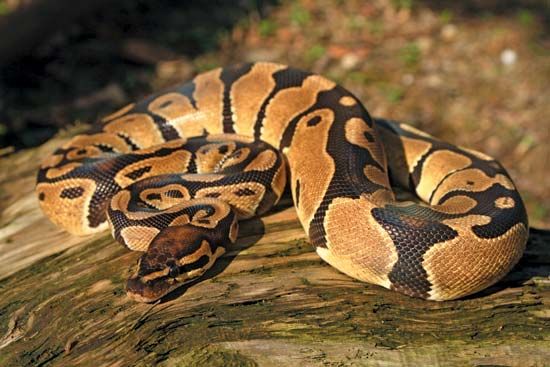
How do pythons hunt and subdue their prey?
Pythons are highly efficient predators that utilize a combination of specialized sensory adaptations and physical strength to hunt and subdue their prey.
Locating Prey
Pythons rely on a sophisticated sensory toolkit to detect food, particularly in low-light conditions. Many species possess labial pits—heat-sensitive organs located between their lip scales—that contain receptors sensitive to infrared radiation. These allow the snake to “see” the heat signatures of warm-blooded mammals and birds in total darkness. Additionally, they use their sense of smell and sight, often flicking their tongues to transfer odor particles to the Jacobson’s organ in the roof of their mouths to identify potential targets.182
Capturing and Subduing
Once prey is within range, a python captures it by striking rapidly and biting down with its powerful jaws to secure a firm hold. Immediately following the strike, the snake coils its muscular body around the victim. It then uses constriction to suffocate the prey, effectively subduing it before consuming it whole. During the swallowing process, pythons secrete a mucus that contains trace amounts of venom proteins, which are harmless to humans.23
In what regions of the world are pythons primarily found?
Pythons are primarily found in the Old World tropics and subtropics, with a distribution spanning several continents and regions:23
- Africa: Various species inhabit sub-Saharan Africa.24
- Asia: Their range extends from India through southern China and across Southeast Asia, including the Philippines and Indonesia.21
- Australia and New Guinea: Several related genera are native to these regions.24
While pythons are native to these areas, the Burmese python has established an invasive population in southern Florida in the United States.21
The only native New World python, Loxocemus bicolor, is an exception to the Old World distribution; it is found in forests ranging from southern Mexico to Costa Rica.2
Sources
- What are the differences between pythons and boa constrictors? — Encyclopædia Britannica
- python — Encyclopædia Britannica
- Burmese python — Encyclopædia Britannica
- What are the differences between pythons and anacondas? — Encyclopædia Britannica
- What is the largest snake in the world? — Encyclopædia Britannica
- reticulated python — Encyclopædia Britannica
- snake - Early development and growth — Encyclopædia Britannica
- reptile - Chemoreception — Encyclopædia Britannica
Published on · 3 min read