Boa
While the provided search results do not explicitly list current endangered species, they highlight that human-introduced predators, such as rats, have…
Are there any species of boas that are endangered, and why?
While the provided search results do not explicitly list current endangered species, they highlight that human-introduced predators, such as rats, have historically caused the extinction of snake species like Bolyeria multocarinata on islands like Round Island.1
The survival of various boa species is often threatened by habitat loss and the introduction of invasive species, which disrupt fragile ecosystems. Protecting these animals is an ethical imperative, as preserving biodiversity is essential for maintaining the health of the environments they inhabit. While some species, such as the boa constrictor, are widespread and popular in the pet trade, others with more restricted ranges are significantly more vulnerable to environmental changes and human interference.12
What are some common misconceptions about boa snakes?
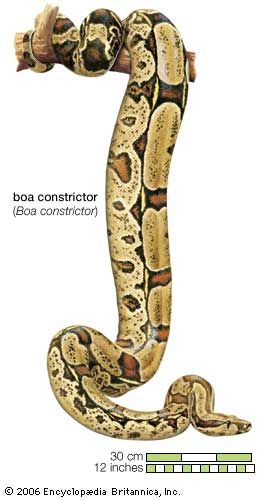
A common misconception is that all boa species possess heat-sensing pits; while these are a defining feature of pythons, they are absent in the boa constrictor, appearing only in a few other boa species.3
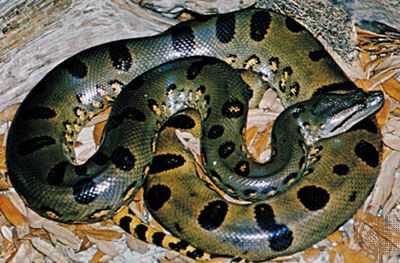
Additionally, people often confuse boas with other large constrictors like anacondas. While both are nonvenomous, anacondas are primarily aquatic with specialized features for life in water, whereas boa constrictors are largely terrestrial and inhabit diverse environments ranging from tropical rainforests to scrublands4.
Finally, there is a frequent misunderstanding regarding their reproduction. Unlike pythons, which are oviparous and lay eggs, boa constrictors are ovoviviparous; they incubate eggs internally and give birth to live young. Despite their reputation as fearsome predators, boa constrictors are often described as having a mild temperament and are easily tamed, leading many farmers to welcome them for their role in controlling rodent populations.32
What are the main characteristics of boa snakes?
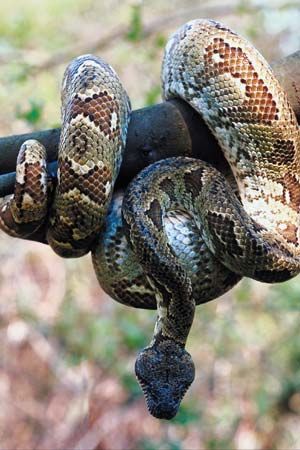
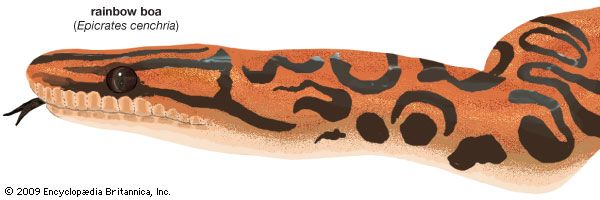
Boa snakes, members of the family Boidae, are characterized by several distinct physical and behavioral traits:
- Physical Structure: They are large, muscular, nonvenomous snakes that possess teeth in both jaws. A notable anatomical feature is the presence of rudimentary hind limbs, which appear externally as small hooks or “spurs” near the tail. These are sometimes used during mating to stimulate the female.32
- Hunting Method: Boas are constrictors. They kill their prey—typically birds and mammals—by grasping them and coiling their bodies around the animal to exert intense pressure, which causes organ failure.452
- Reproduction: Unlike many other snakes, most boas are ovoviviparous. This means females incubate eggs internally and give birth to live young rather than laying eggs in a nest.64
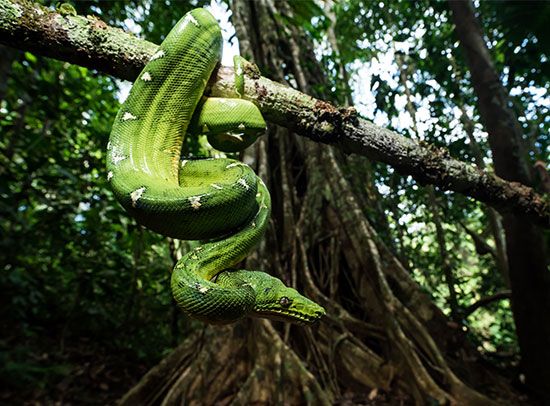
- Habitat and Behavior: While they vary by species, many are terrestrial, though they are also adept at climbing trees to hunt. They are generally active from dusk to dawn and often shelter in logs or burrows during the day.45
How do boas use heat-sensing pits, and what purpose do they serve?
Certain boa species utilize specialized heat-sensing organs known as labial pits to detect warm-blooded prey. These pits, located along the lip scales, function as highly sensitive infrared receptors.89
How They Work
The pits are cavities lined with skin that is thinner than the rest of the head and supplied with a dense network of nerve fibers and blood capillaries. Inside each pit, a thin, densely innervated membrane acts as a directional distance receptor. When heat energy from an external source reaches this membrane, it triggers nerve impulses. Because the pits are positioned on the head, they provide the snake with a “cone of reception” that allows it to localize the position of a heat source with significant precision, even in total darkness. These receptors are particularly sensitive to rapid changes in temperature rather than steady environmental heat.83
Purpose
The primary purpose of these organs is to assist in hunting. By detecting the heat radiation emitted by mammals and birds, these snakes can:
Sources
- boa — Encyclopædia Britannica
- boa constrictor — Encyclopædia Britannica
- What are the differences between pythons and boa constrictors? — Encyclopædia Britannica
- What are the differences between anacondas and boa constrictors? — Encyclopædia Britannica
- Reproductive behaviour - Reptiles — Encyclopædia Britannica
- Boidae — Merriam-Webster
- boid — Merriam-Webster
- reptile - Chemoreception — Encyclopædia Britannica
- Thermoreception - Reptiles and amphibians — Encyclopædia Britannica
Published on · 3 min read