Green Anaconda
The green anaconda is a nonvenomous, semiaquatic boa native to the northern regions of South America. While historically considered a single species…
What is a green anaconda?
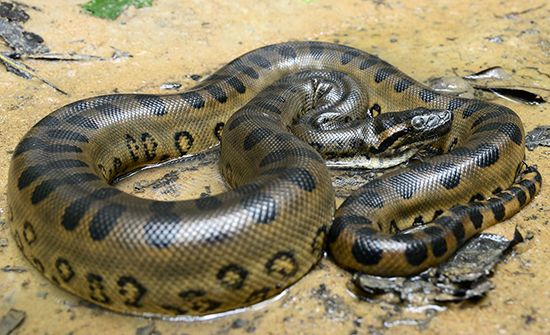
The green anaconda is a nonvenomous, semiaquatic boa native to the northern regions of South America. While historically considered a single species, researchers identified two genetically distinct types in 2024: the southern green anaconda (Eunectes murinus) and the northern green anaconda (E. akayima).1
These snakes are renowned for their immense size, holding the title of the world’s largest by weight and girth. While they average 5.5 meters (18 feet) in length, some specimens reach 9 meters (30 feet) and weigh up to 250 kg (550 pounds). They exhibit sexual dimorphism, with females being significantly larger than males.1
Green anacondas are ambush predators that inhabit slow-moving waters like swamps and marshes. They use constriction to asphyxiate prey, ranging from fish and birds to capybaras and caimans. Because they possess a slow metabolism, they can survive for months without a meal.1
Where do green anacondas live?
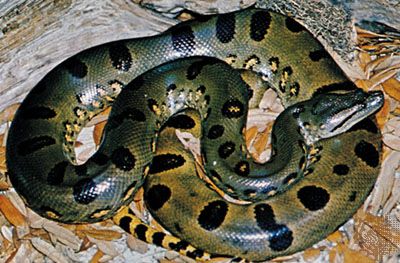
Green anacondas are native to the northern regions of South America, where they are primarily concentrated in the Amazon River and Orinoco River basins. As semiaquatic creatures, they inhabit shallow, slow-moving waters such as swamps, marshes, and streams.2
Their specific distribution varies by species:1
- Northern Green Anaconda (E. akayima): Found in lowland basins, swamps, and some drier grassy areas east of the Andes Mountains. Their range extends from eastern Ecuador, northern Peru, and northern Brazil northward to Colombia, Venezuela, Guyana, Suriname, French Guiana, and Trinidad and Tobago.1
- Southern Green Anaconda (E. murinus): Found from eastern Peru and northern Brazil south through northern Bolivia, extreme eastern Paraguay, and southern Brazil.1
While they spend most of their time in water, they can also be found on land in thick vegetation or in trees. Additionally, they have been spotted as an invasive species in Florida and on some Caribbean islands.2
How big can green anacondas grow?
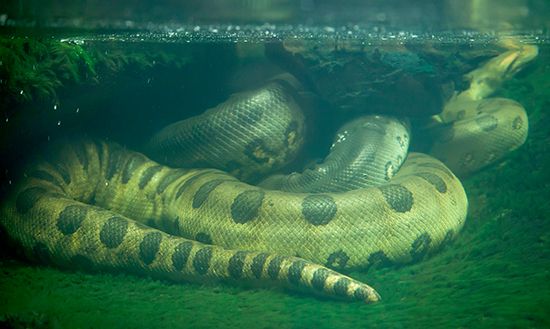
Green anacondas are recognized as some of the largest snakes in the world, holding the title for the greatest mass and girth among all snake species.21
While there is significant public fascination with exceptionally large specimens, most adult green anacondas typically measure about 5 meters (16 feet) in length. However, they are capable of growing much larger:1
- Length: While the average length is approximately 5.5 meters (18 feet), some individuals have been recorded reaching up to 9 meters (30 feet).21
- Weight: Due to their immense girth—often reaching 30 cm (1 foot) in diameter—these snakes can weigh as much as 250 kg (550 pounds).21
Green anacondas exhibit sexual dimorphism, meaning females are significantly larger and heavier than males. Although some media portrayals have featured specimens exceeding 10 meters (30 feet), such sizes have not been scientifically verified.21
What do green anacondas eat?
Green anacondas are carnivorous apex predators that consume a wide variety of vertebrates found within their habitat. Because they possess a slow metabolism, they are capable of surviving for weeks or even months without a meal.43
These snakes are nonvenomous and rely on constriction to kill their prey. They typically lie in wait, camouflaged in the water, and use heat-sensing pit organs to detect the warmth of approaching animals. Once they strike, they coil their bodies around the prey, cutting off blood flow and causing organ failure.13
Their diet is diverse and includes:
- Mammals: Capybaras, deer, tapirs, and peccaries.4
- Reptiles: Caimans and other reptiles.4
- Other prey: Fish, birds, and even jaguars.43
Smaller prey, such as diving birds or small turtles, may be killed using only the mouth and sharp, backward-pointing teeth. Regardless of the size of the meal, they use stretchy ligaments in their jaws to swallow their food whole.43
Sources
- green anaconda — Encyclopædia Britannica
- Important anaconda Facts — Merriam-Webster
- anaconda — Encyclopædia Britannica
- What are the differences between anacondas and boa constrictors? — Encyclopædia Britannica
Published on · 3 min read