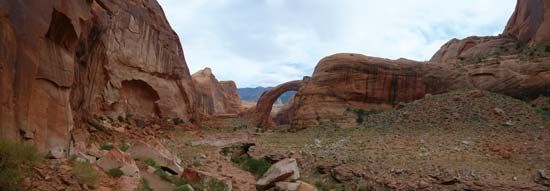
Rainbow Bridge National Monument
Rainbow Bridge National Monument was established in 1910. While the provided information confirms its designation as a national monument, it does not specify…
When was Rainbow Bridge designated as a National Monument, and who was responsible for its protection?
Rainbow Bridge National Monument was established in 1910. While the provided information confirms its designation as a national monument, it does not specify the individual or entity responsible for its protection at that time.12
The site is located within the Navajo Reservation and is recognized as a significant religious site for the region’s Native American peoples. Today, it is situated within the Glen Canyon National Recreation Area.1
How can visitors access Rainbow Bridge, and what are some of the challenges in reaching the monument?
Accessing Rainbow Bridge National Monument requires significant effort due to its remote location on a desert plateau. Visitors can reach the monument only by boat from Lake Powell, or by traveling on foot or horseback.1
The primary challenge in reaching the site is its isolation. Historically, explorers faced a difficult overland journey to document the bridge, which was not recorded until 1909. While access improved significantly in the early 1970s following the creation of Lake Powell by the Glen Canyon Dam, the monument remains tucked away among canyons, requiring deliberate travel planning to navigate the rugged terrain of the Navajo Reservation.1
What is the cultural significance of Rainbow Bridge to Native American tribes in the area?
Rainbow Bridge holds profound cultural and religious significance for the Native American tribes of the region. For these communities, the site is considered a sacred space, deeply connected to the spiritual landscape surrounding Navajo Mountain.1
While the bridge is a geological marvel—often cited as the largest natural bridge in the world—its importance to local tribes predates its 1909 documentation by explorers. The area’s unique environment, where water seeps from canyon walls to support lush vegetation like wild orchids and maidenhair ferns, further emphasizes the site’s role as a place of natural and spiritual vitality.1
We could dive deeper into the history of the Navajo people or explore how other natural landmarks are viewed through the lens of indigenous cultural heritage.
What are the dimensions of Rainbow Bridge, and how does it compare to other natural bridges?
Rainbow Bridge is a pink sandstone arch located in southern Utah that stands as a remarkable example of a natural bridge. Its dimensions are as follows:
- Height: It spans 290 feet (88 metres) above the creek below.1
- Span: The bridge stretches 275 feet (84 metres) across the canyon.1
Rainbow Bridge is widely considered the largest natural bridge in the world. It is frequently compared to other notable formations, such as the Natural Bridge in Virginia. While Rainbow Bridge is a sandstone formation created by stream erosion, the Virginia Natural Bridge is a limestone arch formed by the collapse of a cavern roof, measuring 215 feet (66 metres) in height and 90 feet (27 metres) in length.134
Unlike many other geological features, Rainbow Bridge is noted for its remote location on a desert plateau, which has helped preserve its status as a sacred site.1
Sources
- Rainbow Bridge National Monument — Encyclopædia Britannica
- Rainbow Bridge National Monument — Merriam-Webster
- natural bridge — Encyclopædia Britannica
- Natural Bridge — Encyclopædia Britannica
Published on · 2 min read