Riversleigh Fossils
The Riversleigh fossils are primarily significant for their role in documenting the evolution of Australia's prehistoric life rather than serving as a direct…
What can the Riversleigh fossils tell us about climate change in Australia over millions of years?
The Riversleigh fossils are primarily significant for their role in documenting the evolution of Australia’s prehistoric life rather than serving as a direct proxy for climate change data. These assemblages, located in northwestern Queensland, contain a diverse collection of vertebrates—including early marsupials, bats, and reptiles—that lived during the Miocene and Pliocene epochs, spanning roughly 23 million to 2.6 million years ago.1
While these fossils provide essential insights into the biodiversity and evolutionary history of Australian fauna, the provided search results do not contain specific information linking these particular fossil assemblages to the reconstruction of past climate change patterns. Broader geological history, such as the Pangaean supercycle and the Quaternary ice ages, is documented through other stratigraphic and environmental evidence, such as marine carbonate deposits and glacial records.234
How does the biodiversity found in Riversleigh fossils compare to modern Australian fauna?
The Riversleigh fossils provide a window into a prehistoric Australia that was significantly different from the modern landscape, yet they reveal the deep evolutionary roots of today’s unique fauna. While modern Australian wildlife is characterized by its high degree of specialization and isolation, the Riversleigh assemblages—dating primarily to the Miocene and Pliocene epochs—show that many iconic groups were already diversifying millions of years ago.1
Key comparisons include:
- Marsupial Diversity: Riversleigh has yielded remains of extinct marsupials that occupied niches similar to those of modern animals but with distinct forms, such as large carnivorous “lions” and “wolves,” as well as miniature versions of koalas and phalangers.1
- Evolutionary Continuity: The fossils demonstrate that the marsupial lineage had already radiated widely across the continent, occupying virtually all mammalian adaptive niches long before the arrival of humans.15
- Ancient Lineages: The collection includes prehistoric relatives of the platypus, highlighting the ancient Gondwanan origins of Australia’s unique egg-laying mammals, which persist today alongside more recent arrivals.15
Unlike the modern fauna, which has faced significant pressure from habitat loss and introduced species, the Riversleigh record captures a time of immense, undisturbed evolutionary experimentation.15
What is the significance of the Riversleigh fossil site in Queensland, Australia?
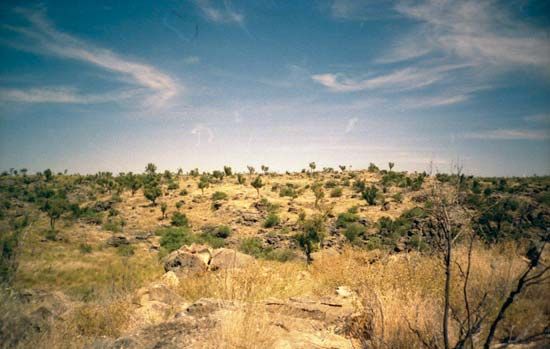
The Riversleigh fossil site in northwestern Queensland is globally significant as the richest and most diverse collection of fossils ever discovered on the Australian continent. Located near the Gregory River, the site has yielded the remains of over 200 previously unknown vertebrate species since intensive exploration began in 1983.1
The fossils primarily date to the Miocene and Pliocene epochs, providing a crucial record of prehistoric life that has vastly expanded our understanding of the evolutionary history of marsupials. Notable discoveries include:1
- Extinct Marsupials: A wide range of unique forms, including large carnivorous kangaroos, marsupial “lions,” marsupial “wolves,” and miniature versions of koalas and phalangers.1
- Diverse Fauna: Numerous new species of bats, reptiles, rodents, and a prehistoric type of platypus.1
In recognition of its scientific importance, the site was designated a World Heritage site in 1994, paired with the fossil site at Naracoorte fossil site at Naracoorte.7
What types of animals have been discovered in the Riversleigh fossil assemblages?
The Riversleigh fossil assemblages have revealed a remarkably diverse array of vertebrate life from the Miocene and Pliocene epochs. Since 1983, paleontologists have identified over 200 previously unknown species at the site, including:1
- Marsupials: A wide variety of early and extinct forms, such as large carnivorous kangaroos, marsupial “lions,” marsupial “wolves,” and miniature versions of koalas and phalangers.1
- Mammals: A prehistoric type of platypus and numerous previously unknown species of rodents.1
- Other Vertebrates: Dozens of new species of bats and several unknown species of reptiles.1
These discoveries have significantly broadened the scientific understanding of Australia’s prehistoric biodiversity and the evolutionary history of its unique marsupial lineages.1
Sources
- Riversleigh fossils — Encyclopædia Britannica
- Australia - Pangaean supercycle — Encyclopædia Britannica
- Australia - The Quaternary Period — Encyclopædia Britannica
- Australia - Principal regimes — Encyclopædia Britannica
- Australia - Animal life — Encyclopædia Britannica
- Miocene Epoch — Encyclopædia Britannica
- Queensland - Plant and animal life — Encyclopædia Britannica
Published on · 3 min read