Rogers Pass
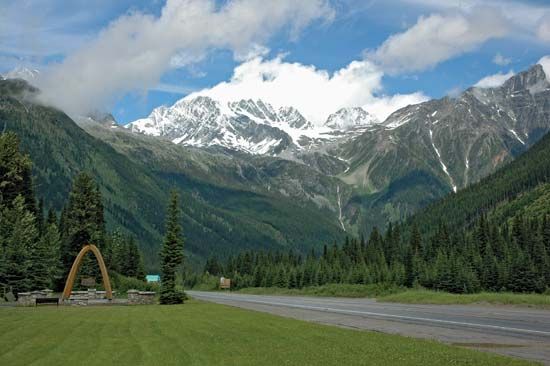
Rogers Pass serves as a vital corridor for tourism in British Columbia by providing a scenic route through the Selkirk Mountains within Glacier National Park.
How does Rogers Pass contribute to the tourism industry in British Columbia?
Rogers Pass serves as a vital corridor for tourism in British Columbia by providing a scenic route through the Selkirk Mountains within Glacier National Park.1
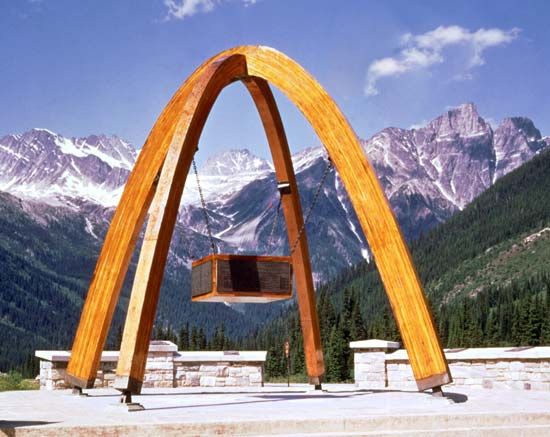
The pass is a key segment of the Trans-Canada Highway, connecting the communities of Revelstoke and Golden. Completed in 1962, this route allows travelers to experience the dramatic mountain landscape, which is protected by extensive snowsheds designed to mitigate the risk of avalanches. Additionally, the site holds historical significance, featuring a monument that commemorates the official opening of the transcontinental highway route.1
How high is Rogers Pass, and how does its elevation affect the local climate?
Rogers Pass is situated at an elevation of 4,354 feet (1,327 metres) above sea level.12
While the provided information notes that this is a relatively low elevation for the Selkirk Mountains, the pass is characterized by steep valley sides that create a significant risk of avalanches. Historically, these conditions were so severe that they claimed many lives during early attempts to lay track for the Canadian Pacific Railway, eventually necessitating the construction of the Connaught Tunnel in 1916 to bypass the surface route. Today, the Trans-Canada Highway segment through the pass is protected by extensive snowsheds to manage the impact of this high-alpine environment.1
The provided search results do not contain specific data regarding the broader local climate beyond the prevalence of avalanche activity.
What role did Rogers Pass play in the construction of the Canadian Pacific Railway?
Rogers Pass played a critical role in the development of the Canadian Pacific Railway as a key passage through the Selkirk Mountains. The route was discovered in 1881 by Major A.B. Rogers while he was surveying for a viable path for the railway’s main line.1
However, the pass presented severe operational challenges. The steep valley sides were highly susceptible to avalanches, which caused numerous fatalities during early attempts to maintain the surface track. To address these dangers and the difficulty of navigating the terrain, the railway eventually moved away from the surface route. In 1916, the 5-mile-long Connaught Tunnel was completed beneath the pass to provide a safer, more reliable transit.1
Decades later, the railway further improved efficiency through the area by constructing the 9.1-mile-long Mount MacDonald Tunnel, completed in 1988. This tunnel was designed to reduce steep track grades, allowing the transit of the Selkirks to be flattened to just under 1 percent for westbound trains.13
What is the historical significance of Rogers Pass in the development of Canada’s transportation network?
Rogers Pass serves as a vital corridor in Canada’s transportation network, acting as the primary gateway through the Selkirk Mountains in British Columbia. Its historical significance is defined by its role in connecting the country via both rail and road.12
Railway Development
Discovered in 1881 by Major A.B. Rogers, the pass provided a necessary route for the Canadian Pacific Railway. However, the extreme danger posed by frequent avalanches on the steep valley sides necessitated major engineering solutions. To ensure safe and reliable passage, the 5-mile Connaught Tunnel was constructed in 1916. Later, in 1988, the 9.1-mile Mount MacDonald Tunnel was completed to further improve transit efficiency by reducing track grades for westbound trains.12
Road Infrastructure
The pass is equally significant to modern vehicular travel. In 1962, a section of the Trans-Canada Highway was completed through the pass, protected by extensive snowsheds to mitigate avalanche risks. The official opening of this route marked a milestone in the completion of the national highway system, commemorated by a monument at the site.1
Sources
- Rogers Pass — Encyclopædia Britannica
- Selkirk Mountains — Encyclopædia Britannica
- railroad - Canadian railroads — Encyclopædia Britannica
Published on · 3 min read