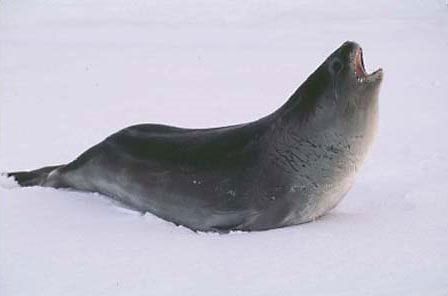
Ross Seal
The Ross seal (Ommatophoca rossi) is an Antarctic seal belonging to the family Phocidae. Named after Sir James Clark Ross, this species is characterized by a…
What is Ross seal?
The Ross seal (Ommatophoca rossi) is an Antarctic seal belonging to the family Phocidae. Named after Sir James Clark Ross, this species is characterized by a short face, very large eyes, and a coat of coarse, greenish-gray fur with yellowish stripes on its sides.12
Typically reaching lengths of about 2.3 meters (7.6 feet) and weighing between 150 and 215 kilograms (330–470 pounds), these seals are known for being solitary creatures. Their diet consists primarily of cephalopods, along with some fish and plankton. Anatomically, they are distinguished by having only two upper incisors, small teeth, and small claws on their forefeet, while lacking claws on their hind feet. Because they inhabit remote regions, much of their behavior remains a mystery to researchers.12
What are the other types of seals found in Antarctica?
In addition to the Ross seal, there are several other species of true seals (family Phocidae) found in the Antarctic region:
- Weddell seal: A nonmigratory, rotund seal that lives around the South Pole. It is an exceptional diver, capable of staying submerged for over an hour and reaching depths of 600 meters. They are known for using their teeth to maintain breathing holes in the ice during winter.34
- Crabeater seal: A slender seal that inhabits drifting pack ice. Despite its name, it feeds primarily on krill, using specialized, elaborately cusped teeth to filter its food from the water.54
- Leopard seal: Unlike most other seals, this species is a top predator that feeds on penguins, seabirds, and other seals, in addition to fish and krill.4
- Southern elephant seal: The largest of the Antarctic seals, these gregarious animals are known for their massive size and the male’s inflatable, trunklike snout. They breed and molt on land but spend their winters at sea.64
Why does the Ross seal have such large eyes?
While the Ross seal is well-known for its distinctively large eyes, the specific evolutionary advantage of this trait remains a subject of ongoing study. Because these seals inhabit remote Antarctic regions and are typically solitary, their behavior and sensory adaptations are not as thoroughly documented as those of other species.1
In general, animals that move between air and water environments, such as seals, have evolved specialized ocular structures to maintain vision in both mediums. Because the cornea loses much of its focusing power when submerged, these animals rely on a re-evolved spherical lens to produce clear images. While the large size of the Ross seal’s eyes likely aids in light collection—a common adaptation in animals that forage in deep or dim environments—the exact functional necessity for their specific size compared to other phocids is not definitively established in current scientific literature.71
Who was Sir James Clark Ross?
Sir James Clark Ross (1800–1862) was a distinguished British naval officer renowned for his significant contributions to magnetic surveys in both the Arctic and Antarctic regions.8
His career included several notable achievements:
- Arctic Exploration: Between 1819 and 1827, he participated in Sir William E. Parry’s Arctic voyages. In 1831, while serving on the second Arctic expedition led by his uncle, Sir John Ross, he successfully located the north magnetic pole.89
- Antarctic Expedition: Commanding the HMS Erebus and HMS Terror during his 1839–1843 expedition, he sought to reach the south magnetic pole and conduct magnetic observations. During this voyage, he discovered the Ross Sea and Victoria Land in 1841.810
- Legacy: Following his return to England in 1843, he was knighted and published A Voyage of Discovery and Research in the Southern and Antarctic Regions (1847).8
Sources
- Ross seal — Encyclopædia Britannica
- Ross's seal — Merriam-Webster
- Weddell seal — Encyclopædia Britannica
- crabeater seal — Encyclopædia Britannica
- elephant seal — Encyclopædia Britannica
- seal — Encyclopædia Britannica
- Photoreception - Diversity of eyes — Encyclopædia Britannica
- Sir James Clark Ross — Encyclopædia Britannica
- Ross Sea — Encyclopædia Britannica
- Sir John Ross — Encyclopædia Britannica
Published on · 3 min read