Saint Clements Island
Saint Clements Island is a 40-acre (16-hectare) islet located in the Potomac River within St. Mary’s County, Maryland.
What is Saint Clements Island?
Saint Clements Island is a 40-acre (16-hectare) islet located in the Potomac River within St. Mary’s County, Maryland.1
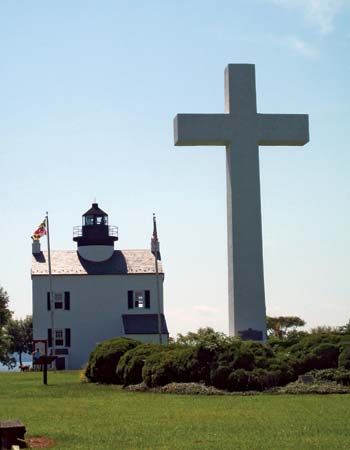
The island holds significant historical importance as the site where the first Maryland settlers, led by the Calverts (Barons Baltimore), arrived on the ships Ark and Dove on March 25, 1634. These Roman Catholic colonists celebrated their first mass on the island before establishing the settlement of St. Marys City. Today, the site is a state park featuring a large cross erected in 1934 to commemorate the arrival, while additional mementos are preserved at the St. Clement’s Island Museum on the mainland at Coltons Point.1
Who were the Calverts and why did they settle in Maryland?
The Calverts were a prominent English family of statesmen who served as the proprietors of the Maryland colony. The family’s involvement began with George Calvert, 1st Baron Baltimore, a Roman Catholic convert who sought to establish a sanctuary for his fellow Catholics in the New World.23
After an unsuccessful attempt to settle in the harsh climate of Newfoundland, George Calvert petitioned King Charles I for a land grant in the more temperate Chesapeake Bay region. Although George died before the charter was finalized, his son Cecilius Calvert inherited the title and the project. Cecilius sent his brother, Leonard Calvert, to serve as the first governor of the colony. Leonard arrived in 1634 aboard the Ark and Dove to establish the settlement of St. Marys City, fulfilling the family’s vision of a refuge where Roman Catholics could practice their faith without persecution.34
What was the significance of the Ark and the Dove ships?
The Ark and the Dove were the two ships that carried the first European settlers to the Maryland colony in 1634. Led by Leonard Calvert, the expedition departed England in November 1633, transporting approximately 200 emigrants, including 17 gentlemen and their wives.63
The arrival of these vessels was significant because it marked the successful establishment of the first permanent European settlement in Maryland at St. Marys City. This voyage fulfilled the vision of George Calvert, 1st Baron Baltimore, who sought to create a sanctuary where Roman Catholics could practice their faith without the persecution they faced in England. Today, the legacy of these ships is preserved through the Maryland Dove, a full-scale, square-rigged replica that serves as a key attraction at the Historic St. Mary’s City outdoor museum.634
How did the first Maryland settlers interact with the local Native American tribes?
When the first English settlers arrived in Maryland in 1634, they established their capital, St. Marys City, on the site of a Secowocomoco Indian village. Relations between the colonists and the local Algonquian-speaking tribes were initially smoothed by the English promise of military support against the Susquehannock and other Iroquoian groups who were pressuring the region from the northwest.64
While the English and Indigenous groups often negotiated boundaries, these agreements were frequently strained by the colonial agenda of expansion and the tendency of settlers to ignore established territorial limits. Although the early years in Maryland were marked by this strategic alliance, the broader history of the mid-Atlantic region during the 17th century was characterized by increasing tension, as the continuous arrival of new colonists and the pressure for land often undermined the understandings reached with local nations.7
Sources
- Saint Clements Island — Encyclopædia Britannica
- Charles Calvert, 3rd Baron Baltimore — Encyclopædia Britannica
- George Calvert, 1st Baron Baltimore — Encyclopædia Britannica
- Leonard Calvert — Encyclopædia Britannica
- Calvert — Merriam-Webster
- Saint Marys City — Encyclopædia Britannica
- Saint Mary’s — Encyclopædia Britannica
- Maryland - History — Encyclopædia Britannica
- Native American - The mid-Atlantic Algonquians — Encyclopædia Britannica
Published on · 2 min read