Saint-Pierre and Miquelon
The archipelago of Saint-Pierre and Miquelon maintains a distinct cultural identity as the last French foothold in North America. Its unique character is…
What unique cultural aspects can be found in Saint-Pierre and Miquelon?
The archipelago of Saint-Pierre and Miquelon maintains a distinct cultural identity as the last French foothold in North America. Its unique character is shaped by several key factors:
- European Heritage: First settled in the early 17th century by seafarers from western France—specifically Basques, Normans, and Bretons—the population continues to speak French and adhere to French customs and traditions.1
- Religious and Social Life: The majority of the population is Roman Catholic, and primary education is largely parochial.1
- Economic History: While cod fishing has historically been the primary occupation, the town of Saint-Pierre experienced a unique period of prosperity during the Prohibition era in the United States, when it served as a hub for bootlegging.12
- Governance: As a French collectivité, the islands operate under a system that integrates them into the French state, with inhabitants holding French citizenship and suffrage.1
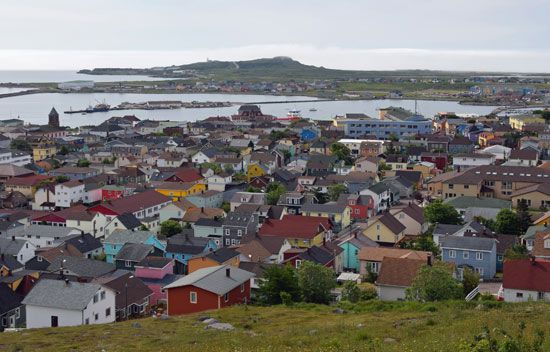
What is the geographical location of Saint-Pierre and Miquelon?
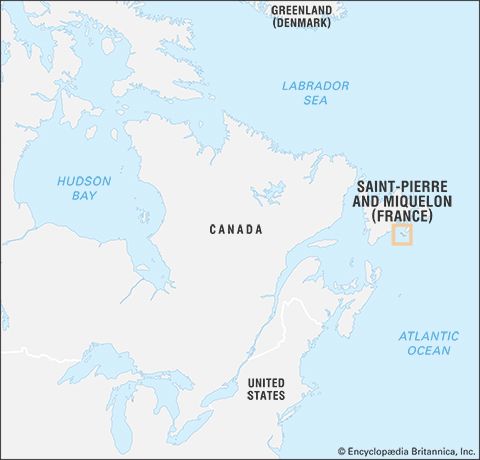
Saint-Pierre and Miquelon is an archipelago located in the Atlantic Ocean, approximately 15 miles (25 km) off the southern coast of the island of Newfoundland, Canada.13
The archipelago consists of several islands, with the main ones being:
- Miquelon and Langlade: These two islands are connected by the sandy Isthmus of Langlade and comprise the majority of the archipelago’s land area.1
- Saint-Pierre: Located to the southeast of Langlade across a 3-mile (5 km) wide channel known as La Baie, this island serves as the administrative and commercial center of the territory.1
- Islets: The region also includes various rocky islets, the only inhabited one being Marins, situated off the eastern coast of Saint-Pierre.1
How has the population of Saint-Pierre and Miquelon changed over time?
The population of Saint-Pierre and Miquelon has remained relatively small throughout its history, reflecting the archipelago’s limited local resources and its reliance on external support.
While the islands were first settled by French seafarers in the early 17th century, the population has experienced modest fluctuations over time. Recent demographic data indicates a slight increase in the total number of inhabitants:
- 2006 Estimate: The population of the capital, Saint-Pierre, was recorded at 5,509 residents.1
- 2019 Estimate: The total population for the entire archipelago was estimated at 5,974.2
Today, the distribution of the population is highly concentrated, with nearly 90 percent of all residents living on the island of Saint-Pierre, which serves as the primary administrative and commercial hub for the territory. Because the local economy cannot fully support the population, the islands remain dependent on subsidies from France and imports from Canada and France.2
How did Saint-Pierre and Miquelon become a French territory?
Saint-Pierre and Miquelon became a French territory through a long history of exploration, settlement, and colonial exchange. While the Portuguese explorer José Alvarez Faguendez first visited the archipelago in 1520, the first permanent French fishing settlement was established in 1604 by seafarers from western France.1
Following this initial settlement, the islands were frequently exchanged between the French and the British due to ongoing colonial conflicts. A significant turning point occurred with the Treaty of Paris in 1763, which saw Britain restore the islands to France. After further periods of shifting control, the archipelago was restored permanently to France in 1816 under the Treaty of Paris (1814).21
In the modern era, the islands’ status evolved to reflect their relationship with France:
- 1946: The islands became a French overseas territory.1
- 1976: They were designated an overseas département, placing them on par with those in metropolitan France.1
- 1985: The status was changed to a collectivité to better align with the tariff structures of the European Community (now the European Union).1
Sources
- Saint-Pierre and Miquelon — Encyclopædia Britannica
- Saint-Pierre — Encyclopædia Britannica
- Saint-Pierre and Miquelon — Merriam-Webster
- Treaty of Paris — Encyclopædia Britannica
Published on · 3 min read