Saki
There are 22 recognized species of saki monkeys, which are arboreal New World monkeys native to South America.
How many species of saki monkeys are there, and how are they classified?
There are 22 recognized species of saki monkeys, which are arboreal New World monkeys native to South America.1
These primates are classified within the family Pitheciidae and the subfamily Pitheciinae. They are generally divided into two main groups:1
- “True” Sakis (Pithecia): This genus consists of 16 species. They are characterized by long, coarse hair that forms a hood-like appearance on the head and a cape over the shoulders.1
- Bearded Sakis (Chiropotes): This group includes 6 species. They are distinguished by their dense coats, rounded tails, and a distinctive, full beard.1
It is important to note that taxonomic classifications can vary depending on the criteria used by researchers, which may lead to different counts of species within these genera in various scientific contexts. Sakis are closely related to uakaris and are part of the order Primates.21
What are the distinctive physical characteristics of saki monkeys?
Saki monkeys are defined by their arboreal nature and several distinct physical traits that vary between the two primary groups, “true” sakis and bearded sakis. All species possess long, nonprehensile, furred tails.1
True Sakis (Pithecia)
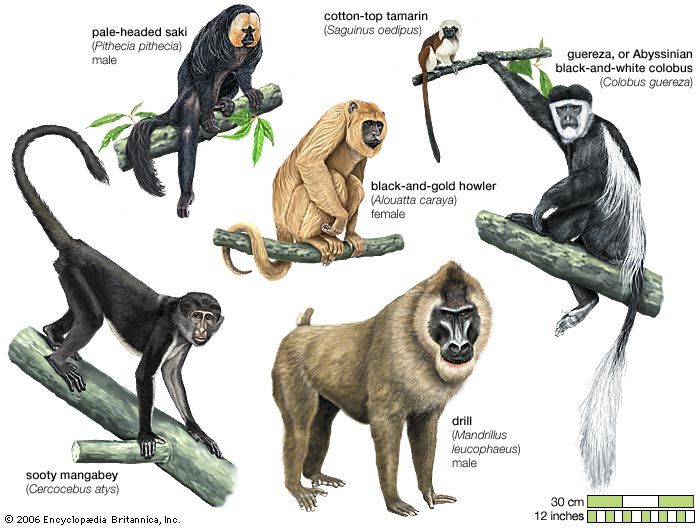
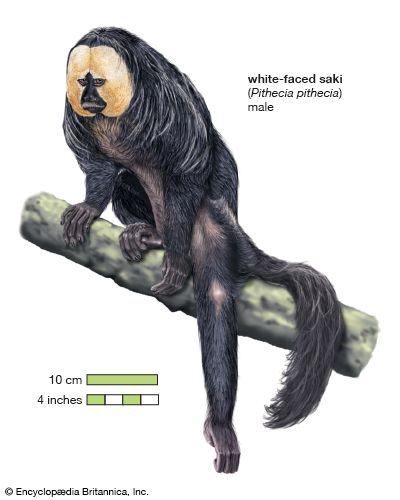
These monkeys are covered in long, coarse hair that creates a hood-like appearance on the head and a cape over the shoulders. They typically measure 30–50 cm in length, excluding their bushy, tapering tails. Sexual dimorphism is often present; for example, male white-faced sakis are black with a white face, while females are grizzled gray.1
Bearded Sakis (Chiropotes)
Bearded sakis are characterized by dense coats of primarily black hair and rounded, heavily furred tails. They are slightly larger, measuring 40–45 cm in length. Their most notable feature is the hair on their heads, which parts in the center and grows thickly along the sides of the face, extending into a full, heavy beard.1
Both groups possess powerful jaws adapted for grinding seeds, which are a staple of their diet.1
What is the diet of saki monkeys and how do they forage for food?
Saki monkeys are arboreal primates that primarily consume a diet of fruit, leaves, and seeds.1
Their foraging is supported by specialized physical adaptations, most notably their powerful jaws, which allow them to grind down hard seeds to access the nutrients within. While the specific mechanics of their daily foraging movements are less documented than those of other primates, they are diurnal animals that spend their lives in the trees. True sakis (Pithecia) typically live in monogamous pairs, while bearded sakis (Chiropotes) forage in small groups consisting of several individuals of both sexes.1
How long do saki monkeys typically live, and what is their reproductive cycle like?
The provided search results do not contain specific information regarding the typical lifespan of saki monkeys. Regarding their reproductive cycle, it is known that saki monkeys produce single offspring. Following birth, the young initially cling to the female’s belly and are later carried on her back until they are capable of traveling independently.3
While some other primates exhibit seasonal breeding patterns or specific gestation periods, the available documentation for the genus Pithecia and Chiropotes does not detail the duration of their gestation or their specific reproductive intervals.3
Sources
- saki — Encyclopædia Britannica
- monkey - Classification — Encyclopædia Britannica
- squirrel monkey — Encyclopædia Britannica
- primate - Diet — Encyclopædia Britannica
- monkey - Old World monkeys versus New World monkeys — Encyclopædia Britannica
- primate - Breeding periods — Encyclopædia Britannica
Published on · 3 min read