Primate
Primates possess several unique anatomical features in their hands and feet that facilitate their arboreal heritage and manipulative capabilities.
What are some unique physical features of primates, such as their hands and feet?
Primates possess several unique anatomical features in their hands and feet that facilitate their arboreal heritage and manipulative capabilities.
Key Structural Features
- Digits and Nails: Most primates retain five digits on each hand and foot. Unlike other mammals that typically have claws or hooves, primates are characterized by flat nails, though some species retain claws on certain digits.12
- Tactile Sensitivity: Primates possess specialized nerve endings known as Meissner’s corpuscles in their hands and feet, which significantly enhance tactile sensitivity—a trait not found in other placental mammals.2
- Grasping Ability: Most primates have prehensile hands and feet. In non-human primates, the big toe (hallux) is divergent and opposable, allowing the foot to function as a pincer for grasping branches.12
Manipulation and Opposability
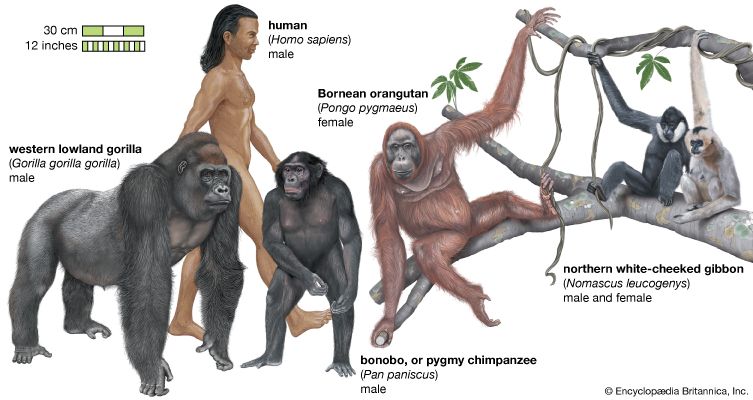
The opposable thumb is a critical component for skilled manipulation. This allows for a rotary movement that enables a precision grip. While this trait varies in effectiveness across the order, it is highly developed in humans and baboons, facilitating fine motor tasks. In contrast, human feet are uniquely adapted for bipedalism, featuring a robust heel, a non-divergent great toe, and a stable arch to support the body’s weight.13
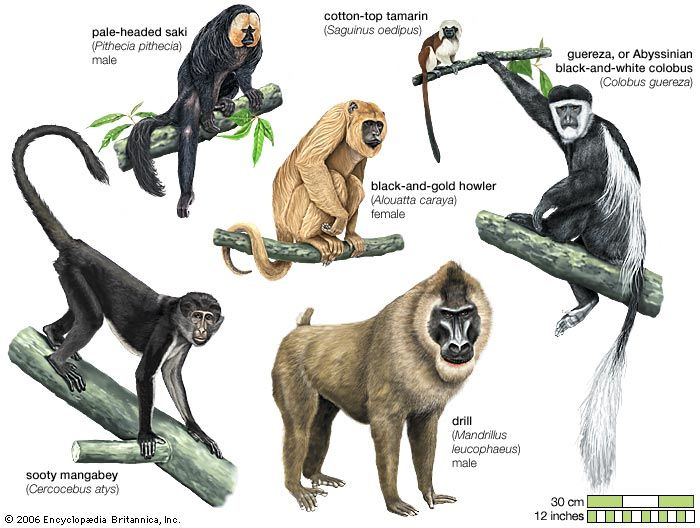
What are the key characteristics that define primates as a group of mammals?
Primates are a diverse group of mammals that share several anatomical and functional characteristics, largely shaped by their evolutionary history as arboreal animals.25
Key Defining Characteristics
- Brain Development: A primary evolutionary trend in primates is the elaboration of the neocortex. Compared to other terrestrial mammals, the primate brain is relatively large and features a unique fissure known as the calcarine sulcus.25
- Sensory Adaptations: Primates rely heavily on vision and touch rather than smell. Their eyes are forward-facing, which facilitates stereoscopic vision for depth perception. Conversely, many primates have a reduced olfactory mechanism compared to other mammals.25
- Hands and Feet: Most primates possess grasping hands and feet with opposable thumbs and big toes (hallux). They are also distinguished by having flat nails on their digits instead of claws or hooves. Additionally, they have specialized nerve endings called Meissner’s corpuscles that enhance tactile sensitivity.25
- Dental Structure: Primate teeth are characterized by low, rounded molar and premolar cusps, which differ from the high, pointed cusps found in many other placental mammals.5
- Skeletal Features: Primates retain collarbones and have separate bones in their forearms (radius and ulna) and lower legs (tibia and fibula).6
- Life History: There is a general trend toward the prolongation of juvenile and adolescent life, which allows for extended periods of learning and social integration within complex groups.4
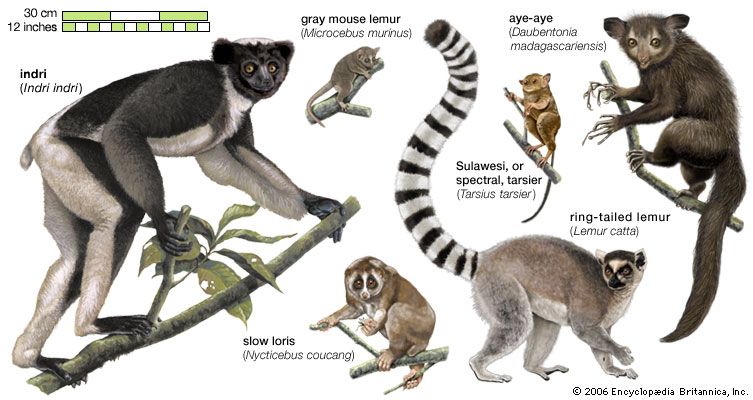
How have primates been used in scientific research, and what ethical concerns surround this practice?
Nonhuman primates have long been utilized in scientific research due to their physiological, neurological, and behavioral similarities to humans. Historically, they have been central to advancements in biomedical research, including the development of the polio vaccine, studies in endocrinology, neurology, psychology, and sociology, as well as experimental organ transplantation and cloning.111213
Ethical Concerns
The use of primates in research is highly controversial, primarily because their high cognitive abilities and emotional complexity raise significant moral questions. Key ethical concerns include:12
- Sentience and Suffering: Critics argue that because primates are sentient beings capable of experiencing pain, distress, and fear, it is morally unacceptable to subject them to harm for human benefit.1412
- Lack of Consent: Unlike human volunteers, primates cannot consent to participate in experiments, which challenges the moral justification of their use as test subjects.1412
- Necessity and Alternatives: Opponents question whether primate research is always essential, advocating for the “three Rs” principle: replacement (using computer models or cell cultures), reduction (using fewer animals), and refinement (minimizing pain and improving welfare).1215
While supporters argue that such research is critical for medical progress, the practice is now subject to strict oversight, including institutional review boards and regulations designed to ensure humane treatment and minimize suffering.12
How are primates classified, and what are the main subgroups within the order Primates?
The order Primates is currently classified into two primary suborders, a system adopted to better reflect phylogenetic relationships.
Suborders and Infraorders
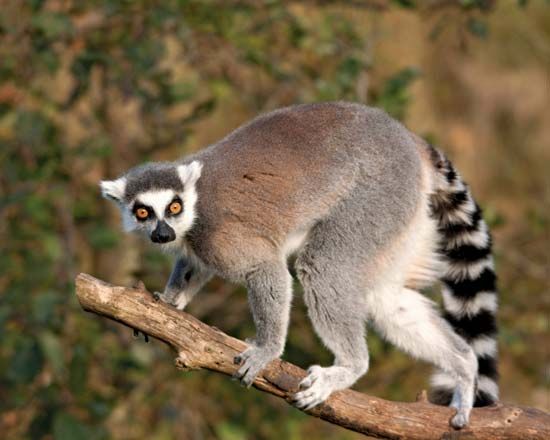
- Strepsirrhini: Often referred to as the “wet-nosed” primates, this group includes lemurs and lorises. They are characterized by a moist, bare muzzle and a reflective layer behind the retina called the tapetum lucidum. This suborder is divided into the infraorders Chiromyiformes (aye-ayes), Lemuriformes (lemurs), and Lorisiformes (lorises and bush babies).
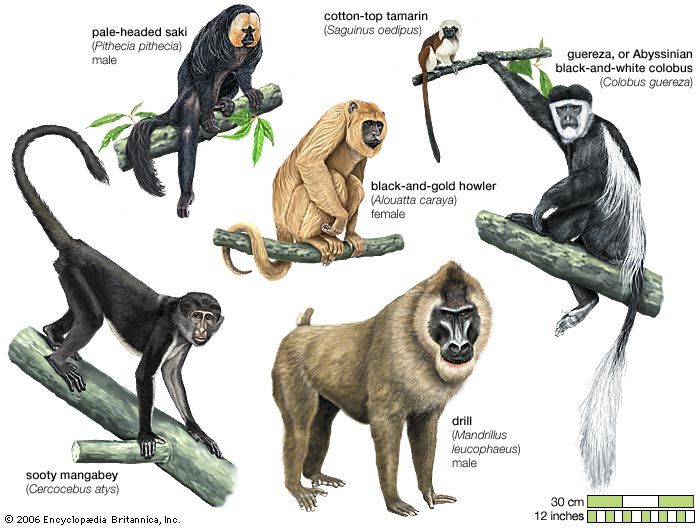
- Haplorrhini: This group includes tarsiers, monkeys, apes, and humans. They possess a nose covered in hair and lack a tapetum lucidum, relying instead on an area of enhanced vision called the fovea. This suborder is divided into the infraorders Tarsiiformes (tarsiers) and Simiiformes (anthropoids).
Simiiformes Breakdown
The infraorder Simiiformes is further categorized into:
- Platyrrhini: New World monkeys found in Central and South America.
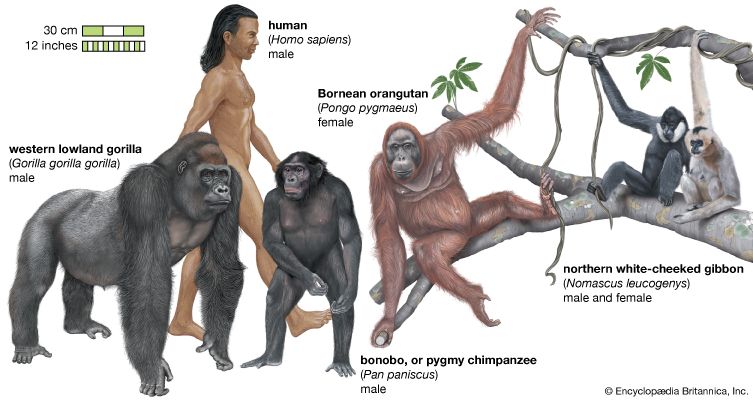
- Catarrhini: Old World monkeys and hominoids (apes and humans), which are further divided into the superfamilies Cercopithecoidea (Old World monkeys) and Hominoidea (apes and humans).
Sources
- primate - Hands and feet — Encyclopædia Britannica
- primate - General structure — Encyclopædia Britannica
- human evolution - The anatomy of bipedalism — Encyclopædia Britannica
- primate — Encyclopædia Britannica
- primate - Size range and adaptive diversity — Encyclopædia Britannica
- chimpanzee - Social behaviour — Encyclopædia Britannica
- primate - Reproduction and life cycle — Encyclopædia Britannica
- primate - Teeth — Encyclopædia Britannica
- primate - Gestation period and parturition — Encyclopædia Britannica
- primate - Vertebral column and posture — Encyclopædia Britannica
- primate - Historical background of primate studies — Encyclopædia Britannica
- Animal testing: Top Questions — Encyclopædia Britannica
- macaque — Encyclopædia Britannica
- Animal testing — Encyclopædia Britannica
- Animal testing - Con 3: Alternative testing methods now exist that can replace the need for animals. — Encyclopædia Britannica
- primate - Renewed interest in primate origins — Encyclopædia Britannica
- primate - Classification — Encyclopædia Britannica
Published on · 4 min read