Siliceous Sponge
A siliceous sponge is any sponge whose primary skeletal structure is composed of silica, rather than calcium carbonate or purely fibrous organic materials.…
What is siliceous sponge?
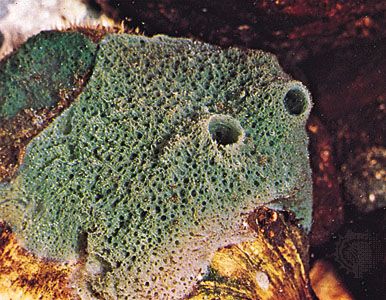
A siliceous sponge is any sponge whose primary skeletal structure is composed of silica, rather than calcium carbonate or purely fibrous organic materials. Representing more than 95 percent of all known sponge species, these organisms belong primarily to the class Demospongiae, though the glass sponges of the class Hexactinellida are also notable members.1
The skeleton of a siliceous sponge is typically formed by discrete elements called spicules. These spicules are composed essentially of silicic acid, along with water, trace minerals, and an organic axial fiber known as spiculin. They exhibit a vast array of sizes and shapes, which are frequently used by scientists to identify different species.12
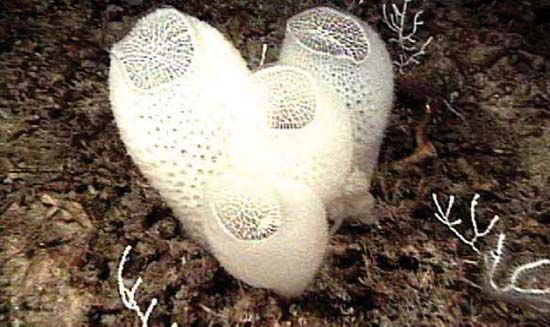
While most siliceous sponges are marine, a few freshwater species exist. The glass sponges, in particular, are known for their delicate, lattice-like skeletons that remain after the soft parts of the animal decay, such as the Venus’s flower basket.12
How do glass sponges survive in the deep ocean?
Glass sponges (class Hexactinellida) are uniquely adapted to thrive in the deep ocean, inhabiting depths ranging from 25 to 8,500 meters (80–29,000 feet). Their survival in these extreme environments is supported by several key biological and structural features:5
- Siliceous Skeleton: Their bodies are supported by a delicate, geometric network of silica spicules. This rigid, glass-like skeleton provides essential structural integrity in deep-sea conditions.167
- Habitat Specialization: Unlike many other sponges that prefer rocky substrates, glass sponges are characteristic of deep, muddy sea bottoms. They have evolved to anchor themselves firmly in these soft sediments or attach to hard surfaces, allowing them to colonize areas of the ocean floor that are inaccessible to many other organisms.125
- Filter Feeding: Like other members of the phylum Porifera, they survive by filter feeding, using a system of canals to propel water through their bodies and extract food particles.5
- Resilience: As a group that has existed since the Cambrian Period, they have demonstrated remarkable evolutionary stability, with many modern species showing close affinities to those from the Cretaceous Period.8
What is the difference between megascleres and microscleres?
In the study of sponges, particularly within the class Demospongiae, siliceous spicules are categorized into two primary types based on their size and function: megascleres and microscleres.3
Megascleres
Megascleres are the larger, primary structural elements that form the main framework of the sponge’s skeleton. They exhibit a vast variety of forms, including:
- Monaxons: Spicules with one axis, such as oxeas (pointed at both ends), styles (one end pointed, one rounded), and strongyles (both ends rounded).3
- Modified forms: Variations like tylostyles or tylotes, which feature swollen ends, or acanthostyles, which have spiny surfaces.3
- Multi-rayed forms: These include triacts (three rays) and tetracts (four rays), such as calthrops or specialized types like protriaenes and anatriaenes.3
Microscleres
Microscleres are significantly smaller and are generally considered secondary or specialized components. They are thought to be derived from a spherical, multi-axoned (polyaxon) ancestor. Common forms include:
- Asters: Star-shaped spicules with varying numbers of rays.3
- Protective elements: Spheres, sterrasters, and discasters, which often form a protective armor around the sponge.3
- Specialized types: These include sigmas, toxas, chelas, and anchoras, which often feature complex teeth or plates at their ends.3
How do sponges use spicules to protect themselves from predators?
Sponges utilize their hard skeletal elements, known as spicules, as a primary physical defense mechanism against predators. These structures, which can be composed of silica or calcium carbonate, provide a rigid, often sharp, and abrasive framework that makes the sponge difficult or unpleasant for many organisms to consume.391
In addition to their structural role, certain types of microscleres—such as spheres, sterrasters, and discasters—are specifically arranged to form a protective “armour” around the sponge’s body. This physical barrier, combined with the disagreeable taste and smell often associated with sponges, serves to discourage potential predators, including various fishes and invertebrates. While some specialized predators, such as certain mollusks and crustaceans, have evolved to feed on sponges despite these defenses, the spicules remain a fundamental adaptation for survival in diverse marine environments.93
Sources
- siliceous sponge — Encyclopædia Britannica
- sponge - Evolution and paleontology — Encyclopædia Britannica
- sponge - Mineral skeletons — Encyclopædia Britannica
- sponge - Biochemical aspects — Encyclopædia Britannica
- glass sponge — Encyclopædia Britannica
- glass sponge — Merriam-Webster
- sponge - Annotated classification — Encyclopædia Britannica
- sponge - Distribution and abundance — Encyclopædia Britannica
- poison - Animal poisons ( zootoxins ) — Encyclopædia Britannica
- sponge - Associations with other organisms — Encyclopædia Britannica
- sponge - Habitats — Encyclopædia Britannica
Published on · 3 min read