Glass Sponge
A glass sponge is any member of the class Hexactinellida (also known as Hyalospongiae or Triaxonia), which are marine sponges characterized by a skeleton…
What is glass sponge?
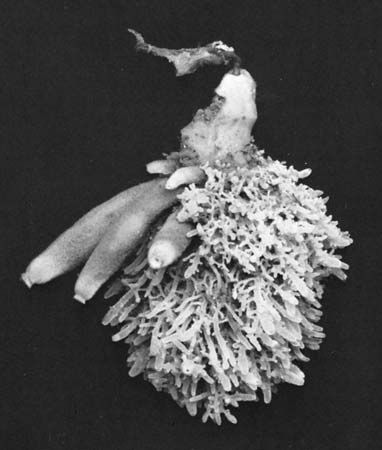
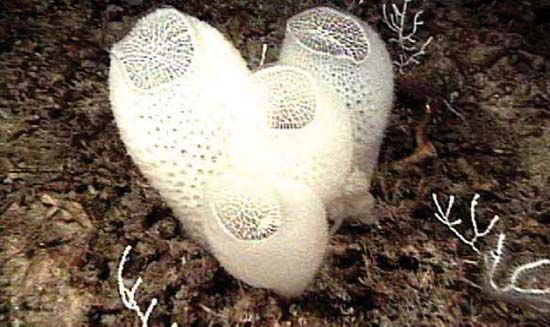
A glass sponge is any member of the class Hexactinellida (also known as Hyalospongiae or Triaxonia), which are marine sponges characterized by a skeleton composed of silica spicules. These needlelike structures often form delicate, geometric, lattice-like networks that can resemble glass when dried.123
These organisms typically inhabit deep-water environments on muddy sea bottoms. They are distinguished by their 6-rayed spicules, which serve as a primary skeletal component. Notable examples include the glass rope sponge (Hyalonema) and the Venus’s flower basket (Euplectella), the latter of which was historically prized by collectors for its intricate structure. Unlike other siliceous sponges that belong to the class Demospongiae, glass sponges are specifically categorized within the class Hexactinellida.132
How do glass sponges extract silica from seawater?
What makes the Venus’s flower basket sponge unique?
The Venus’s flower basket, belonging to the genus Euplectella, is unique for several reasons:
- Intricate Skeleton: It is renowned for its delicate, white, lattice-like skeleton composed of silica, which forms a curved tube approximately 25 cm (10 inches) long.6
- Structural Attachment: The sponge attaches itself to the sea bottom using a specialized tuft of fibers located at its narrow base.6
- Symbolic Significance: In Japan, the sponge is considered a symbol of eternal love. This cultural association stems from the fact that these baskets frequently house a mated pair of shrimp within their central cavity.6
- Feeding Mechanism: As a member of the class Hexactinellida, it feeds by drawing organic debris and microscopic organisms into its central cavity through numerous holes in its body wall.6
While other glass sponges share the characteristic of a silica-based skeleton, the specific aesthetic and biological associations of the Euplectella make it a particularly distinct and prized specimen.61
How do deep-sea creatures survive in such extreme environments?
Deep-sea creatures have evolved remarkable physiological and morphological adaptations to survive in the extreme conditions of the ocean’s depths, where they face intense hydrostatic pressure, total darkness, and limited food resources.
Managing Pressure and Environment
At great depths, hydrostatic pressure is hundreds of times higher than at sea level. To survive this, many deep-sea animals lack air-filled compartments like lungs or swim bladders, which would otherwise compress or collapse. In contrast, surface-dwelling animals that dive deep often possess mechanisms to manage gas uptake, preventing decompression sickness as they return to the surface.7
Survival in Darkness
In the aphotic zone, where no sunlight penetrates, many organisms utilize bioluminescence to survive. This chemically generated light serves several critical functions:
- Predation: Anglerfish use luminous lures to attract prey toward their jaws.89
- Defense: Some species use photophores to match the intensity of light from above, breaking up their silhouettes to hide from predators below.109
- Communication: Light flashes act as essential signals for species recognition and mating.9
Nutrition and Energy
Food is scarce in the deep sea. Many organisms feed on organic matter “raining down” from the upper ocean, while others rely on chemoautotrophic bacterial associations to sustain themselves.11
Sources
- glass sponge — Encyclopædia Britannica
- glass sponge — Merriam-Webster
- siliceous sponge — Encyclopædia Britannica
- Hexactinellida — Merriam-Webster
- hexactinellid — Merriam-Webster
- Venus’s flower basket — Encyclopædia Britannica
- Marine bioluminescence — Encyclopædia Britannica
- life - Temperature and desiccation — Encyclopædia Britannica
- Marine ecosystem - Physical and chemical properties of seawater — Encyclopædia Britannica
- cetacean - Circulation and thermoregulation — Encyclopædia Britannica
- echinoderm - Food and feeding habits — Encyclopædia Britannica
- Biosphere - Hydrostatic pressure — Encyclopædia Britannica
- Bioluminescence - The role of bioluminescence in behavior — Encyclopædia Britannica
Published on · 2 min read