Soap Lake
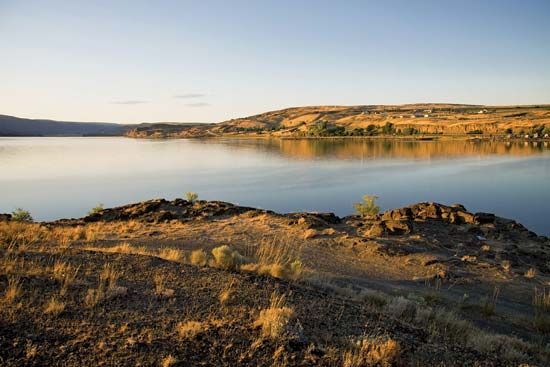
Soap Lake is a mineral-rich lake located in the Grand Coulee valley of central Washington state, U.S. It is the southernmost lake in a chain within the…
What is Soap Lake?
Soap Lake is a mineral-rich lake located in the Grand Coulee valley of central Washington state, U.S. It is the southernmost lake in a chain within the valley and is volcanic in origin.1
The lake is well-known for its high concentrations of minerals and salts, which have historically been regarded as having medicinal properties. Its name is derived from the frothy white suds that form along the shoreline, a phenomenon caused by the wind acting upon the water’s high carbonate content. During the early and mid-20th century, the city situated on its shores became a popular destination as a health resort.1
How do minerals affect the water’s appearance?
Minerals and chemical compounds significantly influence the appearance and physical characteristics of water. In some cases, high concentrations of specific minerals create distinct visual phenomena; for example, the high carbonate content in Soap Lake reacts with wind to produce frothy white suds along its shoreline.1
Beyond surface foam, other factors affect water appearance:
- Coloration: Water can take on a brownish-yellow hue due to the presence of algae or decaying organic matter like leaves.2
- Chemical Impurities: Dissolved metals such as iron, manganese, copper, and zinc can affect water quality, often leading to staining on plumbing fixtures and laundry.2
- Precipitation: When lakes become saturated with minerals like calcite or aragonite, these substances can precipitate out of the water, altering the composition of lake sediments.3
While some of these characteristics are purely aesthetic, others, such as the presence of hydrogen sulfide, can also impact the odor of the water.2
What is the Grand Coulee valley?
The Grand Coulee is a valley located in eastern Washington, U.S., that extends south-southwest from the canyon of the Columbia River at the point where the river turns west to form the Big Bend.5
The valley is closely associated with the Grand Coulee Dam, a massive gravity dam that serves as the centerpiece of the Columbia Basin Project. The reservoir created by the dam, Franklin D. Roosevelt Lake, supports extensive irrigation efforts in the region. The valley itself stretches southwestward past Coulee City toward Soap Lake, a site historically noted for its mineral-rich, medicinal waters.678
How do volcanic lakes form?
Volcanic lakes form through a variety of geological processes related to volcanic activity, which creates depressions that eventually fill with water. These basins are categorized based on how the volcanic material and structure interact with the landscape:9
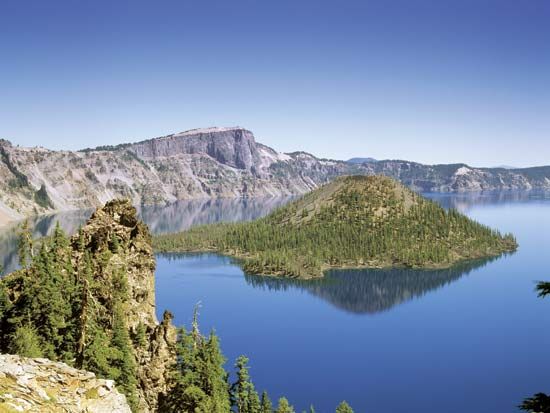
- Calderas: These are large, bowl-shaped depressions formed when the top of a volcanic cone collapses after its underlying magma reservoir is rapidly emptied by voluminous eruptions. Crater Lake is a classic example of a lake occupying such a collapse basin.910
- Craters: Lakes may occupy the actual craters of volcanic cones. While rare in unmodified cinder cones, they often form in craters created by explosions or the collapse of underground magma chambers.9
- Maars: These are broad, low-relief volcanic craters formed by explosive eruptions. They are often built of non-volcanic material and are found in regions like Germany, Italy, and New Zealand.9
- Lava Flow Obstructions: Basins can form when lava flows interrupt existing drainage patterns, effectively damming water behind the volcanic material.9
- Volcano-Tectonic Depressions: Some large basins, such as that of Lake Toba, are formed by a combination of volcanic collapse and tectonic activity, where the shape of the depression is influenced by preexisting faults and joints in the Earth’s crust.910
Sources
- Soap Lake — Encyclopædia Britannica
- lake - Chemical precipitates — Encyclopædia Britannica
- hydrosphere - Lake waters — Encyclopædia Britannica
- water supply system - Aesthetic concerns — Encyclopædia Britannica
- Grand Coulee — Merriam-Webster
- Columbia River - Economy of the Columbia River — Encyclopædia Britannica
- Coulee Dam — Encyclopædia Britannica
- Grand Coulee Dam — Encyclopædia Britannica
- lake - Basins formed by tectonism , volcanism, and landslides — Encyclopædia Britannica
- volcano - Major types — Encyclopædia Britannica
- caldera — Encyclopædia Britannica
- volcano - Determinants of size and shape — Encyclopædia Britannica
Published on · 3 min read