Lake Toba
Lake Toba is a large lake situated in the Barisan Mountains of north-central Sumatra, Indonesia. Covering approximately 440 square miles (1,140 square km)…
What is Lake Toba?
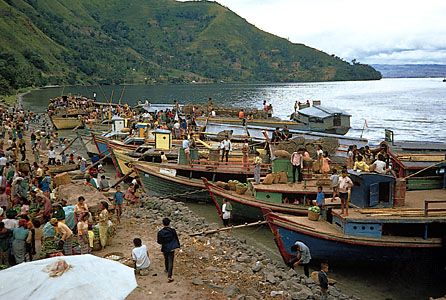
Lake Toba is a large lake situated in the Barisan Mountains of north-central Sumatra, Indonesia. Covering approximately 440 square miles (1,140 square km), the lake is notable for containing Samosir Island, which occupies a significant portion of its center.1
The lake occupies the caldera of Mount Toba, an ancient volcano. Its formation resulted from a combination of tectonic activity and a massive volcanic eruption that occurred between 71,000 and 74,000 years ago. This eruption, considered by many to be the largest in human history, expelled an estimated 2,800 cubic km of ash and lava, potentially triggering a severe ice age that nearly caused human extinction.23
The basin itself is located within a strike-slip fault belt. Today, the lake drains eastward through the Asahan River, which has been utilized for major hydroelectric projects to support regional industrialization.31
What is a caldera and how does it form?
A caldera is a large, bowl-shaped volcanic depression typically exceeding one kilometer in diameter, rimmed by steep, inward-facing cliffs. While the term is sometimes confused with a crater, calderas are significantly larger, and a crater may actually form within a caldera.45
Formation Process
Contrary to the historical belief that the tops of mountains were blown away by explosions, most calderas form through the collapse of a volcanic cone or group of cones. This process occurs when a massive, rapid eruption expels a significant volume of magma from an underlying reservoir. Once the magma is removed, the support for the mountain’s summit is lost, causing the top to drop into the resulting void.645
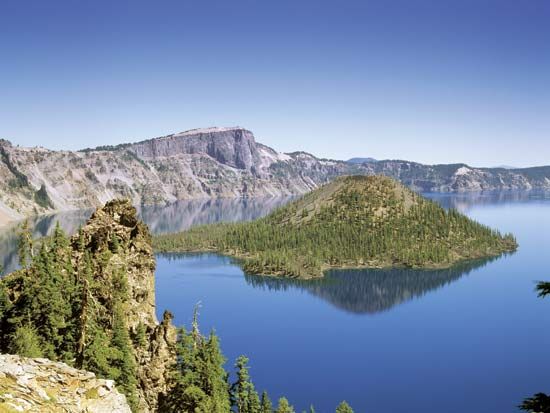
In other instances, such as on shield volcanoes, calderas form when large rift eruptions or lateral intrusions drain magma from shallow chambers, leaving the ground above unsupported. Following the initial collapse, subsequent minor eruptions may create smaller cones on the caldera floor, and the depression may eventually fill with water to form a lake, such as Crater Lake in Oregon-Lake-Oregon) in Oregon.54
How do supervolcanoes differ from regular volcanoes?
The provided search results do not contain a definition or specific classification for “supervolcanoes.” While the articles discuss various volcanic landforms—such as stratovolcanoes, shield volcanoes, and calderas—they do not explicitly define or differentiate the term “supervolcano” from these other types.
Because the Britannica knowledge base provided does not contain information regarding the specific classification of supervolcanoes, I cannot provide a comparison.
What are some other famous volcanic lakes around the world?
Many volcanic depressions around the world have filled with water over time, creating striking lakes. Here are some notable examples:
- Crater Lake: Located in Oregon, this is a classic example of a caldera lake. It is renowned for its great depth and high, encircling rim, with Wizard Island representing a secondary cone that formed within the caldera.5311
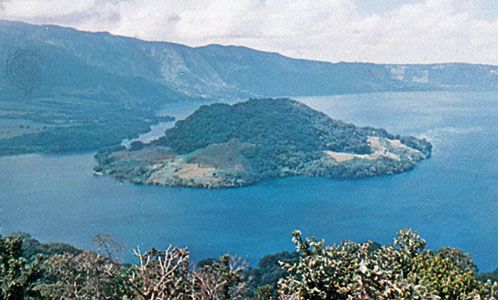
- Lake Toba: Situated in Sumatra, this is considered the largest caldera in the world. Its basin was formed through a combination of volcanic and tectonic activity, and it features an island in its center created by renewed volcanic processes.53
- Taal Lake: Located in the Philippines, this lake is unique because it contains a crater within its larger caldera structure, illustrating how volcanic features can nest within one another.11
- Lake Mývatn: Found in Iceland, this lake occupies a basin that formed following the collapse of the interior portion of a large lava flow.3
- Maars: These are specific types of volcanic craters formed by explosions. The Eifel volcanic district in Germany is famous for its maars, which are also found in locations like Iceland, Italy, and New Zealand.3
Sources
- Lake Toba — Encyclopædia Britannica
- Mount Toba — Encyclopædia Britannica
- lake - Basins formed by tectonism , volcanism, and landslides — Encyclopædia Britannica
- Did you know? — Merriam-Webster
- caldera — Encyclopædia Britannica
- volcano - Calderas — Encyclopædia Britannica
- stratovolcano — Encyclopædia Britannica
- volcano - Long-term environmental effects — Encyclopædia Britannica
- Global warming - Volcanic aerosols — Encyclopædia Britannica
- volcano - Major types — Encyclopædia Britannica
- Indonesia - Volcanoes — Encyclopædia Britannica
- Crater — Encyclopædia Britannica
- Philippines - Relief — Encyclopædia Britannica
Published on · 3 min read