Solenodon
Solenodons are mammals that reproduce by giving birth to one or two young per litter. While the provided information notes that the Cuban solenodon is a…
How do solenodons reproduce and care for their young?
Solenodons are mammals that reproduce by giving birth to one or two young per litter. While the provided information notes that the Cuban solenodon is a social species where several individuals may share the same burrow, specific details regarding their mating behaviors or the duration of parental care are not documented in the available records.1
The information provided regarding reptile courtship and fertilization is not applicable to solenodons, as solenodons are mammals and do not share the reproductive biology of reptiles.12
What are the different species of solenodons, and how do they differ?
There are two living species of solenodon, a family of rare, shrewlike insectivores native to the Caribbean islands:
- Cuban solenodon (S. cubanus): Found only in the southeastern region of Cuba, this species is social, with multiple individuals often sharing a single burrow.
- Hispaniolan solenodon (S. paradoxus): This species inhabits the island of Hispaniola, which includes both Haiti and the Dominican Republic.
While both species share a similar physical build—characterized by a chunky body, long flexible snout, and toxic saliva used for hunting—they are distinguished primarily by their geographic range and social behavior.
Additionally, two recently extinct species have been identified:
- Marcano’s solenodon (S. marcanoi): Known from skeletal remains in Hispaniola, this species likely went extinct after 1500 CE following the introduction of European house rats.
- Giant solenodon (S. arredondoi): A larger species from western Cuba that may have reached up to half a meter in length and weighed approximately 2 kg.
How do solenodons hunt and what is their diet?
Solenodons are nocturnal foragers that rely on their keen senses and specialized physical traits to hunt. They primarily search for food by probing leaf litter and soil with their long, flexible snouts. To access hidden prey, they use their powerful front feet and long, sharp claws to tear apart rotten tree trunks.1
Their diet is diverse, consisting mainly of invertebrates, but they are opportunistic predators that also consume land crabs, snails, frogs, lizards, snakes, and bird eggs.1
A unique aspect of their hunting strategy is the use of toxic saliva. When a solenodon captures prey, it bites using its incisors, allowing the venom to enter the victim’s body. Because they are active hunters that require significant energy, they also have a high need for water.1
What are the unique physical characteristics of solenodons?
Solenodons are unique, rare insectivores that possess several distinct physical characteristics:
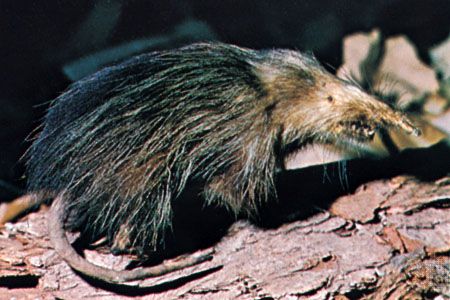
- Body Structure: They have a chunky, shrewlike build with short, stocky legs, measuring 28 to 39 cm (11 to 15 inches) in length, excluding the tail. They typically weigh between 800 and 1,100 grams (1.8 to 2.4 pounds).1
- Head and Snout: Their head is elongated, tapering into a long, flexible snout equipped with long whiskers. They have very small eyes and short, round ears.13
- Dentition and Saliva: They possess 40 teeth, and their incisors are specialized to deliver toxic saliva into prey during a bite.13
- Fur and Skin: Their coarse fur ranges from dark brown or blackish on the head and back to a lighter, buff or whitish color on the sides. They also possess skin glands that produce a distinct, goatlike odor.1
- Limbs and Tail: They have a long, scaly, and scantily haired tail. Their front feet are powerful and armed with long, sharp claws, which are essential for tearing into rotten wood to find food.13
- Skull: Anatomically, their skull is notable for lacking a zygomatic arch.3
Sources
- solenodon — Encyclopædia Britannica
- reptile - Courtship and fertilization — Encyclopædia Britannica
- solenodon — Merriam-Webster
Published on · 3 min read