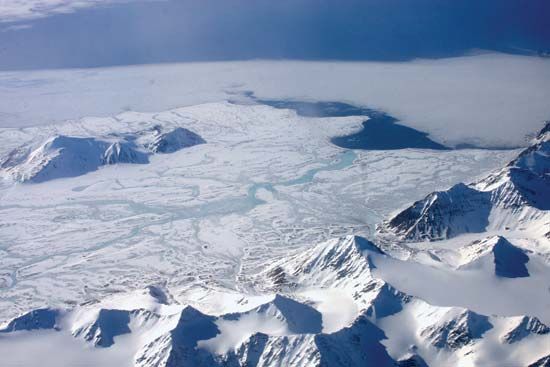
Southeast Svalbard Nature Reservation
The Southeast Svalbard Nature Reservation is a protected area established by Norway in 1973. Located within the Svalbard archipelago, the reserve covers…
What is Southeast Svalbard Nature Reservation?
The Southeast Svalbard Nature Reservation is a protected area established by Norway in 1973. Located within the Svalbard archipelago, the reserve covers 2,463 square miles (6,380 square km) and encompasses the islands of Barents and Edge.
The landscape of the reservation is characterized by numerous small glacial caps that extend across significant portions of both islands. The area is bordered by the Olga Strait to the east and Stor Fjord to the west. Despite the harsh Arctic environment, the reserve supports local wildlife, most notably the Svalbard reindeer, which survives by grazing on the region’s sparse vegetation.1
How do Svalbard reindeer adapt to the harsh Arctic climate?
Reindeer (Rangifer tarandus) have evolved several specialized physical and physiological adaptations to survive the harsh Arctic climate:
- Insulation: Reindeer possess heavy guard hairs that are hollow, which significantly increases the insulating properties of their coats. Additionally, their coloration shifts seasonally, turning whitish in winter to provide camouflage against the snow.3
- Foraging: They have deeply cloven hooves that allow their feet to spread on soft ground or snow. During winter, they use their sharp hooves and antlers to dig craters through the snow to reach reindeer moss, a high-carbohydrate lichen.34
- Metabolism and Nutrition: In winter, their metabolism slows down. To survive on a low-protein diet, they recycle urea within their digestive system, effectively utilizing its nitrogen. Females retain their antlers throughout the winter, which allows them to defend these valuable feeding craters from other reindeer.35
- Body Size: As large herbivores, they benefit from a smaller surface-area-to-volume ratio, which helps minimize heat dissipation in cold environments.4
What other protected areas exist within the Svalbard archipelago?
In addition to the Southeast Svalbard Nature Reservation, the archipelago features other protected areas established by Norway to conserve its unique Arctic environment.
One notable area is the South Spitsbergen National Park, which was established in 1973. Located in the southern corner of the island of Spitsbergen, this park serves as both a national park and a bird sanctuary. It encompasses 2,046 square miles (5,300 square km) and includes four distinct bird sanctuaries situated off its southern and western coasts: Sørkapp, Dunøyene, Isøyene, and Olsholmen. The park is a critical breeding ground for species such as eider ducks and barnacle geese, and it hosts several significant seabird colonies.1
Beyond these specific designations, the broader Svalbard region maintains legal protections for various wildlife, including seals, walruses, and whales, ensuring the preservation of the archipelago’s biodiversity.6
Why is the Svalbard Global Seed Vault located in this region?
The Svalbard Global Seed Vault is located on the island of Spitsbergen primarily for its geological and environmental stability, which provides a secure “safety deposit box” for the world’s food crops7.
Key reasons for this location include:
- Permafrost Storage: The facility is embedded deep into a mountainside within permafrost. This natural environment is intended to keep the seeds in cold storage even if the mechanical cooling systems were to fail.7
- Geographic Security: Built high above sea level, the vault is protected against potential flooding and the long-term effects of climate change.7
- Remote Stability: Its remote location within the Arctic provides a secure, isolated environment away from external hazards, ensuring the preservation of biodiversity and genetic resources for global food security.7
While the permafrost was intended as a fail-safe, rising Arctic temperatures have recently prompted ongoing evaluations regarding the long-term reliability of this natural cooling method.7
Sources
- Southeast Svalbard Nature Reservation — Encyclopædia Britannica
- Svalbard — Encyclopædia Britannica
- reindeer: Top Questions — Encyclopædia Britannica
- reindeer — Encyclopædia Britannica
- Tundra - Arctic mammals — Encyclopædia Britannica
- South Spitsbergen National Park — Encyclopædia Britannica
- The Arctic’s Seed-Filled Doomsday Fortress — Encyclopædia Britannica
Published on · 3 min read