Spinosaurus
The provided search results do not contain information regarding the portrayal of Spinosaurus in popular culture, such as movies or documentaries.
How has Spinosaurus been portrayed in popular culture, such as movies and documentaries?
The provided search results do not contain information regarding the portrayal of Spinosaurus in popular culture, such as movies or documentaries.
The available data focuses on the natural history, fossil discoveries, and scientific debates surrounding the anatomy and lifestyle of this theropod dinosaur, specifically its adaptations for piscivory and its status as a semi-aquatic predator.
What does the name ‘Spinosaurus’ mean, and why was it given this name?
The name Spinosaurus translates to “spined reptile”. It was formally named in 1915 by the German paleontologist Ernst Stromer.23
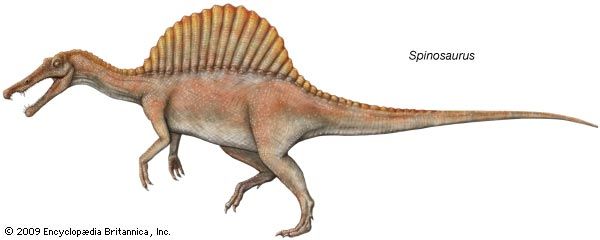
The name was chosen to highlight the dinosaur’s most distinctive physical feature: a prominent “sail back” structure created by tall vertebral spines. These spines, which extended from the animal’s back, are believed by many researchers to have served purposes such as social display or species recognition, though some theories have suggested the structure may have functioned as a hump for storing water or lipids.32
The suffix -saurus is derived from the Greek word sauros, meaning “lizard,” a common convention in naming dinosaurs to denote their reptilian origins.1
How did the Spinosaurus’s body shape and adaptations differ from other large carnivorous dinosaurs?
Spinosaurus possessed several distinct anatomical features that set it apart from other large theropod dinosaurs, such as Tyrannosaurus:
- Skull and Teeth: Unlike the curved, bladelike teeth of most theropods, Spinosaurus had straight, conical teeth suited for gripping slippery prey. Its long, narrow skull resembled that of a crocodile, with nostrils positioned near the eyes rather than at the tip of the snout, facilitating piscivory.
- Back Structure: It featured a prominent “sail” created by tall vertebral spines, which likely served as a mechanism for social display or species recognition.13
- Tail and Locomotion: A significant discovery of a broad, paddle-shaped tail suggests it was adapted for propulsion in water. While early theories proposed it was a fully aquatic predator, current research classifies it as a semi-aquatic, wading predator that likely hunted both fish and terrestrial prey.14
- Size: Reaching lengths of 14–18 meters (46–59 feet), it is considered the largest known carnivorous dinosaur, surpassing the size of the Tyrannosaurus rex.13
What evidence suggests that Spinosaurus was semi-aquatic?
Evidence suggesting that Spinosaurus was a semi-aquatic predator stems from several distinct anatomical adaptations discovered in its fossil record.13
- Skull Morphology: The dinosaur possessed a long, narrow skull similar to that of a crocodile, with nostrils positioned near the eyes rather than at the snout’s tip, which is an adaptation for breathing while partially submerged.1
- Dentition: Its teeth were straight and conical, specialized for gripping slippery prey like fish, rather than the curved, bladelike teeth found in other theropods.1
- Tail Structure: The discovery of a large, flattened, paddle-shaped tail provided evidence of a structure capable of propelling the animal through water.1
- Buoyancy and Modeling: While early theories suggested dense bones allowed for underwater hunting, subsequent modeling indicated the animal was highly buoyant. This buoyancy likely prevented deep diving, leading researchers to classify it as a semi-aquatic, wading predator that hunted at the water’s edge.1
Sources
- Spinosaurus — Encyclopædia Britannica
- Why Does -saur Appear So Often in Dinosaur Names? — Encyclopædia Britannica
- Has a complete skeleton been discovered? — Encyclopædia Britannica
- Spinosaurus: Top Questions — Encyclopædia Britannica
Published on · 2 min read