Spithead
Spithead is a strait of the English Channel that serves as a deep, sheltered passage between the northeastern coast of the Isle of Wight and the mainland of…
What is Spithead?
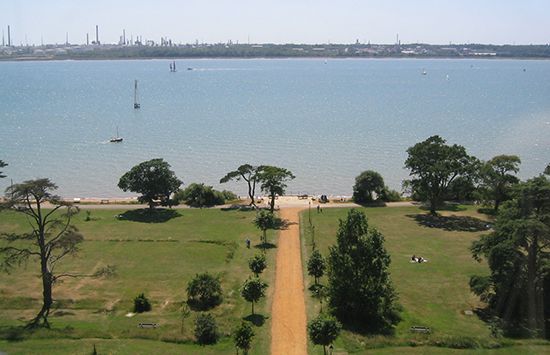
Spithead is a strait of the English Channel that serves as a deep, sheltered passage between the northeastern coast of the Isle of Wight and the mainland of England. It represents the drowned eastern portion of a former river valley, with The Solent forming its westward continuation.12
The area is historically significant for its association with the Royal Navy, frequently serving as the site for major naval reviews. Geographically, Spithead is vital for maritime commerce, as it provides the safest approach for large vessels entering and departing Southampton Water, one of England’s primary commercial harbors. The western side of the channel is defined by the Spit Sand, which leads into Portsmouth harbour.12
What is the historical significance of the Solent?
The Solent holds significant historical importance as a strategic maritime gateway and a focal point for English naval defense. Its role in history is defined by several key factors:
Military and Naval Significance
- Strategic Defense: The Solent and its eastern extension, Spithead, have served as critical anchorages for the Royal Navy for centuries. The area’s geography, particularly the position of Portsmouth, allowed it to become England’s preeminent naval base.21
- Battle of the Solent: In July 1545, the strait was the site of a major naval encounter between English and French forces. This battle successfully deterred a French invasion of England, though it is famously remembered for the sinking of the English warship Mary Rose.3
- Defensive Fortifications: To protect the naval base and the approach to the ports, various defensive structures were built over the centuries, including 16th-century Tudor fortresses like Hurst Castle and Calshot Castle, as well as masonry forts constructed along Spithead in the 1860s.41
Cultural and Commercial Legacy
Beyond its military history, the strait is renowned for its maritime culture. It is a world-famous center for yachting, particularly centered around the port of Cowes on the Isle of Wight, and has long been the traditional setting for major naval reviews.42
How are naval reviews conducted at Spithead?
Naval reviews at Spithead are ceremonial events where the British monarch or a high-ranking official inspects a gathering of Royal Navy warships. These displays are traditionally held in the sheltered, deep-water channel located between the northeastern coast of the Isle of Wight and the English mainland, often positioned off the port of Cowes.1
During these events, vessels are typically anchored in long, orderly lines. The reviewing party, often aboard a royal yacht or a flagship, sails slowly along these lines to observe the assembled fleet. These reviews serve as significant demonstrations of naval strength, national pride, and historical continuity, reflecting the area’s long-standing role as a primary anchorage for the British fleet.1
Why is the Isle of Wight important to British maritime history?
The Isle of Wight has played a pivotal role in British maritime history, primarily due to its strategic location in the English Channel and its separation from the mainland by the deep strait known as The Solent.
Its historical significance is anchored in several key areas:
- Naval Defense: The island has long served as a defensive outpost. Cowes Castle, built by Henry VIII in 1540, exemplifies the island’s historical importance in protecting the southern coast of England.5
- Yachting Heritage: The Isle of Wight is internationally recognized as a center for yachting. The formation of the first English yacht club at Cowes in 1815, which later became the Royal Yacht Squadron, established the Solent as the premier site for British yachting, bolstered by royal patronage.56
- Industrial Contribution: The island has a deep-rooted tradition in marine engineering and boatbuilding. Today, this legacy continues through the manufacture of yachts, sails, and hovercraft.75
Sources
- Spithead — Encyclopædia Britannica
- The Solent — Encyclopædia Britannica
- Battle of the Solent: Top Questions — Encyclopædia Britannica
- Portsmouth — Encyclopædia Britannica
- Isle of Wight — Encyclopædia Britannica
- Cowes — Encyclopædia Britannica
- yacht - Yachting and yacht clubs — Encyclopædia Britannica
Published on · 3 min read