Sturtian Series
The study of the Sturtian Series provides critical evidence for understanding the complex relationship between plate tectonics and Earth’s climate history.…
How does the study of the Sturtian Series contribute to our understanding of plate tectonics?
The study of the Sturtian Series provides critical evidence for understanding the complex relationship between plate tectonics and Earth’s climate history. As a major unit of the Adelaide Geosyncline, the Sturtian Series contains extensive tillites and glacial deposits that serve as markers for the Cryogenian Period glaciations.12
Geologists link these glacial events to the tectonic breakup of the supercontinent Rodinia. The process unfolded as follows:
- Tectonic Rifting: The fragmentation of Rodinia involved massive volcanic activity and the creation of flood basalts.3
- Climate Feedback: This widespread volcanism increased the rate of rock weathering, a chemical process that sequestered carbon dioxide from the atmosphere.3
- Global Cooling: The resulting reduction in atmospheric carbon dioxide weakened the greenhouse effect, triggering the severe global cooling observed in the Sturtian glacial record.3
By analyzing these sedimentary sequences, researchers can better reconstruct the timing of continental rifting and the profound environmental consequences of tectonic shifts during the Proterozoic Eon.13
How does the Sturtian Series compare to other glacial periods in Earth’s history?
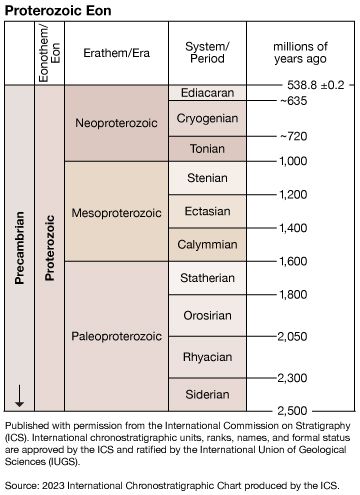
The Sturtian Series represents one of the most significant glacial episodes in Earth’s history, occurring during the Cryogenian Period (approximately 720 million to 660 million years ago). Compared to other glacial periods, it is distinguished by its extreme duration and global reach.35
Comparison with Other Glacial Periods
- Duration and Extent: The Sturtian glaciation lasted for 50–60 million years, making it the longest glacial interval of the Cryogenian. Evidence, including glacial deposits found near the paleoequator, suggests that ice sheets covered much, if not all, of the planet, a phenomenon often discussed under the Snowball Earth or Slushball Earth hypotheses.56
- Precambrian Context: While the Huronian glaciation (2.4–2.1 billion years ago) was also extensive, the Sturtian is part of a series of three distinct worldwide glaciations in the late Proterozoic, followed by the Marinoan and the much shorter Gaskiers glaciation.3
- Recent Glaciations: In contrast, the Pleistocene Epoch (2.6 million to 11,700 years ago) featured multiple, shorter climatic cycles of glaciation and interglaciation. Unlike the Cryogenian events, which were driven by the massive tectonic breakup of Rodinia, more recent ice ages have been characterized by complex, shorter-term fluctuations in climate.4765
What is the geographical distribution of the Sturtian Series rocks around the world?
The Sturtian Series is primarily defined as a division of Proterozoic rocks located in south-central Australia, specifically within the Adelaide Geosyncline. It serves as the most widespread unit of the Precambrian sedimentary basin in that region, cropping out prominently between Adelaide and the Flinders Ranges in South Australia.18
While the Sturtian Series is formally named for and best documented in this Australian succession, the broader Sturtian glaciation—the global climatic event associated with these rock deposits—is recognized worldwide. During the Cryogenian Period, the breakup of the supercontinent Rodinia triggered massive volcanic activity and global cooling, leading to the deposition of glacial materials (such as tillites and diamictites) across various ancient continental fragments that were part of the global landmass at that time.138
What is the Sturtian Series and what geological period does it belong to?
The Sturtian Series is a division of Proterozoic rocks primarily found in south-central Australia, specifically within the Adelaide Geosyncline. It forms the lower portion of the Umberatana Group and is characterized by its glacial origins, evidenced by tillites—cemented glacial till deposits—and boulder-laden horizons containing striated and faceted rocks.1
This series belongs to the Cryogenian Period, a time interval within the Proterozoic Eon. The Sturtian glaciation, which occurred during this period, is believed to have been triggered by intense volcanism associated with the breakup of the supercontinent Rodinia. This volcanic activity led to increased weathering, which reduced atmospheric carbon dioxide and weakened the greenhouse effect, resulting in a significantly colder global climate.3
Sources
- Sturtian Series — Encyclopædia Britannica
- Rodinia — Encyclopædia Britannica
- Cryogenian Period: Top Questions — Encyclopædia Britannica
- Precambrian - Worldwide glaciations — Encyclopædia Britannica
- ice age — Encyclopædia Britannica
- Pleistocene Epoch - Glacial records — Encyclopædia Britannica
- Cryogenian Period — Encyclopædia Britannica
- Silurian Period - Isotope stratigraphy — Encyclopædia Britannica
- ice sheet — Encyclopædia Britannica
- Australia - The Precambrian — Encyclopædia Britannica
Published on · 3 min read