Sumatran Rhinoceros
Sumatran rhinoceroses, like other rhinoceros species, are primarily solitary animals that rely on specific methods to communicate within their dense forest…
How do Sumatran rhinoceroses communicate with each other?
Sumatran rhinoceroses, like other rhinoceros species, are primarily solitary animals that rely on specific methods to communicate within their dense forest habitats.12
Their communication strategies include:
- Vocalizations: Rhinoceroses utilize a variety of sounds, including snorting, squealing, bellowing, and sometimes whistling, to interact with one another.3
- Infrasonic Communication: Similar to elephants, these animals communicate using infrasonic frequencies—sounds that fall below the threshold of human hearing. This adaptation is particularly useful for maintaining contact in environments with dense vegetation and may also allow females to signal their receptivity to males for breeding.1
- Scent Marking: Excretory products play a significant role in their social interactions. Rhinoceroses use urine and dung to mark their home ranges and territories. These markers help establish an individual’s presence and maintain contact between animals that share or overlap in their home ranges.21
- Limited Visual Signals: While visual signals are not highly developed in these nonsocial animals, they do employ a few specific facial expressions for communication.3
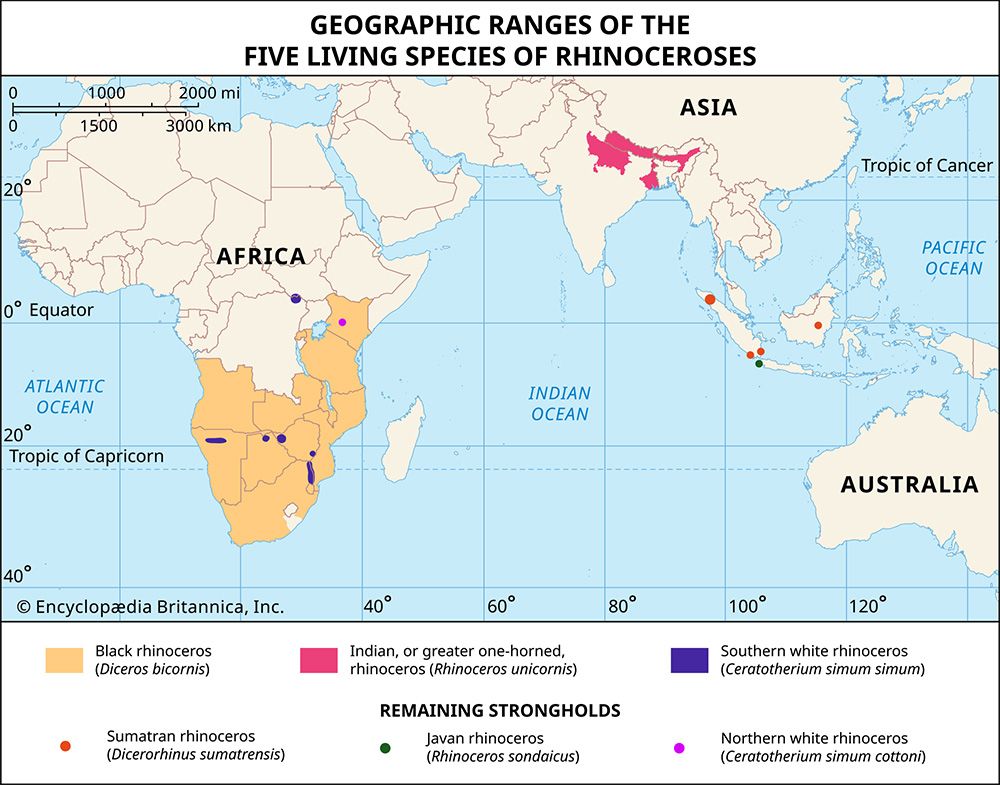
How does the Sumatran rhinoceros differ from other rhinoceros species?
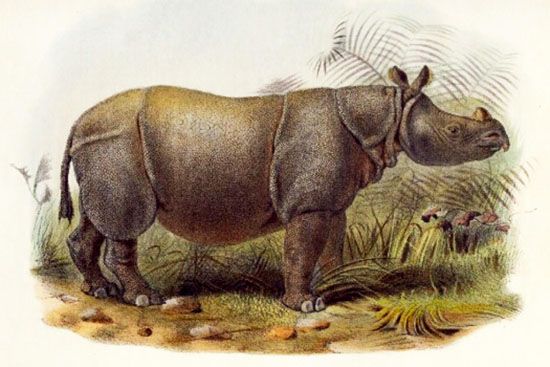
The Sumatran rhinoceros (Dicerorhinus sumatrensis) is distinct from the other four living rhinoceros species in several key ways:
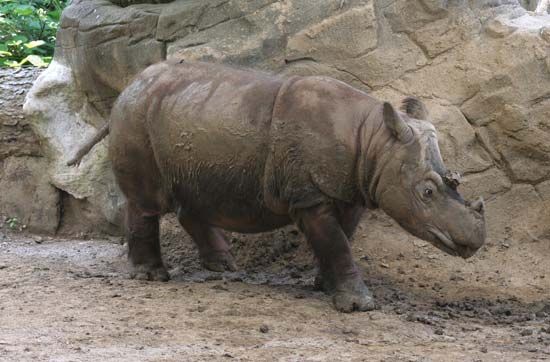
- Physical Appearance: It is the smallest living rhinoceros species, standing 1 to 1.5 metres (3 to 5 feet) at the shoulder and weighing less than 850 kg (1,870 pounds). Most notably, it is the only rhinoceros species covered in long body hair.15
- Evolutionary Status: It is considered the most ancient of all living rhinoceros species.1
- Behavioral Adaptations: Unlike some of its relatives, the Sumatran rhinoceros is an active climber capable of navigating mountainous terrain. While the white rhinoceros is a grazer and the great Indian rhinoceros is primarily a grazer, the Sumatran rhinoceros is mainly a browser, feeding on plants in forest gaps.15
- Comparison to Other Asian Species: It is one of three Asian species, alongside the Javan rhinoceros and the great Indian rhinoceros. Unlike the one-horned Javan and Indian species, the Sumatran rhinoceros possesses two horns.5
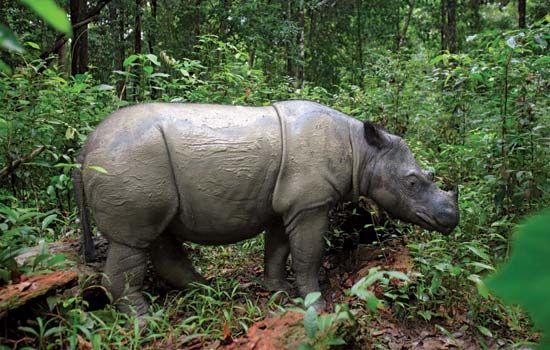
What are the key physical characteristics of the Sumatran rhinoceros?
The Sumatran rhinoceros (Dicerorhinus sumatrensis) possesses several distinct physical characteristics that set it apart from other rhinoceros species:
- Size: It is the smallest living rhinoceros species, typically standing 1 to 1.5 metres (3 to 5 feet) at the shoulder and measuring about 2.5 metres (8 feet) in length. Adults generally weigh less than 850 kg (1,870 pounds).125
- Body Covering: Unlike other modern rhinoceroses, which are nearly or completely hairless, the Sumatran rhinoceros is covered in long body hair.12
- Horns: It is a two-horned species, distinguishing it from the one-horned Javan and Indian rhinoceroses. Like all rhinoceroses, these horns are composed of keratin, the same protein found in hair.25
- General Morphology: Like other members of the family Rhinocerotidae, it has thick skin and three-toed feet tipped with broad, blunt nails.2
As the most ancient of the five remaining rhinoceros species, its unique physical traits reflect its long evolutionary history.1
How long do Sumatran rhinoceroses typically live in the wild?
The provided Britannica knowledge base does not contain specific information regarding the typical lifespan of the Sumatran rhinoceros in the wild. While the records note that rhinoceroses in general may breed until they are between 30 and 40 years old, specific longevity data for the Sumatran species is not available in the provided search results.1
Sources
- Sumatran rhinoceros — Encyclopædia Britannica
- rhinoceros — Encyclopædia Britannica
- Chemoreception - Territorial behavior — Encyclopædia Britannica
- perissodactyl - Expression and communication — Encyclopædia Britannica
- perissodactyl - Rhinoceroses — Encyclopædia Britannica
- perissodactyl - Social organization and territory — Encyclopædia Britannica
- perissodactyl - Reproduction — Encyclopædia Britannica
Published on · 3 min read