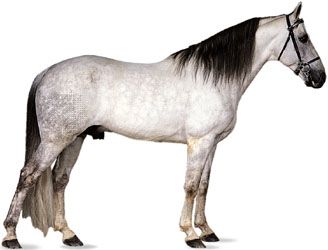
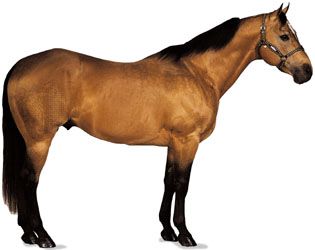
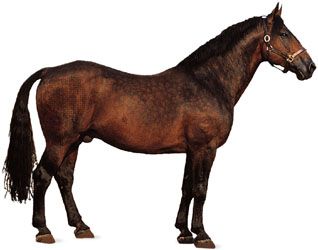
Thoroughbred
Thoroughbreds are a distinct breed of horse characterized by a refined, athletic build developed primarily for speed and stamina. Their key physical features…
What are the distinctive physical characteristics of Thoroughbred horses?
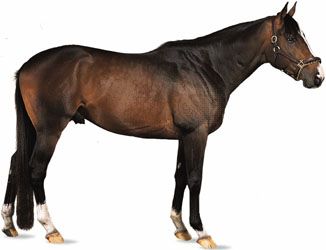
Thoroughbreds are a distinct breed of horse characterized by a refined, athletic build developed primarily for speed and stamina. Their key physical features include:
- Head and Body: They possess delicate, fine heads with large, expressive eyes, broad or deep chests, and relatively short, straight backs.12
- Legs and Stride: Their legs are fine-boned with short bones, a structure that facilitates a long, easy, and efficient stride.12
- Size: At maturity, they average approximately 16 hands (64 inches, or 163 cm) in height and weigh about 1,000 pounds (450 kg).1
- Coat and Skin: They typically have thin skin and are commonly found in bay, chestnut, brown, black, or gray coat colors.12
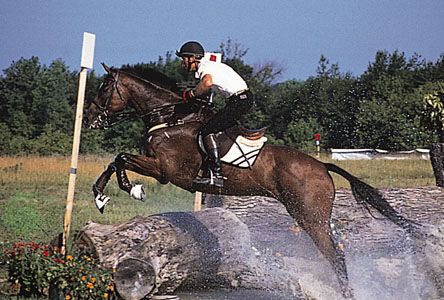
Renowned for their high-spirited nature, these horses are widely used in racing, jumping, and dressage, and they are frequently utilized to improve other breeds due to their exceptional physical capabilities.1
How does the Thoroughbred’s temperament compare to other horse breeds?
Thoroughbreds are characterized by a sensitive and high-spirited temperament, traits that are closely linked to their development for speed and stamina in racing and jumping. While they are noted for their courage and athletic drive, their temperament is distinct from other breeds that may be favored for different qualities.1
For instance, the Tennessee Walking Horse is specifically recognized as the most naturally good-tempered horse breed, contrasting with the more intense, high-energy nature often associated with the Thoroughbred. Other breeds, such as the American Quarter Horse, are noted for their ability to adapt easily to various riding disciplines, suggesting a different behavioral profile compared to the specialized, high-spirited focus of the Thoroughbred.1
Because Thoroughbreds are often used to improve other breeds, their influence—and by extension, their spirited nature—can be found in many modern sport horses, such as the Hanoverian and Trakehner, which are also prized for their elegance and performance capabilities.1
What are some famous Thoroughbred racehorses throughout history?
Throughout history, several Thoroughbred racehorses have achieved legendary status due to their exceptional speed, stamina, and competitive drive.
Notable Champions
- Secretariat: Widely considered the greatest racehorse of the late 20th century, he became the ninth winner of the American Triple Crown in 1973. He famously won the Belmont Stakes by 31 lengths and set a dirt-track record that still stands today.4
- Man o’ War: Often cited as the greatest horse of the 20th century, he won 20 of his 21 races between 1919 and 1920. Although he did not compete in the Kentucky Derby, he dominated the Preakness and Belmont Stakes and famously defeated the Triple Crown winner Sir Barton in a highly publicized “race of the century” in 1920.5
- Seabiscuit: A grandson of Man o’ War, he became one of the most celebrated campaigners and money winners of the 1930s, famously defeating War Admiral in a 1938 match race.5
In total, only 13 horses have achieved the prestigious Triple Crown, including modern winners such as American Pharoah (2015) and Justify (2018).6
How has the Thoroughbred breed influenced other horse breeds?
The Thoroughbred breed has played a pivotal role in the development and refinement of many other horse breeds worldwide. Prized for their exceptional speed, stamina, and courage, Thoroughbreds are frequently used in crossbreeding programs to enhance the athletic performance and physical characteristics of local or specialized breeds.1
The influence of the Thoroughbred is evident in several prominent breeds:
- Sport Horses: Thoroughbreds are commonly crossed with other breeds to produce high-quality hunters and sport horses. For example, the Cleveland Bay is often bred with Thoroughbreds to create versatile riding horses. Similarly, the Hanoverian and Trakehner breeds have been significantly influenced by Thoroughbred blood, which contributes to their elegance, fluid gaits, and success in disciplines like dressage and show jumping.1
- Versatile Riding Breeds: The American Paint Horse was developed in part through the influence of Thoroughbred blood, resulting in a versatile riding animal.1
By introducing their refined physical traits and athletic drive, Thoroughbreds help breeders balance specific qualities, such as combining speed with the unique characteristics of other lineages.17
Sources
- Thoroughbred — Encyclopædia Britannica
- horse - Thoroughbred — Encyclopædia Britannica
- Standardbred — Encyclopædia Britannica
- Secretariat — Encyclopædia Britannica
- Triple Crown: Top Questions — Encyclopædia Britannica
- Man o’ War — Encyclopædia Britannica
- horse racing - Breeding theory and practice — Encyclopædia Britannica
Published on · 3 min read