Wallace Line
The Wallace Line is a hypothetical boundary that separates the distinct faunal regions of Asia and Australia. Proposed by the 19th-century British naturalist…
What is Wallace Line?
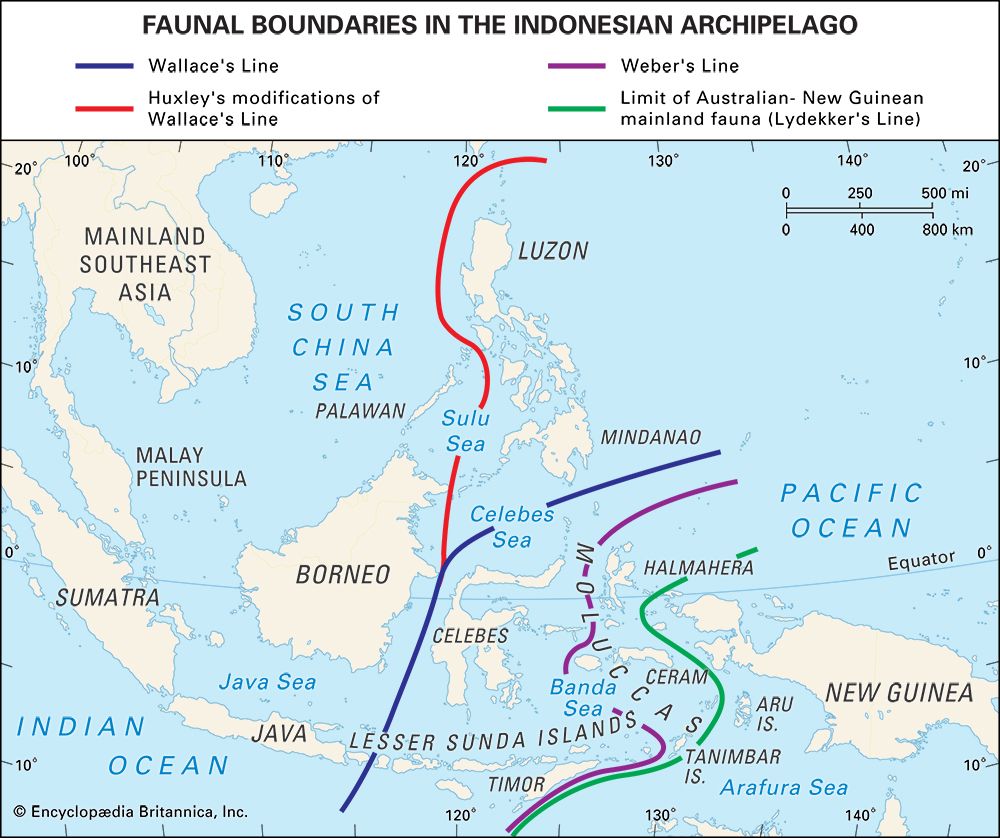
The Wallace Line is a hypothetical boundary that separates the distinct faunal regions of Asia and Australia. Proposed by the 19th-century British naturalist Alfred Russel Wallace, the line runs through the Malay Archipelago, passing between the islands of Bali and Lombok, through the Makassar Strait, and eastward south of Mindanao.12
While many modern zoogeographers no longer recognize the Wallace Line as a strict regional boundary, it remains significant for representing an abrupt limit in the distribution of many major animal groups. Many species of mammals, birds, and fish are found in abundance on one side of the line but are poorly represented or entirely absent on the other. This observation was a key piece of evidence Wallace used to develop his theories on evolution and biogeography.13
How did plate tectonics influence the distribution of animals across the Wallace Line?
The distribution of animals across the Wallace Line is fundamentally linked to the region’s complex geological history and the separation of two distinct continental shelves.
The line serves as a boundary between the Sunda Shelf, a southward extension of mainland Southeast Asia, and the Sahul Shelf, which includes Australia and New Guinea. These shelves were once exposed as dry land during periods of lower sea levels, allowing for the migration of land-based animals within their respective regions. However, they remained separated by deep-water channels that acted as significant barriers to dispersal.145
Plate tectonics further shaped this divide as Australia drifted northward from the supercontinent of Gondwanaland. As the Australian plate collided with the westward-moving Pacific Plate and approached the Asian margin, it created the complex, volcanically active island arcs and deep-sea trenches that define the region today. These tectonic processes maintained deep-water barriers that prevented the intermingling of Asian and Australian fauna, resulting in the abrupt faunal transition observed by Alfred Russel Wallace.617
What is the difference between the Wallace Line and the Lydekker Line?
The Wallace Line and Lydekker’s Line are both biogeographic boundaries used to describe the transition between Asian (Oriental) and Australian faunal regions, but they define different limits within the Indonesian archipelago.18
- Wallace Line: Proposed by Alfred Russel Wallace, this line marks the western boundary of the transition zone known as Wallacea. It runs through the Lombok and Makassar Straits, separating islands with predominantly Asian-derived fauna from those to the east.18
- Lydekker’s Line: This boundary is located to the east of the Wallace Line. It follows the edge of the Sahul Shelf—the continental shelf of Australia and New Guinea—and represents the limit where fauna is almost exclusively Australian in origin.8
The region between these two lines, Wallacea, contains a complex mixture of both Oriental and Australian species. While the Wallace Line highlights the abrupt drop-off of Asian species, Lydekker’s Line marks the eastern extent of the transition zone, effectively delineating the edge of the Australian continental shelf.81
What are some examples of unique animals found on either side of the Wallace Line?
The Wallace Line serves as a significant biogeographic boundary, separating the Asian (Oriental) faunal region to the west from the Australian faunal region to the east. The distribution of animals across this line is marked by distinct differences in their evolutionary origins and biological characteristics.110911
West of the Wallace Line (Asian Fauna)
The islands west of the line, situated on the Sunda Shelf, host a variety of large placental mammals typical of the Asian mainland. Notable examples include:1011
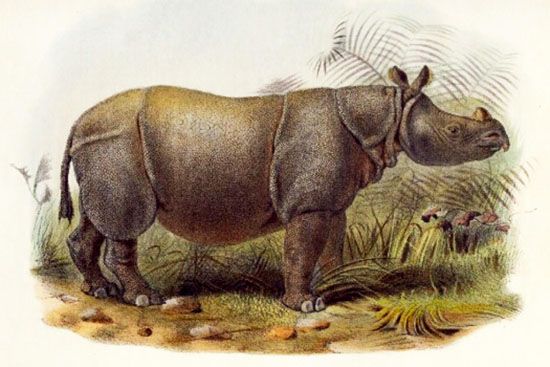
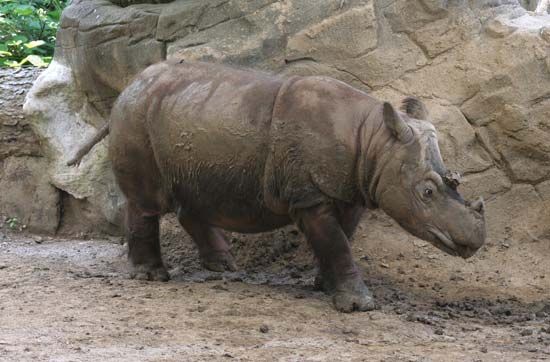
- Rhinoceroses: Including the critically endangered Javan and Sumatran species.1011
- Orangutans: Native to the forests of Borneo and Sumatra.1011
- Tigers and Elephants: Large mammals that are abundantly represented in the Asian region.1011
- Tapirs: Such as the Malayan tapir.1011
East of the Wallace Line (Australian Fauna)
To the east, the fauna shifts toward groups associated with the Australian continent and New Guinea, characterized by a higher prevalence of marsupials. Examples include:1011
- Marsupials: Such as bandicoots and cuscuses.1011
- Distinctive Birds: Including cockatoos, bowerbirds, and birds of paradise.10
- Unique Endemics: The babirusa and the tamarau are examples of specialized species found in the transition zone of Celebes.1011
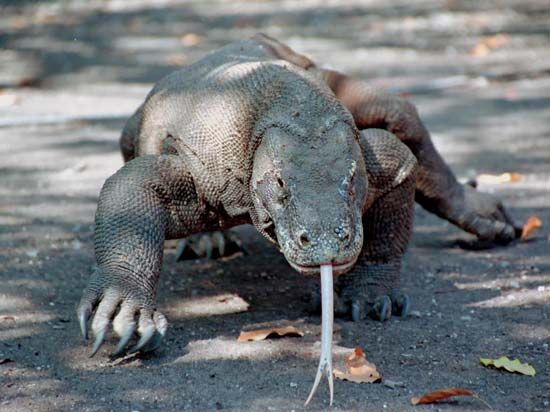
- Komodo Dragon: A giant lizard found on islands such as Komodo and Rinca.10
Sources
- Wallace Line — Encyclopædia Britannica
- Wallace's line — Merriam-Webster
- Alfred Russel Wallace - The career of a naturalist — Encyclopædia Britannica
- Sahul Shelf — Encyclopædia Britannica
- Sunda Shelf — Encyclopædia Britannica
- Australia - Chronological summary — Encyclopædia Britannica
- Alfred Russel Wallace: Top Questions — Encyclopædia Britannica
- Weber's line — Merriam-Webster
- biogeographic region - Wallacea — Encyclopædia Britannica
- Indonesia - Plant and animal life — Encyclopædia Britannica
- biogeographic region - Oriental region — Encyclopædia Britannica
- Southeast Asia - Animal life — Encyclopædia Britannica
Published on · 3 min read