Sundarbans National Park
Sundarbans National Park is located in the extreme southeastern part of West Bengal state in eastern India. It serves as a core region within the larger…
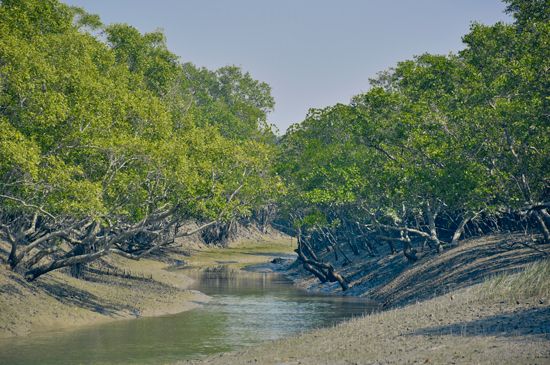
Where is Sundarbans National Park located, and what makes its ecosystem unique?
Sundarbans National Park is located in the extreme southeastern part of West Bengal state in eastern India. It serves as a core region within the larger Sundarbans region, a vast delta shared by India and Bangladesh at the mouth of the Ganges and Brahmaputra rivers.12
The ecosystem is unique for several reasons:
- World’s Largest Mangrove Forest: It contains the largest mangrove forest globally, characterized by salt-tolerant species like the sundari tree.12
- Semiaquatic Wildlife: It is home to the world’s only population of Bengal tigers that have adapted to a semiaquatic lifestyle, navigating the tidal creeks and mudflats.2
- Dynamic Physiography: The landscape is a complex network of tidal rivers, creeks, and estuaries that are constantly reshaped by daily tides, erosion, and heavy siltation.12
- High Biodiversity: The park supports a vast array of endangered species, including Ganges river dolphins, estuarine crocodiles, and numerous migratory birds.12
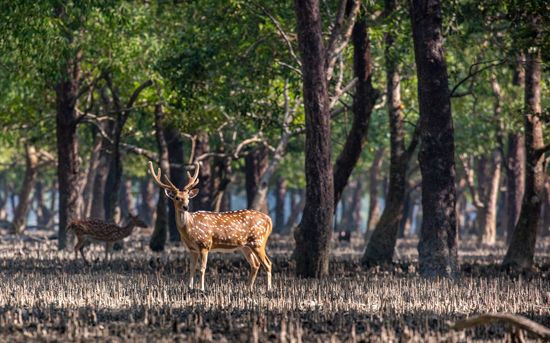
How does the mangrove forest in Sundarbans contribute to the local and global environment?
The mangrove forests of the Sundarbans provide critical environmental benefits that extend from local coastal protection to global ecological stability.
Local Environmental Contributions
- Coastal Defense: The dense mangrove vegetation acts as a vital buffer, protecting shorelines from tropical cyclones, storm surges, and flooding.34
- Habitat Support: These forests serve as essential nursery grounds for diverse marine life, including fish, crabs, and shrimp, which are foundational to local fisheries and biodiversity.3
- Water Quality: The complex root systems trap sediments and pollutants, which helps maintain the health of nearby aquatic ecosystems.3
Global Environmental Contributions
- Ecosystem Services: As keystone species, mangroves maintain the balance of coastal environments, supporting species that migrate across vast distances.3
- Climate Mitigation: By stabilizing coastlines and sequestering carbon, these forests play a significant role in helping regions adapt to climate change and mitigating the economic impacts of global flooding.41
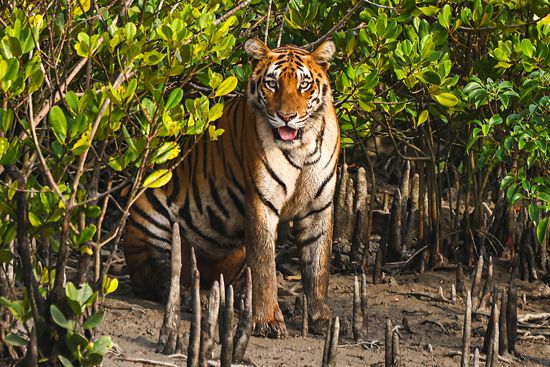
What is the history behind the establishment of Sundarbans National Park?
The establishment of Sundarbans National Park was the result of a long-term commitment to protecting the region’s unique biodiversity. While much of the area had long held the status of a forest reserve, formal conservation efforts in India were significantly intensified with the creation of the Sundarbans Tiger Reserve in 1973.14
Following this, the national park itself was officially established in 1984, serving as a core protected region within the larger tiger reserve. The park’s ecological importance was further recognized on an international scale when it was designated a UNESCO World Heritage site in 1987. Additionally, UNESCO has since demarcated the entire Sundarbans region as a biosphere reserve, underscoring its status as a critical refuge for rare and endangered species, most notably the Bengal tiger.14
What are the major threats facing the Bengal tiger population in Sundarbans?
The Bengal tiger population in the Sundarbans faces significant threats stemming from both human activity and environmental instability.
Environmental and Habitat Threats
- Climate Change and Sea-Level Rise: Rising sea levels and increased saltwater intrusion are altering the delicate mangrove ecosystem. This leads to the depletion of forest cover and threatens the salt-sensitive vegetation that provides essential shelter and hunting grounds for the tigers.2
- Hydrological Changes: Human-induced modifications, such as the construction of dams, land reclamation, and the diversion of water channels, have disrupted the natural flow of the delta, further increasing salinity levels in the region.21
- Increased Storm Intensity: The rising frequency and intensity of tropical cyclones pose a direct threat to the stability of the tigers’ habitat.2
Human-Induced Threats
- Poaching: Illegal poaching remains a critical danger to the survival of the species.27
- Human-Tiger Conflict: As human populations grow in areas surrounding the forest, the potential for conflict increases. Tigers frequently come into contact with humans who enter the forest to harvest resources, leading to dangerous encounters.27
- Habitat Fragmentation: The conversion of land for agriculture, roads, and other human-controlled spaces continues to shrink the available territory for these apex predators.7
Sources
- Sundarbans — Encyclopædia Britannica
- Sundarbans National Park — Encyclopædia Britannica
- mangrove: Top Questions — Encyclopædia Britannica
- West Bengal: Top Questions — Encyclopædia Britannica
- Sundarbans National Park: Top Questions — Encyclopædia Britannica
- Mangroves Matter - Learn more — Encyclopædia Britannica
- Bengal tiger — Encyclopædia Britannica
Published on · 3 min read