Tanager
Tanagers are songbirds belonging to the family Thraupidae, and they are found exclusively in the Americas. While they are most prevalent in tropical regions…
Where are tanagers typically found, and what habitats do they prefer?
Tanagers are songbirds belonging to the family Thraupidae, and they are found exclusively in the Americas. While they are most prevalent in tropical regions, their distribution spans from temperate North America down to Argentina.1
Regarding their preferred habitats, these birds are primarily arboreal, meaning they spend the majority of their time in trees. They are typically found in the following environments:1
- Tropical forests and gardens: These serve as the primary habitat for the majority of the species.1
- Treetops, undergrowth, and shrubbery: Tanagers occupy these specific layers of the forest canopy and vegetation to forage and nest.1
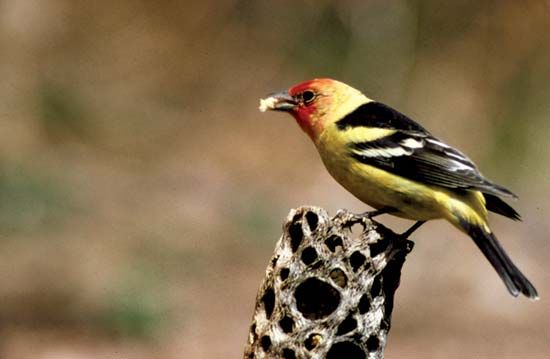
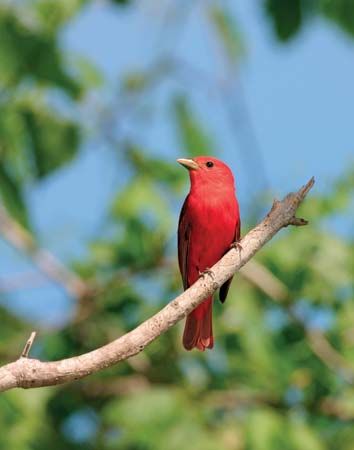
While most species thrive in tropical settings, a few, such as the scarlet tanager, summer tanager, and western tanager, are known to breed in temperate North American climates.1
How do tanagers communicate with each other?
As members of the family Thraupidae, tanagers are classified as songbirds. Like many other birds, they utilize birdsong as a primary method of communication.
These vocalizations serve several critical functions, particularly during the breeding season:
- Mate Attraction: Males use complex songs to attract potential mates.1
- Territorial Defense: Songs are used to advertise a male’s presence on its territory, signaling to other males to keep away.1
- Species and Individual Recognition: Through these vocalizations, other birds can identify the species of the singer. In some cases, they can even discern the mood or individual identity of the bird based on specific components of the song.1
While the provided search results do not detail specific non-vocal communication methods for tanagers, birds generally rely on a combination of sound and visual displays—such as the display of their brilliant plumage—to interact with one another.213
What are the distinctive physical characteristics of tanagers?
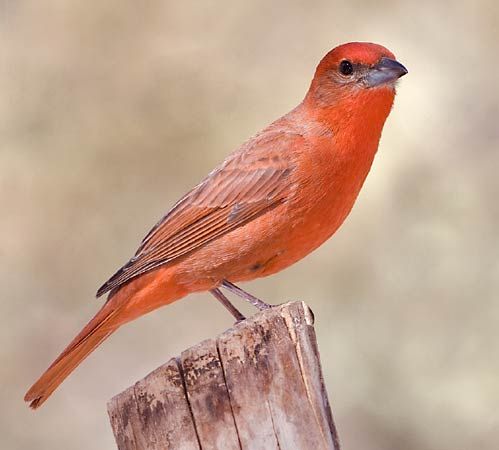
Tanagers are characterized by several distinct physical features that define this diverse family of songbirds:
- Size: Most species measure between 10 and 20 cm (4 to 8 inches) in length.1
- Body Structure: They possess short necks and bills that vary in shape, though they are consistently characterized by being slightly toothed and hooked.1
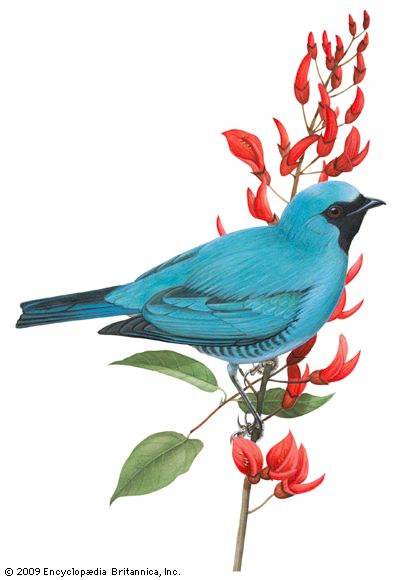
- Plumage: The family is widely noted for the brilliance of its plumage. Their feathers often feature solid, vibrant colors—including reds, yellows, greens, blues, and black—frequently arranged in striking patterns.1
- Sexual Dimorphism: In many species, the sexes exhibit different appearances; while some are similar in color, females are often significantly duller than their male counterparts.1
While the swallow-tanager shares some similarities with the broader family, it is distinguished by its long wings and a specialized, swallowlike bill, as well as unique throat pouches used for feeding.4
What are the mating and nesting behaviors of tanagers?
The reproductive behaviors of tanagers (family Thraupidae) are diverse, reflecting the varied environments they inhabit across the Americas. While specific details for every species are not fully documented, general patterns of their mating and nesting habits include:5
- Nesting Habits: Tanagers are primarily arboreal, typically constructing their nests within the trees, undergrowth, or shrubbery of their forest or garden habitats. Their nesting behavior is described as varied, and they typically produce a clutch size ranging from two to four eggs.5
- General Passerine Context: As members of the order Passeriformes, tanagers generally follow the common pattern of being solitary nesters. In this arrangement, a monogamous pair typically maintains a territory large enough to support their essential breeding activities, including courtship, mating, and food gathering.1
- Parental Care: Like other birds, tanagers must manage the incubation of their eggs to ensure the embryos develop at an optimum temperature. This often involves the development of brood patches on the adult’s abdomen, which allow for more effective heat transfer to the eggs.6
Sources
- Tanager — Encyclopædia Britannica
- Birdsong — Encyclopædia Britannica
- Sex - Courtship — Encyclopædia Britannica
- Swallow-tanager — Encyclopædia Britannica
- Passeriform - Territoriality and courtship — Encyclopædia Britannica
- Reproductive behaviour - Parental care — Encyclopædia Britannica
- Reproductive behaviour - Caring for offspring — Encyclopædia Britannica
Published on · 3 min read