Thousand Islands National Park
Thousand Islands National Park is a Canadian national park located in southeastern Ontario along the St. Lawrence River, situated between the cities of…
What is Thousand Islands National Park?
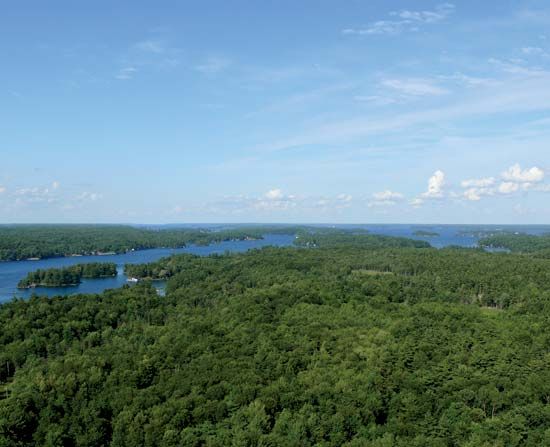
Thousand Islands National Park is a Canadian national park located in southeastern Ontario along the St. Lawrence River, situated between the cities of Kingston and Brockville.1
Formerly known as Saint Lawrence Islands National Park, this protected area was established in 1904. It encompasses a total of 1,013 acres (410 hectares), which includes a mainland reservation at Mallorytown Landing, 18 heavily forested islands, and 80 rocky islets. These features are part of the larger Thousand Islands region, a scenic archipelago of more than 1,500 islands that straddles the border between Canada and the United States. The park serves as a popular destination for those looking to experience the unique geography and natural beauty of the river corridor.2134
How did the War of 1812 influence the naming of these islands?
The War of 1812 significantly influenced the nomenclature of the Thousand Islands. Following the conclusion of the conflict, the islands were formally surveyed in 1818, at which time many were assigned names to commemorate the people, battles, and events associated with the war.3
What makes the St. Lawrence River ecosystem unique?
The St. Lawrence River ecosystem is defined by its vast diversity, transitioning through multiple climatic and hydrological zones as it flows from the Great Lakes to the Gulf of St. Lawrence.5
Key characteristics of this unique ecosystem include:
- Climatic Transitions: The system shifts from subarctic to temperate zones and back again, creating distinct regional contrasts in water temperature and hydrology.5
- Biological Diversity: The river supports a wide range of life, including sturgeon, herring, beluga whales, and various mollusks. It is also a vital corridor for massive migrations of waterfowl, such as ducks and geese, which utilize river reefs and sandy shores.6
- Vegetation Zones: The riverbanks feature diverse forest types, ranging from deciduous and mixed forests to open taiga. Unique, river-linked flora include sandbank grasses in freshwater sections and salt-tolerant (halophytic) plants in the estuary.6
- Marine and Fluvial Dynamics: The river exhibits a profound shift from a freshwater, fluvial character near Montreal to a marine environment in the estuary, where tidal influence becomes dominant.53
Why was the park’s name changed from Saint Lawrence Islands National Park?
The park formerly known as Saint Lawrence Islands National Park was renamed Thousand Islands National Park to better reflect its geographic location and identity within the Thousand Islands region. While the park was established in 1904, the name change serves to align the official designation with the widely recognized name of the archipelago it encompasses, which stretches along the St. Lawrence River between Kingston and Brockville.213
We could dive deeper into the history of the park’s establishment or explore the recreational activities available in the Thousand Islands region today.
Sources
- Thousand Islands National Park — Encyclopædia Britannica
- Thousand Islands National Park — Merriam-Webster
- Thousand Islands — Encyclopædia Britannica
- Thousand Islands — Merriam-Webster
- St. Lawrence River - Plant and animal life — Encyclopædia Britannica
- St. Lawrence River - Climate and hydrology — Encyclopædia Britannica
- St. Lawrence River - Physiography — Encyclopædia Britannica
Published on · 2 min read